






TL;DR
- When IAM and tagging are configured independently in AWS, Azure, and GCP, governance becomes fragmented at the exact point workloads cross provider boundaries. Moving enforcement to the Terraform plan creates one pre-deployment control point, so non-compliant infrastructure is stopped before it becomes an incident, audit finding, or remediation task.
- Cost ownership breaks when provider billing structures no longer match how engineering teams organize services and environments. Aggregating spend at the platform layer removes the fragile mapping work between accounts, subscriptions, projects, tags, and internal teams, while exposing cost before deployment lets engineers correct sizing before waste exists.
- A self-service form still fails if developers must understand regions, projects, resource groups, or other provider-specific infrastructure concepts. The useful abstraction is to expose only application-level decisions while the platform resolves provider, region, IAM, policy, and deployment details underneath.
- Service catalogs become another source of infrastructure drift when every team can introduce overlapping templates without centralized lifecycle and policy control. Versioned, centrally governed stacks turn the catalog from a collection of competing implementation choices into a constrained set of deployable patterns that already satisfy current rules.
- Terraform state becomes a governance problem when every team and provider maintains separate backends with independently configured permissions and audit controls. Centralizing the IaC configuration and state-management model creates an auditable source of truth, while deriving topology from live state avoids the separate documentation layer that inevitably becomes stale.
- Adding another dashboard does not resolve multi-cloud complexity when engineers can still bypass its controls through provider consoles or unmanaged infrastructure. The tradeoff is between optional visibility and enforceable control: a useful control plane must govern every deployment path at the IaC layer, including infrastructure imported from legacy click-ops.
Why Multi-Cloud Environments Break Existing Governance Models
Fifty-two percent of organizations now rank multi-cloud and hybrid complexity among their top three infrastructure challenges, with 97% using multiple tools to manage their environments, averaging five per company. Cloud complexity management, the discipline of maintaining consistent control and cost accountability across infrastructure spanning two or more providers, didn’t become a problem because teams chose the wrong tools. It became a problem because each provider ships its own console, billing API, identity model, policy surface, and tooling; the tooling that existed before those providers multiplied was never designed to span them.
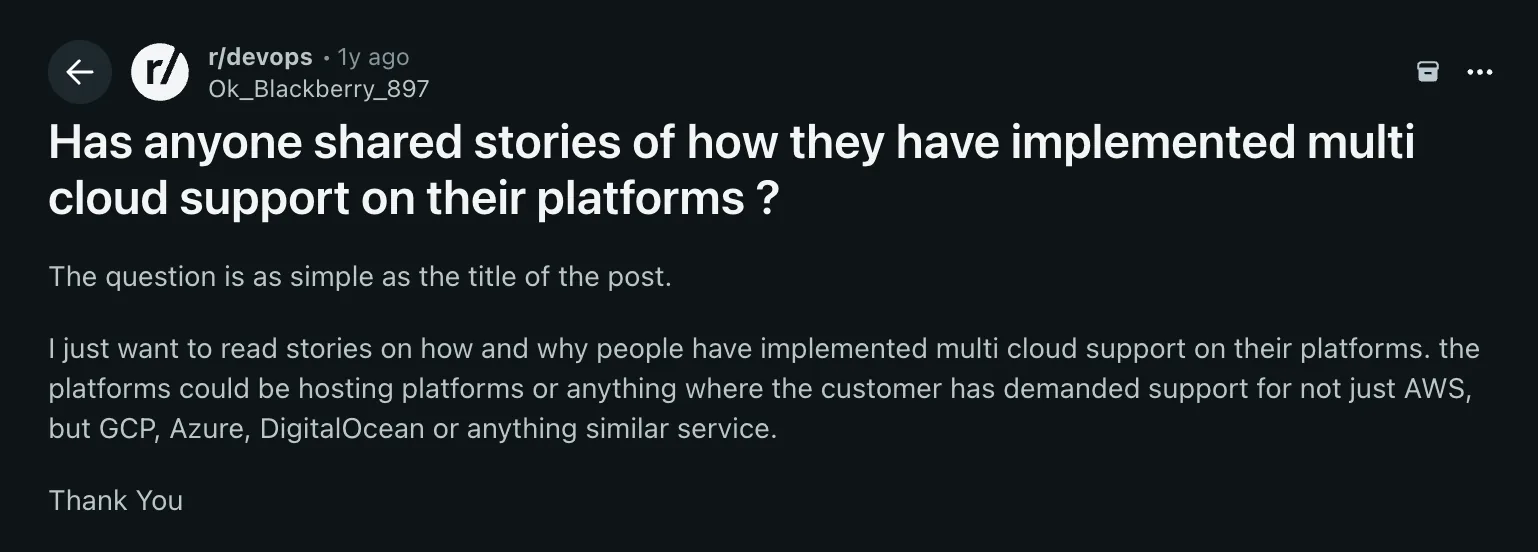
The breakdown isn’t at provisioning; Terraform handles that well enough. It’s at governance: RBAC configurations drift across providers because they’re set independently, tagging policies apply in AWS but not in GCP, and team-level cost attribution requires pulling data from billing APIs that use different dimension models. A post on r/devops asking how engineers have implemented multi-cloud support drew responses that circled the same theme: the hard part isn’t choosing a second provider, it’s maintaining consistent governance, automation, and cost visibility once workloads already span more than one.
What follows is a walkthrough of the four operational domains where cloud complexity compounds: policy enforcement, cost visibility, developer self-service, and IaC state management. Each section covers a specific failure pattern and traces how Cycloid’s unified control plane addresses it, with named features and documented behaviors rather than general claims.
Policy Drift in Multi-Provider Estates and Where It Starts
The first governance model to break in a multi-cloud estate is access control, because each cloud provider’s IAM system uses a different inheritance hierarchy, and no native mechanism synchronizes them. Tagging, the data layer that every downstream compliance and cost tool depends on, breaks second, because enforcement mechanisms are provider-specific.
How Independently Configured Consoles Create Security Gaps
AWS IAM, Azure RBAC, and GCP IAM each define permissions through different constructs: policies attached to principals in AWS, role assignments scoped to resources in Azure, and bindings attached to projects in GCP. A permission boundary configured in AWS doesn’t know what Azure role assignments exist for the same engineering team, and configuring both correctly requires working in two consoles with two mental models. When the same platform engineer who set up AWS access doesn’t configure the Azure equivalent, the access gap sits quietly until an audit or, worse, an incident exposes it.
The first thing to trace is how the same engineering team moves through separate provider consoles without a shared permission boundary. The access gap is easiest to miss between those independently configured paths, because nothing visibly fails until an audit or incident exposes the mismatch.
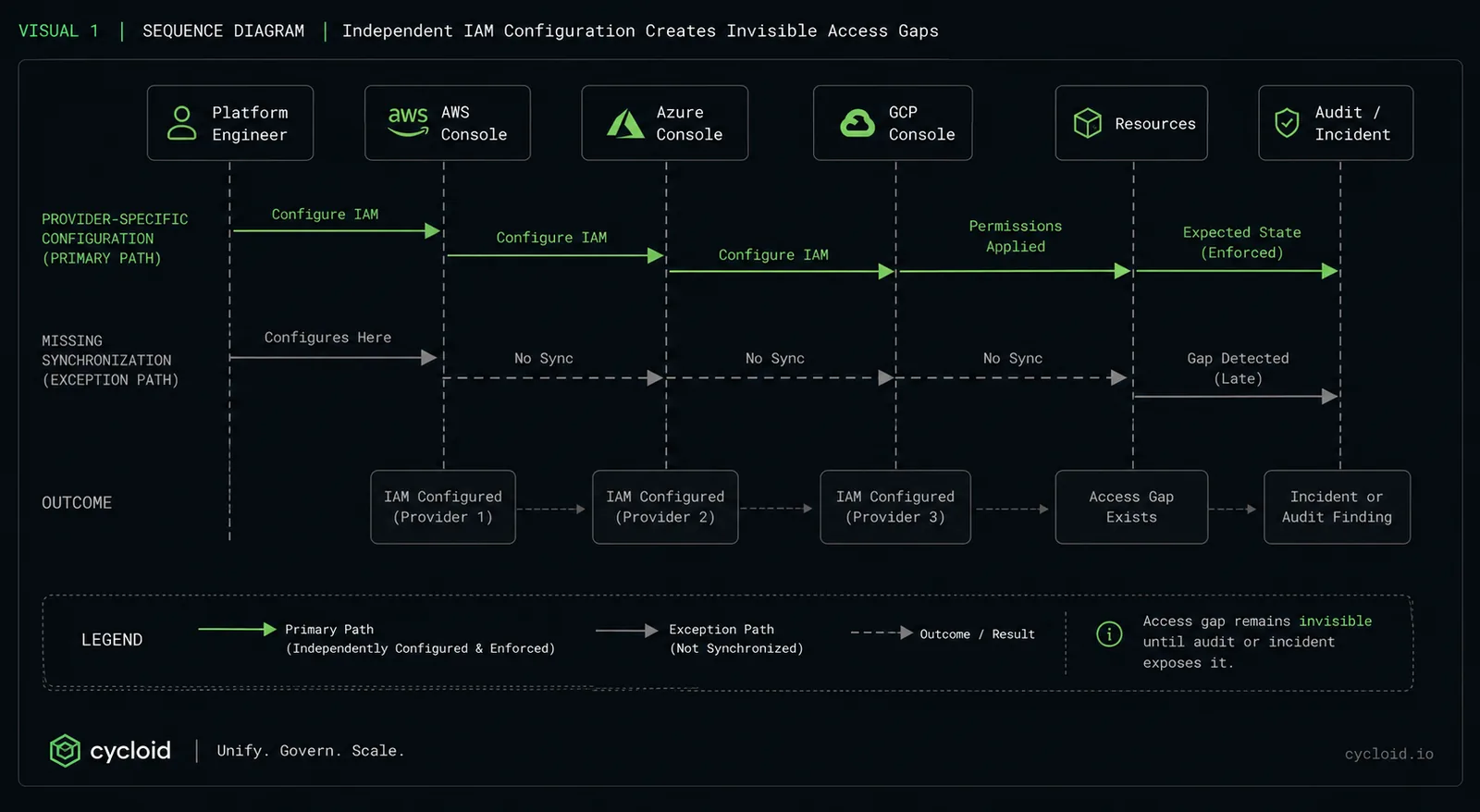
This is why multi-cloud IAM drift is difficult to catch through provider consoles alone: each path can look correctly configured while the combined estate still contains an authorization gap. The control point therefore has to move above the individual providers, where the same deployment can be evaluated before permissions become live.
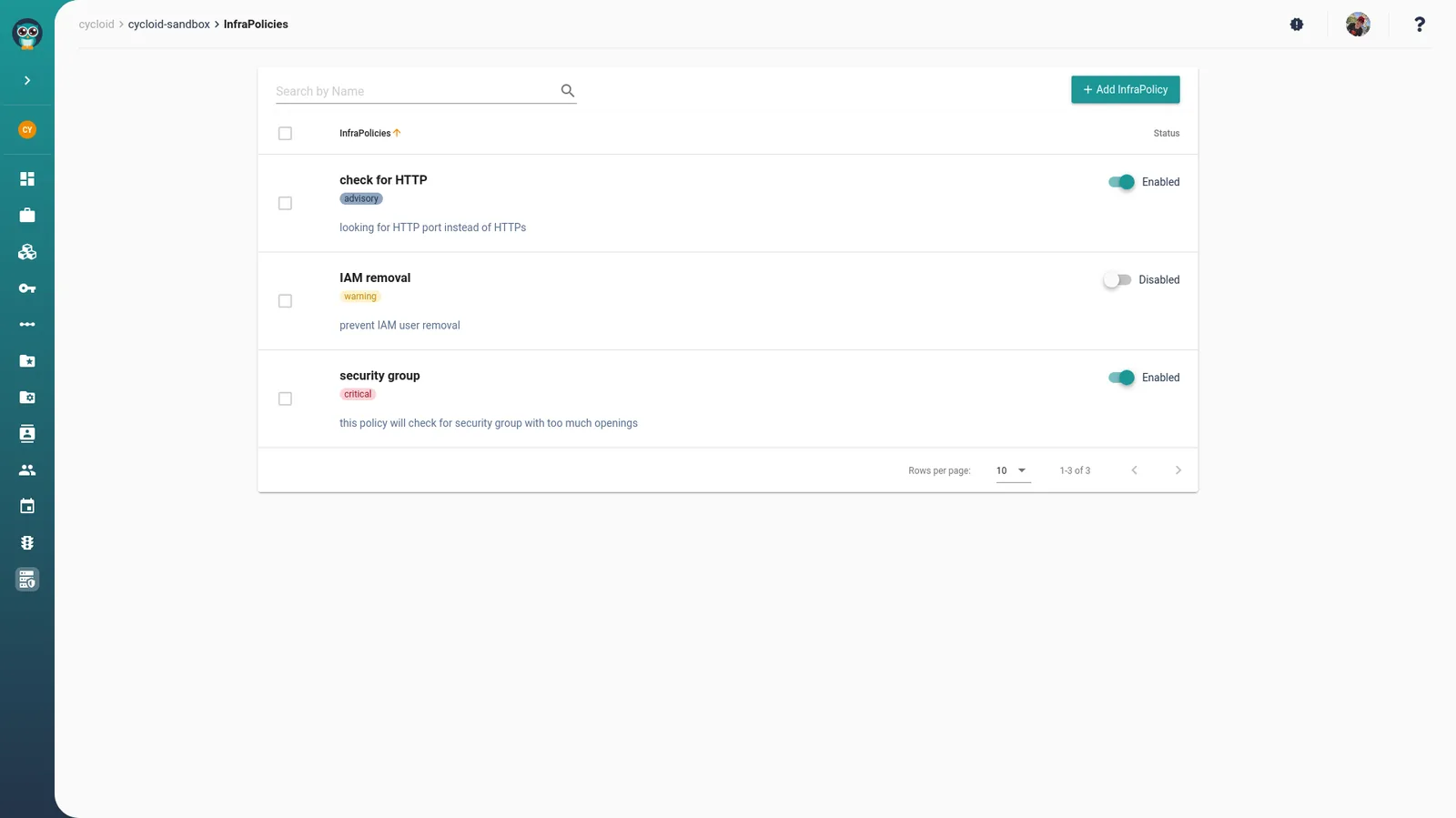
Cycloid’s Infrapolicies move governance from a post-deploy audit finding to a pre-deploy enforcement step. Policies defined as code apply at deployment time across providers, meaning a Terraform plan that violates the policy doesn’t produce a deployed resource with a compliance warning attached. It results in a blocked deployment, with a specific policy violation identified in the pipeline output. The distinction matters operationally: fixing a blocked plan takes minutes, while remediating a deployed resource takes a change window, a risk assessment, and a second review cycle.
When Tagging Policies Break Across Accounts
AWS Service Control Policies can enforce tagging at the organization level, requiring specific tag keys for a resource creation call to succeed. Azure Policy can do something similar within Azure subscriptions. Neither mechanism spans both providers. A tag standard enforced in AWS with an SCP doesn’t apply to GCP resources at all, which means cost attribution data becomes non-comparable the moment workloads cross providers, and compliance reports require manual reconciliation of two datasets that use different schemas.
Infrapolicies in Cycloid address tagging enforcement at the IaC layer rather than at the provider API layer. A policy rule can reject any Terraform plan that doesn’t include the required tag keys and values, regardless of which provider the plan targets. The enforcement point is the same for AWS, Azure, and GCP resources because it operates on the Terraform plan output rather than the provider’s native policy surface.
Approval Workflow Coverage When Changes Don’t Flow Through a Single Point
Ad hoc provisioning, console click-ops, and PRs merged without platform review all route around whatever approval process the IDP defines. If engineers can bypass the platform by going directly to a provider console, the approval workflow applies only to the traffic that already respects it. The governance coverage is precisely as wide as the adoption rate of the platform itself, which means partial adoption produces partial governance, the worst possible state because it creates a false confidence that controls are in place.
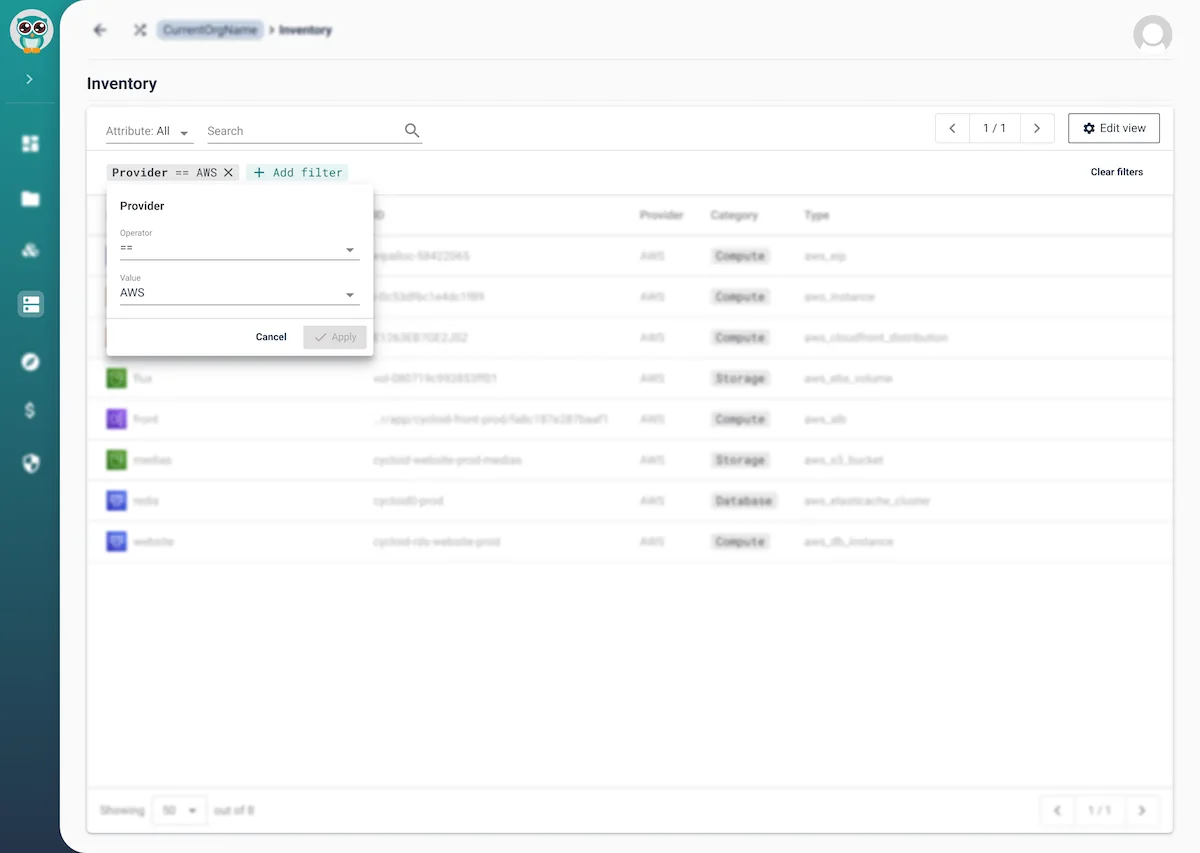
Cycloid’s RBAC model and approval workflows require infrastructure changes to flow through the platform, with granular role assignments that apply to all environments regardless of which provider hosts the workload. Combined with the Asset Inventory that tracks all resources across providers, the platform creates a single view of what exists, who changed it, and whether the change followed the approval process.
Moreover, utilizing the asset inventory in conjunction with the Cycloid Terraform HTTP backend offers automation and additional features, including InfraView for projects utilizing Terraform.
Where Cloud Cost Visibility Breaks in Multi-Cloud Environments
Cost data from AWS, Azure, and GCP arrives on different schedules, uses different dimension models, and doesn’t automatically map to internal team structures. That mismatch turns cost management from a reporting exercise into a data engineering project that requires ongoing maintenance.
The Mismatch Between Billing APIs and Engineering-Level Accountability
AWS Cost Explorer, Azure Cost Management, and GCP Billing each expose spend data organized around provider-specific concepts: AWS uses linked accounts and cost allocation tags, Azure uses subscriptions and resource groups, and GCP uses projects and labels. An engineering team that owns a service running across two providers needs cost data aggregated by team and environment, not by provider account structure. Building that aggregation layer requires pulling data from all three APIs, normalizing tag schemas, and maintaining mappings between internal team identifiers and provider-specific organizational units. When a team’s structure changes or a workload shifts between providers, the mapping breaks, and the cost data goes dark until someone rebuilds it.
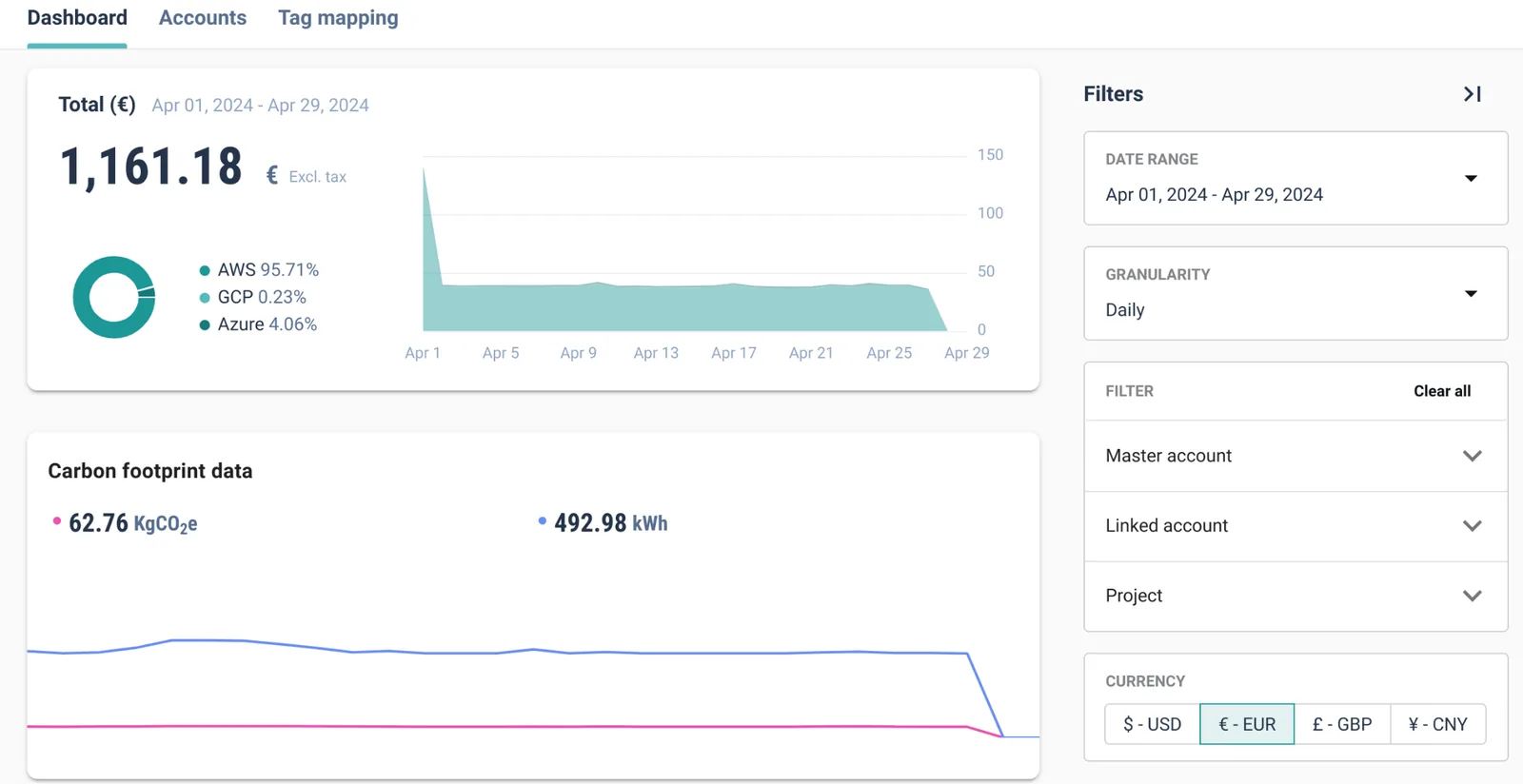
Cycloid’s Cloud Cost Management aggregates spend across AWS, Azure, and GCP into a single dashboard, with breakdowns by project and environment that match the organizational structure configured within the platform. The aggregation happens at the platform layer rather than requiring a separate data pipeline, which means cost visibility doesn’t lag behind organizational changes.
Why Pre-Deployment Cost Estimation Changes Spending Behavior
A Terraform plan shows resource changes but it doesn’t show dollar amounts. An engineer who deploys a stack without knowing what it’ll cost has no information to right-size it at the moment when right-sizing is cheapest, before the resource exists. Post-deploy cost dashboards reveal spend after the fact, and correcting over-provisioned resources after deployment requires a second change cycle: identifying the waste, proposing a resize, reviewing the change, and deploying again.
Follow the upper loop first, where cost becomes visible only after the workload has already been deployed and spending has accumulated. Then trace the lower path to the budget decision, where sizing can still change before infrastructure exists.
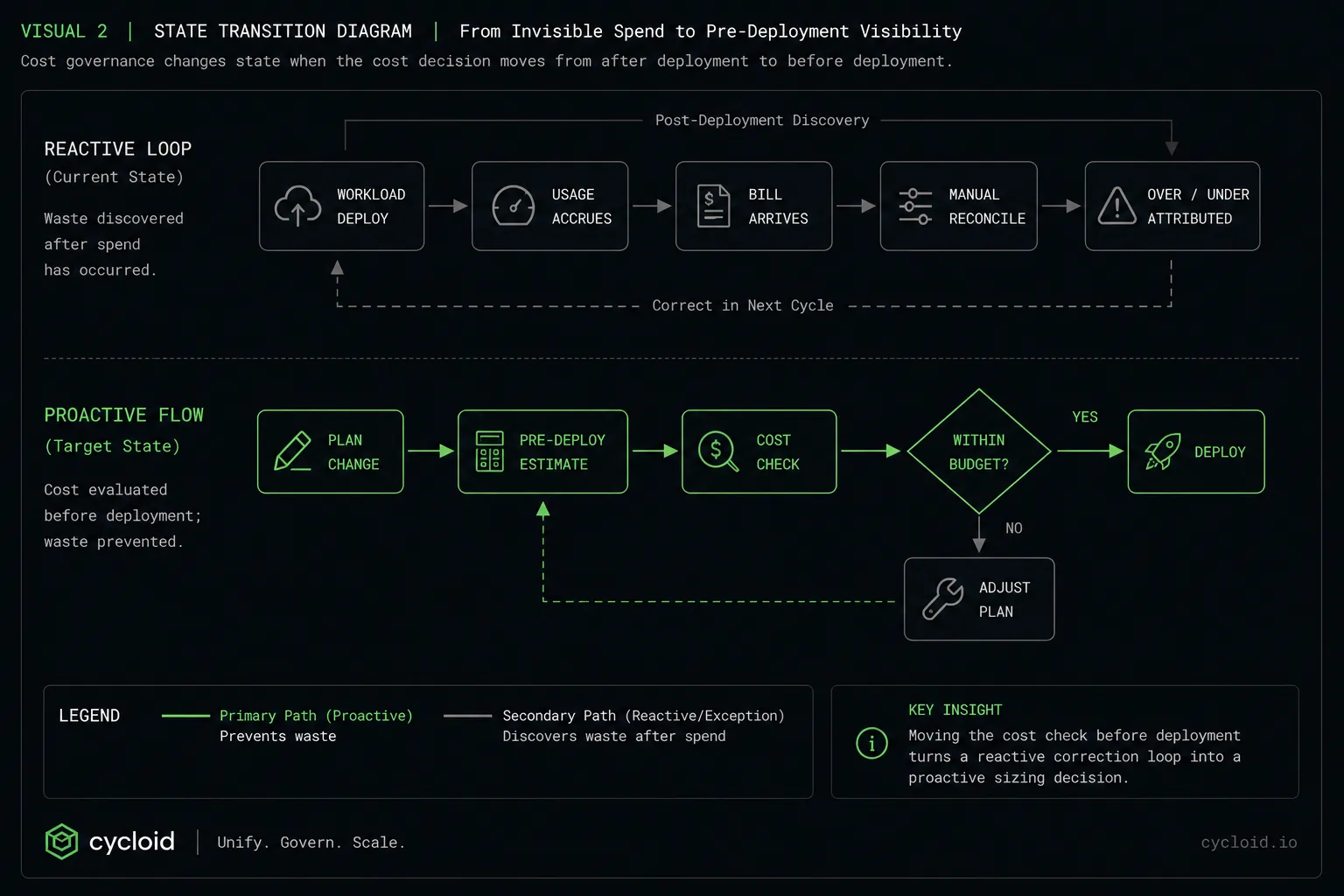
The difference is not another reporting layer; it is the point at which the cost decision occurs. Once the estimate sits inside the deployment workflow, an oversized resource can be corrected as part of the original change instead of becoming a second remediation cycle.
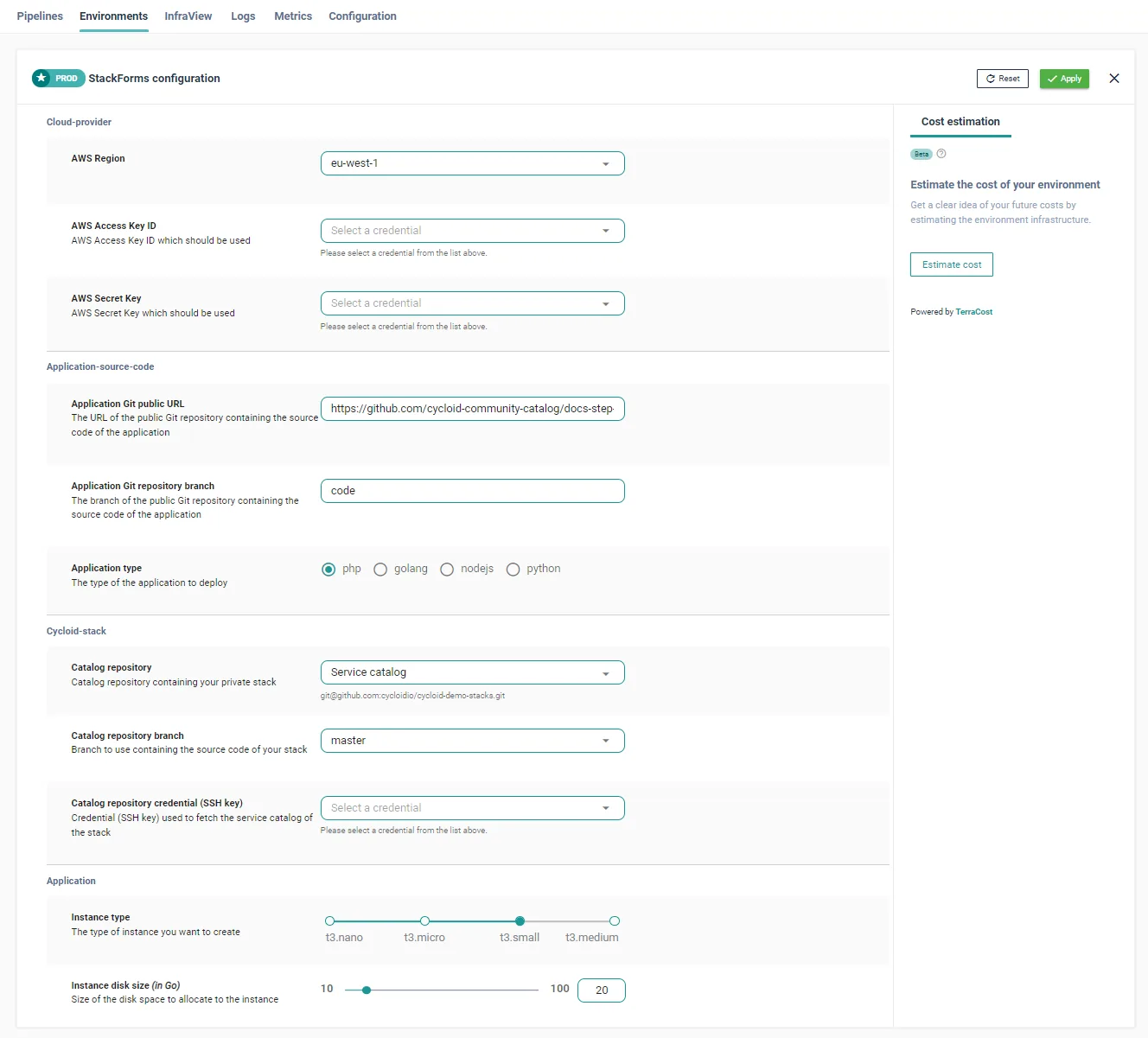
Cycloid integrates TerraCost, its open-source cost estimation engine, directly into StackForms. The cost estimate appears alongside the deployment form, before the engineer clicks deploy.
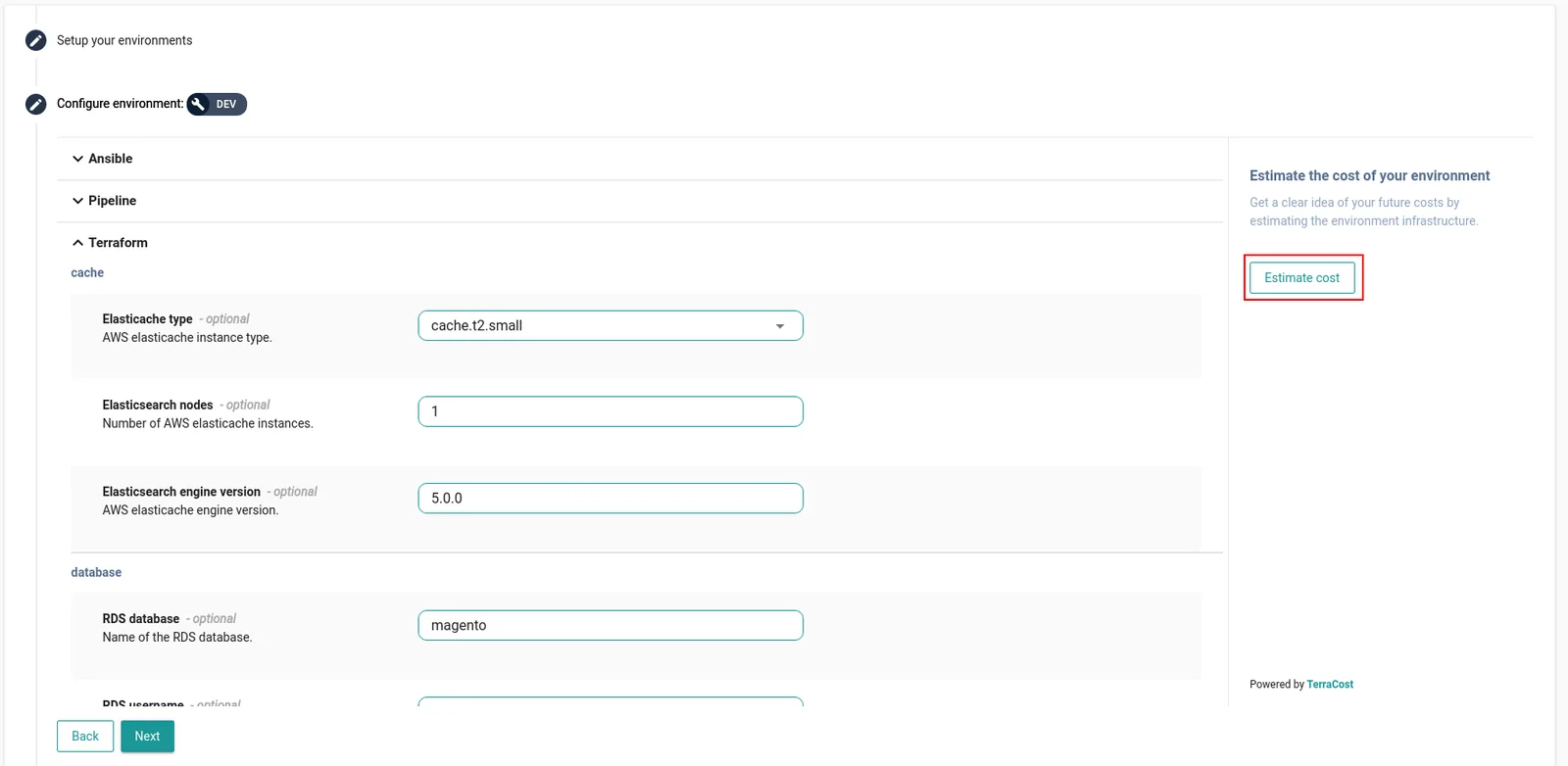
If any estimation was possible, it will then give you its output:
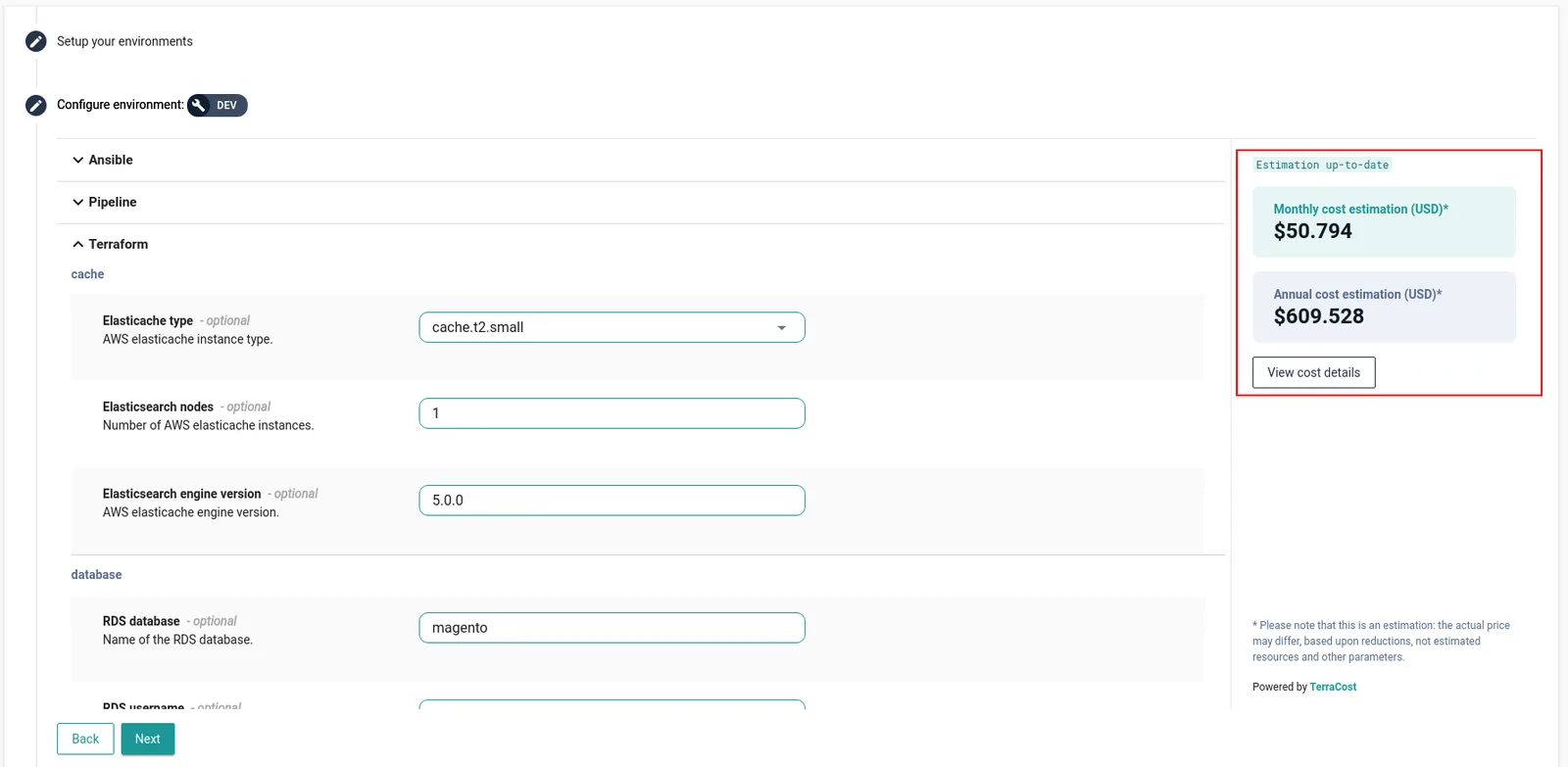
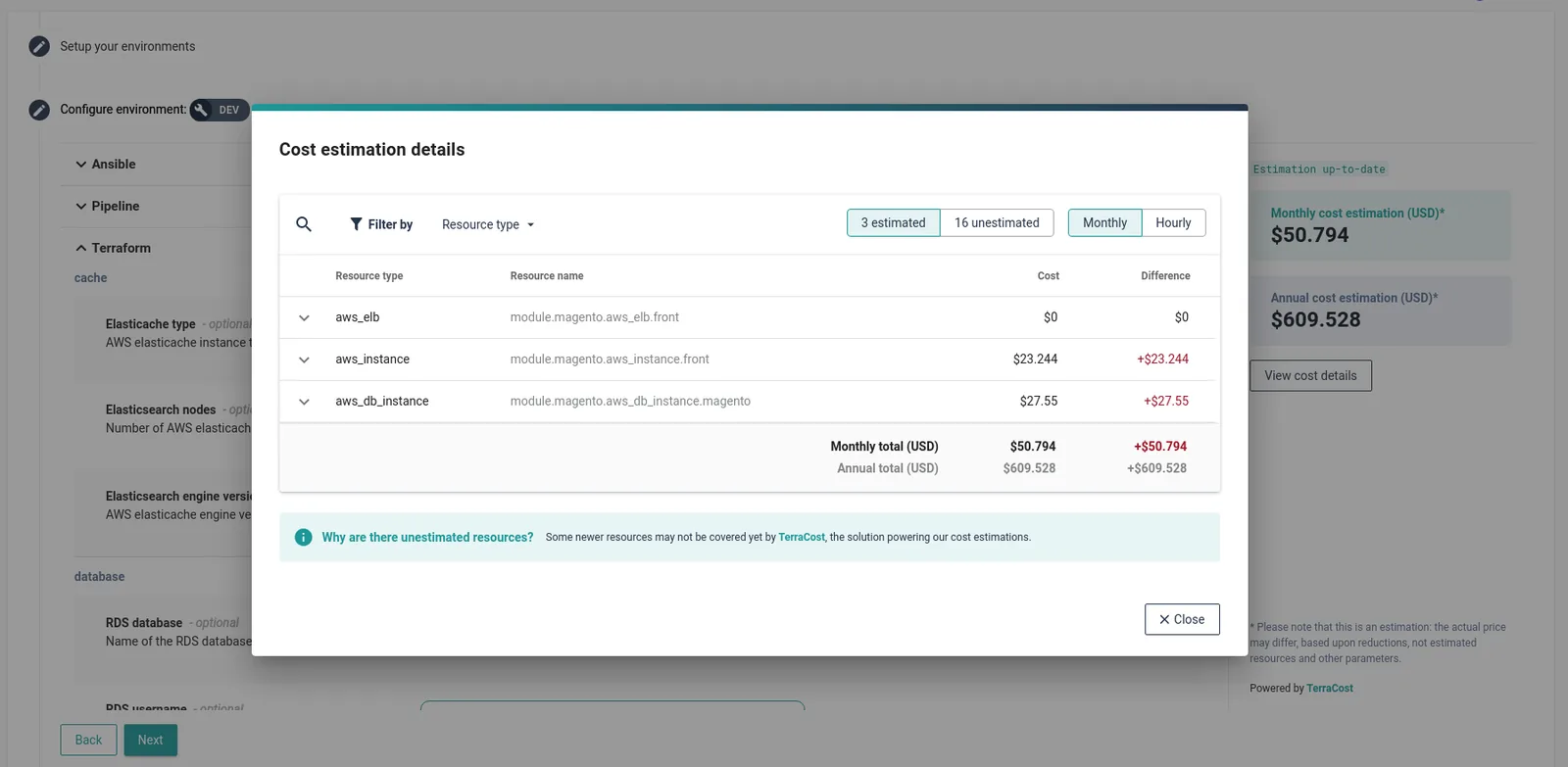
Here you will also be able to dig into the details of that estimation, to see which parts represent each component or which got ignored:
The StackForms quickstart documentation, shows how the .forms.yml configuration maps IaC parameters to form widgets, and TerraCost hooks into that same flow:
use_cases:
  - name: default
    sections:
      - name: Global configuration
        groups:
          - name: Instance settings
            technologies: [terraform]
            vars:
              - name: "Instance type"
                description: "EC2 instance type for the workload"
                key: instance_type
                widget: dropdown
                type: string
                default: "t3.medium"
                values: ["t3.small", "t3.medium", "t3.large", "t3.xlarge"]
The dropdown selection triggers a cost estimate that updates in the portal before deployment. The engineer sees the monthly cost difference between a t3.medium and a t3.xlarge before either resource exists. That’s a workflow change, not a reporting change.
Carbon Footprint Tracking Next to Cost Data
EU sustainability regulations, including CSRD and the EU Taxonomy framework, are moving carbon reporting from voluntary disclosure to mandatory compliance for large enterprises. When carbon footprint tracking lives in a separate tool from cost management, platform teams run two parallel data collection processes for two reporting obligations that share the same underlying cloud resource data.
Cycloid’s Cloud Carbon Footprint module tracks emissions data in the same dashboard as cost management and uses the same resource inventory. A single data collection pipeline feeds both cost and carbon views, eliminating duplicate integration effort and keeping the two datasets synchronized by default.
Developer Self-Service at Multi-Cloud Scale: Where the Design Breaks
Self-service portals fail at multi-cloud scale not because the UI is wrong, but because the abstraction layer doesn’t separate what the developer needs to decide from what the platform should decide for them. When the form exposes provider-specific configuration, it’s not self-service; it’s a GUI atop the same IaC complexity.
What Happens When Forms Expose Provider-Specific Configuration
A deployment form that surfaces AWS region selectors, GCP project IDs, and Azure resource group names as separate fields forces the developer to hold a mental model of each provider’s organizational structure. The cognitive load that self-service was supposed to remove lands right back on the developer, just formatted as a web form instead of a Terraform variable file. The error rate doesn’t decrease because the complexity didn’t decrease; it just moved from a text editor to a dropdown menu.
Cycloid’s StackForms separate platform-layer configuration from developer-facing inputs. The stack definition in .cycloid.yml declares the IaC technology, pipeline paths, and variable mapping:
name: 'Web application stack'
canonical: 'stack-webapp'
config:
  default:
    name: 'default'
    description: 'Standard web application deployment'
    terraform:
      main:
        path: 'terraform/main.tf'
        variables:
          path: 'terraform/variables.sample.tfvars'
          destination: '($ .project $)/terraform/($ .environment $).tfvars'
    pipeline:
      pipeline:
        path: 'pipeline/pipeline.yml'
        variables:
          path: 'pipeline/variables.sample.yml'
          destination: '($ .project $)/pipeline/variables-($ .environment $).yml'
The developer never sees this file; the developer sees a form with environment tier, application name, and sizing options. The platform team controls which provider, region, and IAM role map to each environment tier.
Service Catalog Sprawl When Stacks Aren’t Centrally Governed
A service catalog that grows via pull requests without central review introduces decentralized complexity faster than it removes provisioning toil. Overlapping stacks for the same resource type, maintained by different teams, with no enforcement of current security or tagging standards, create a catalog in which the “right” template is a matter of opinion rather than policy. Twelve months into ungoverned catalog growth, the platform team spends more time auditing stacks than building new ones.
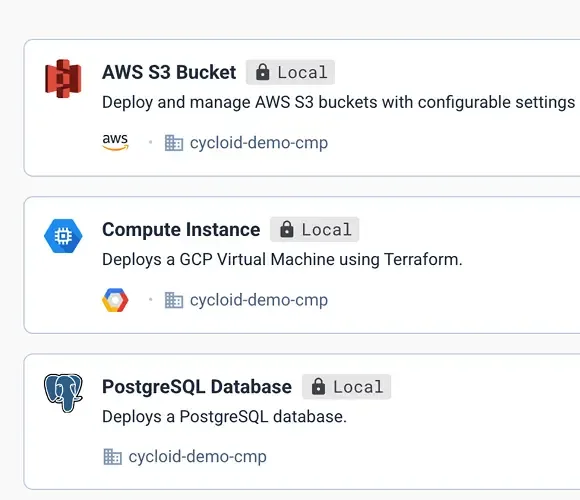
Cycloid’s service catalog interface showing multiple stack categories with version indicators and environment tags. Note the versioning on each stack entry, which shows centralized lifecycle management.
Cycloid’s Stacks are versioned, reusable infrastructure templates owned by the platform team. Additionally, you have to include a .forms.yml file at the same level as your .cycloid.yml. This file defines the stack user inputs.
Infrapolicies can reject any Stack deployment that doesn’t conform to the current policy set, regardless of who authored the Stack. Version control is stored in a Git-backed catalog repository, and Cycloid crawls it to automatically build the service catalog. A stack that violates a tagging or security policy doesn’t appear as a deployable option.
The Ops Ticket Loop That Self-Service Is Supposed to Break
The bottleneck in traditional infrastructure provisioning isn’t the available compute. It’s the ops team’s ticket queue. Self-service breaks this loop only when developers can complete the deployment without escalating. A self-service portal that still requires ops review for every deployment moves the queue rather than removing it. Cycloid’s documented metric of up to 70% fewer ops tickets comes from form-driven provisioning that exposes only the decisions the developer needs to make, while the platform enforces everything else: policy compliance, cost tagging, approval routing, and provider selection.
IaC Governance and the State Management Problem Across Providers
Terraform state files hold the canonical record of deployed infrastructure. When multiple teams manage their own state backends across different providers, the state layer itself becomes an ungoverned surface: different access controls, different backup policies, no unified audit trail.
Why Terraform State Becomes a Governance Risk at Scale
Each provider offers its own state backend: S3 in AWS, Blob Storage in Azure, GCS in GCP. A team running Terraform across two providers stores state in two backends, each with its own access control configuration. At ten teams, that’s potentially twenty state backends with twenty access policies that nobody reviews in aggregate. State file access is a security-sensitive permission, since the state file contains resource IDs, IP addresses, and sometimes secrets in plaintext. Decentralized state management means there is no single source of truth for which infrastructure exists, and no central audit of who accessed the state files.
Cycloid’s GitOps-first approach version-controls all IaC, including state configuration, in a centralized Config and Catalog Repository. The catalog repository becomes the auditable source of truth for what infrastructure is defined, and the platform manages the lifecycle from that single origin.
Auto-Generated Infrastructure Diagrams as an Operational Tool
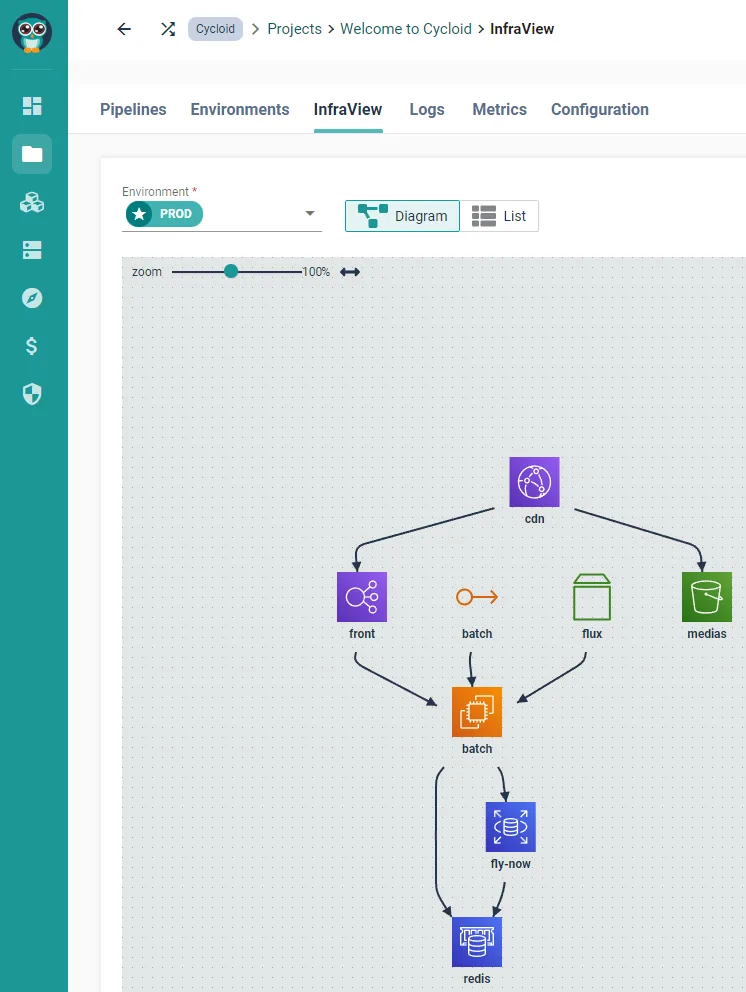
Documentation debt isn’t a discipline problem. It’s an incentive problem. Engineers don’t update infrastructure diagrams because diagrams don’t produce alerts when they go stale, but undocumented infrastructure slows incident response and complicates dependency analysis during migrations. Cycloid’s InfraView generates infrastructure topology diagrams from live Terraform state. The diagram stays current because it’s derived from the same state that provisions the infrastructure rather than being maintained separately.
Cloud Complexity Management: Where Tool Consolidation Hits Its Real Limits
Cloud complexity doesn’t shrink when you add another dashboard. It shrinks when governance, cost visibility, self-service, and state management flow through one control plane that sits above all providers and enforces rules at the IaC layer. The operational question isn’t whether to consolidate tooling; it’s whether the consolidation point has enforcement authority over every deployment path, or whether it’s another optional layer that engineers route around when they need to move fast. Cycloid’s approach, combining an internal developer platform with cloud management capabilities in a single vendor-agnostic control plane, addresses that question by making governance a pre-deploy gate rather than a post-deploy report.
The four failure patterns this article walked through (policy drift across independently configured consoles, cost visibility that fractures when billing data crosses provider boundaries, self-service forms that relocate complexity rather than remove it, and Terraform state management that decentralizes into ungoverned backends) share a common root cause. Each one starts with a governance layer designed for a single provider and doesn’t extend cleanly to a multi-provider environment. The teams that resolve cloud complexity management don’t add more tools to cover each gap; they choose a control plane with the authority to enforce rules across them all.
FAQs
1. What is cloud complexity management, and why has it become harder to address with native cloud tools?
Cloud complexity management is the practice of maintaining consistent governance, cost control, and operational visibility across infrastructure running on two or more cloud providers. Native tools from AWS, Azure, and GCP each govern only their own resources, so enforcement gaps open the moment workloads cross providers.
2. How do you enforce consistent governance policies across AWS, Azure, and GCP without managing them separately in each console?
Policy-as-code tools that operate on the Terraform plan output, rather than on each provider’s native policy API, apply the same rules regardless of target provider. Cycloid’s Infrapolicies block non-compliant deployments before resources are provisioned, applying one policy set across all providers.
3. What is the difference between a cloud management platform and an internal developer platform?
A cloud management platform focuses on governance, cost tracking, and multi-cloud visibility for operations teams. An internal developer platform focuses on self-service and the speed of developer workflows. Cycloid combines both into a single control plane, providing governance for ops and self-service for developers without running two separate stacks.
4. How does pre-deployment cost estimation change cloud spending behavior compared to post-deploy cost monitoring?
Pre-deployment estimation gives engineers cost data at the moment when changing resource sizing is cheapest: before the resource exists. Post-deployment monitoring reveals waste after the provisioning decision is made, requiring a second change cycle to correct it. Cycloid’s TerraCost engine displays estimated cost inside the deployment form.
Check our Comparisons: Cycloid vs Backstage / Cycloid vs Port / Cycloid vs Humanitec