GREENOPS SOLUTIONS
Measure and Reduce Your Cloud Carbon Footprint
Less talking, more acting. Manage your cloud carbon footprint and set your company on a greener path with Cycloid’s GreenOps module – alongside the FinOps cost reporting that funds the business case.

GreenOps (Green Operations) is the practice of embedding sustainability into cloud engineering workflows – measuring, tracking, and reducing the carbon footprint of cloud infrastructure as an integral part of the engineering process. GreenOps extends FinOps by adding carbon as a metric alongside cost: reducing cloud waste reduces both spend and emissions simultaneously. The Software Carbon Intensity (SCI) standard – an ISO-accredited specification (ISO/IEC 21031:2024) from the Green Software Foundation – provides the measurement framework.

Lack of true visibility into your cloud carbon emissions

Difficulty understanding the real impact of the numbers

Lack of green initiatives in organizations
The challenge
This might be obvious to note, but the cloud that hosts every company’s IT infrastructure is not a cloud at all – it is a series of massive concrete buildings full of servers that need constant cooling and consume large amounts of electricity and water. Cloud computing has now overtaken the aviation industry in global CO2 emissions on most credible estimates.
Carbon footprint data from cloud operations are often inconsistent, opaque, or simply unavailable. This does not excuse organisations from making a change. It is everyone’s job to make digital transformation sustainable, and there is a way to make cloud emission data transparent and easy to understand. The time to act is now.

Emissions from cloud computing range between 2.5% and 3.7% of all global greenhouse gas emissions, which exceeds emissions from commercial flights (2.4%). Source: IEA Data Centres and Data Transmission Networks tracking.
Our GreenOps & FinOps Features
Get insight into your cloud carbon footprint alongside FinOps data
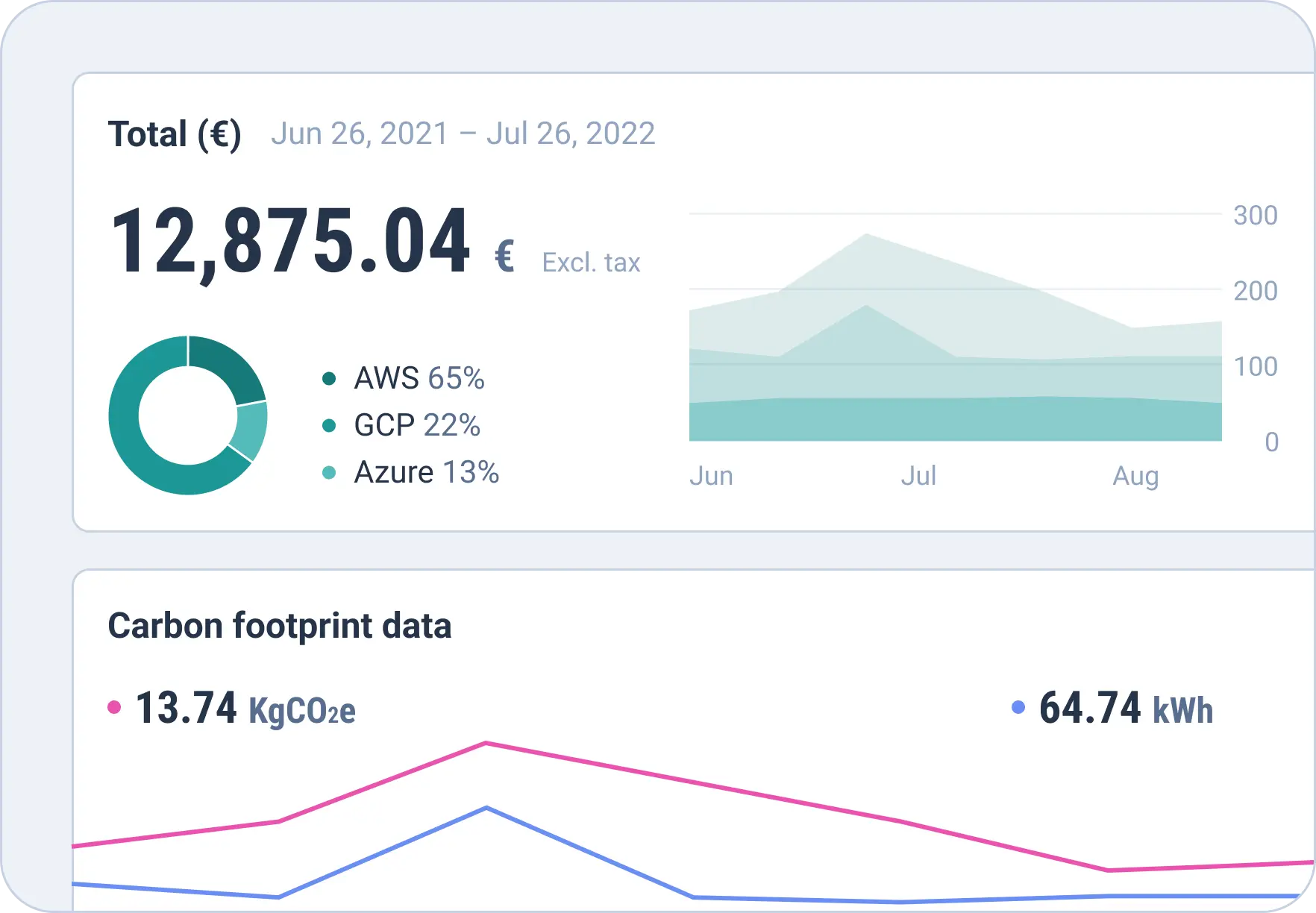
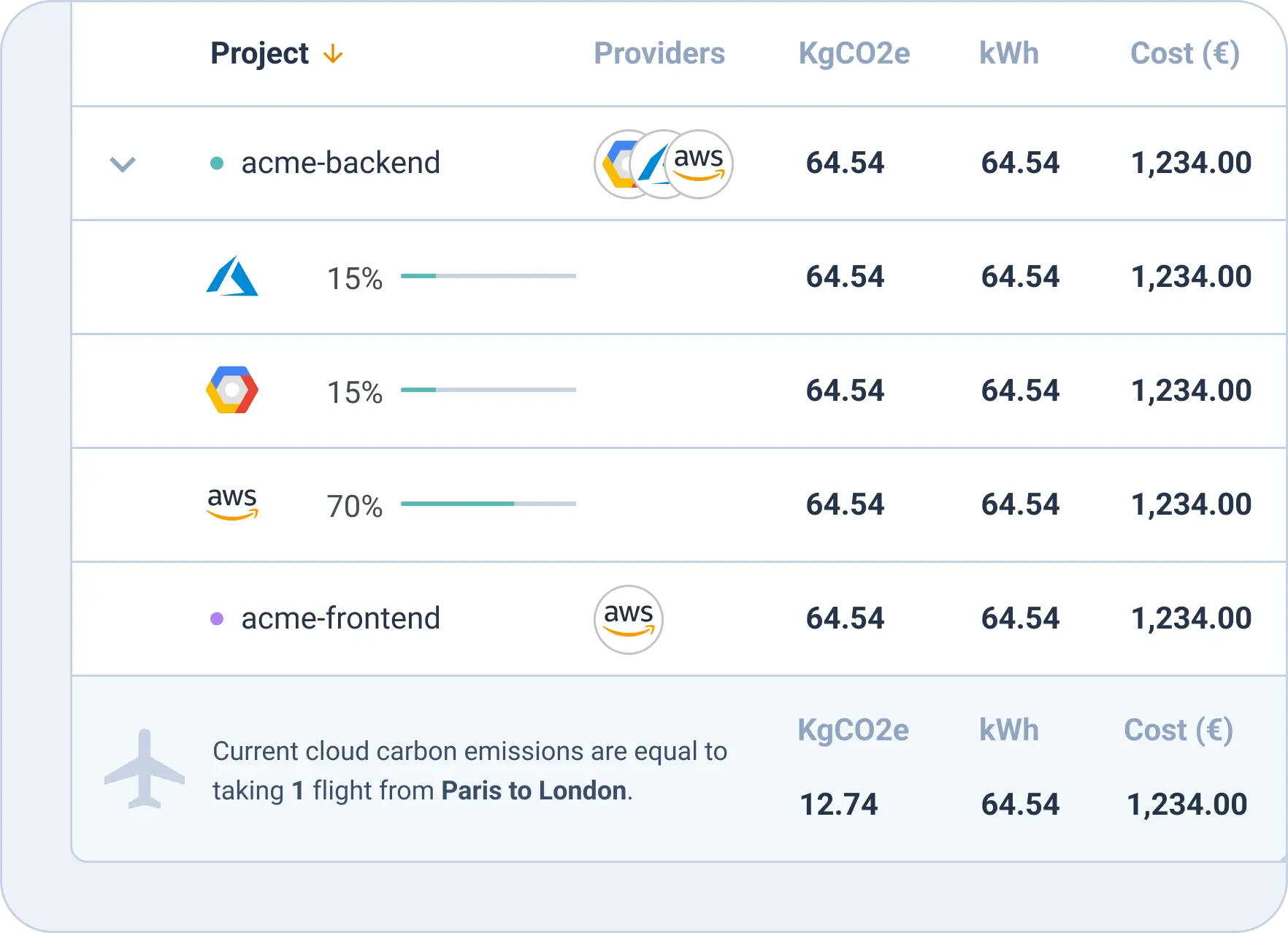
True data transparency is the main roadblock to more sustainable cloud computing. Part of Cycloid’s mission is to make emissions data available at a glance, alongside your cloud spending data. That is FinOps + GreenOps in one view – an approach that makes carbon footprint an integral part of your FinOps strategy. Cycloid’s Cloud Carbon Footprint feature is embedded within our Cloud Cost Management module and shows carbon emissions data alongside your public and private cloud costs in a single-panel view.
Reporting
Cycloid’s Cloud Carbon Footprint feature reports on data related to scope 2 of the European Sustainability Reporting Standards (ESRS) and helps you prepare ESG reports. With the EU’s Corporate Sustainability Reporting Directive (CSRD) now in force, scope 2 emissions are no longer optional disclosure – they are regulated reporting.
Reduce cloud costs
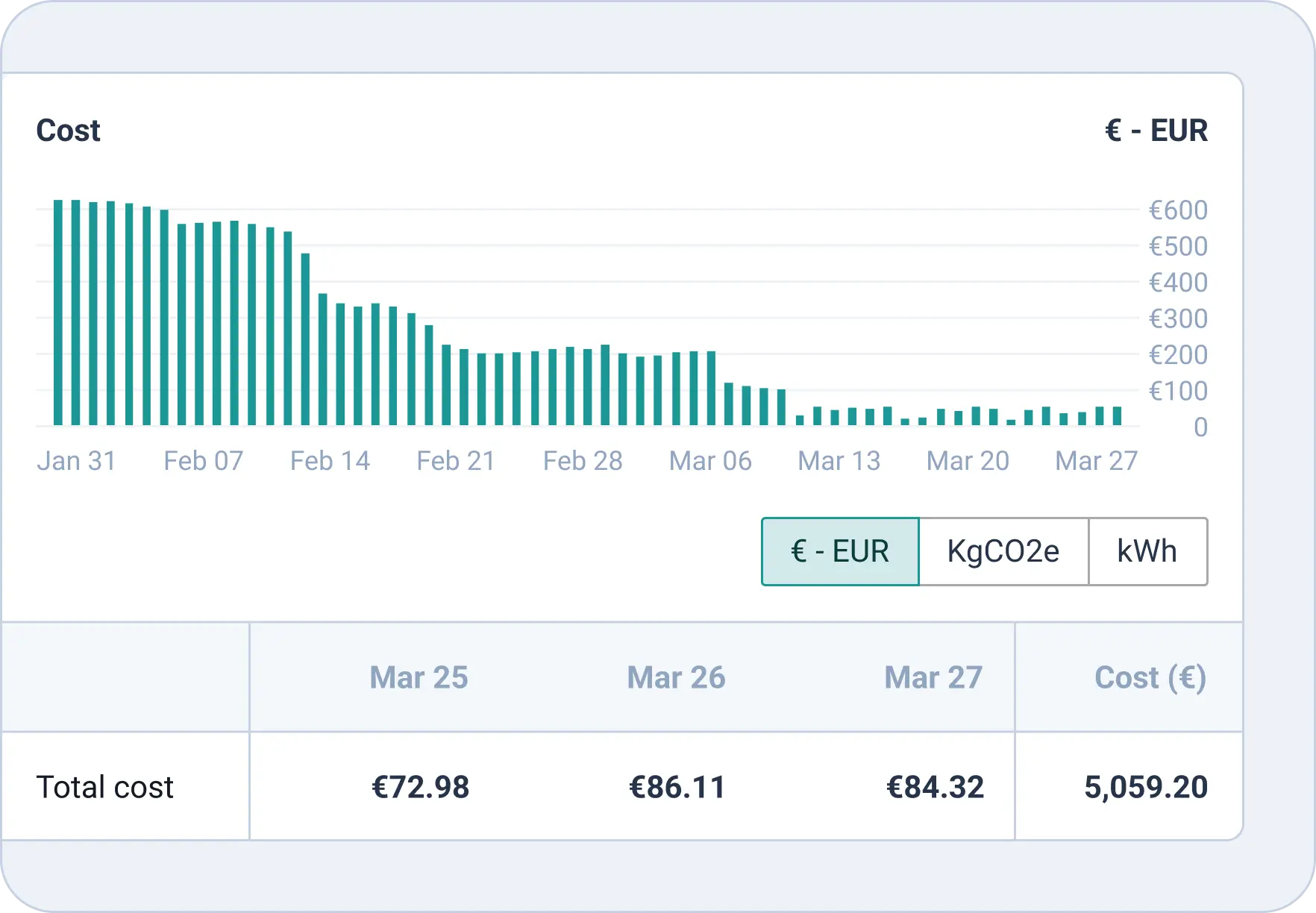
Once you have the cloud computing emissions data, you can take steps toward reducing your cloud carbon footprint. No matter how the servers are maintained, the less cloud you use, the better. It is impossible to turn it off as a successful IT business, but there are many instances where minimising cloud overspending makes all the difference. Adopt a sobriety mindset and focus on consuming less and more efficiently – which is great not only for the environment but also for your wallet.
Cycloid’s GreenOps modules are available as a stand-alone solution.
Inspire green initiatives
Taking care of your cloud consumption carbon footprint can be the first step towards wider green practices in your organisation and teams. Doing your part as an individual can feel like a drop in the bucket, but a clear green company strategy supported by data can inspire your people to take on more environmentally-conscious behaviours. Lead your teams by example and adopt a non-negotiable stance on reducing your carbon footprint.
Read our Green IT infosheet →
The cloud is the modern factory.
Life the Cycloid way
True control over your cloud

View precise cloud carbon emissions data in the same breath as your cloud costs.
Greener choices

Lead the green revolution in your org, motivate and empower people to make better decisions to reach sustainability goals.
Consume less, spend less

Reduce cloud overspending and save cash and the environment.
Cloud-based organisations have an obligation to make more environmentally-conscious decisions and reduce their carbon footprint - and now they can.
Guardians of the Cloud

DEFINITION
What Is GreenOps?
GreenOps – short for Green Operations – is the practice of bringing sustainability accountability to the variable-spend model of cloud computing. A GreenOps tool makes this practical at scale: it gives engineering, finance, and sustainability teams a shared, real-time view of what the organisation’s cloud estate emits, where the hotspots are, and which engineering decisions can move the number.
The cloud’s on-demand pricing model creates a carbon accountability gap that mirrors the cost accountability gap FinOps was created to solve. Engineers provision resources without seeing the emissions impact; sustainability teams receive scope 2 figures weeks later with no way to trace them back to the teams or projects that generated them. GreenOps closes that gap by embedding emissions awareness directly into engineering workflows.
The Green Software Foundation’s Software Carbon Intensity (SCI) specification is now an ISO-accredited standard (ISO/IEC 21031:2024). It defines carbon emissions per functional unit of software (per user, per transaction, per API call) rather than as an absolute total, which makes results comparable across teams, products, and providers. A SCI for AI extension was ratified to cover AI workload measurement, with SCI for Web set to follow in 2026.
GREENOPS VS FINOPS
How the Two Practices
Complement Each Other
FinOps and GreenOps share the same telemetry. Both rely on per-team, per-project resource usage data and both reward cutting waste. They differ in what they measure, when they measure it, and who they answer to.
| Dimension | FinOps | GreenOps | Cycloid (both) |
|---|---|---|---|
| Primary metric | Cost ($ / EUR / month) | Carbon (kg / tonnes CO2e) | Both, side by side in the dashboard |
| When measured | Pre-deployment estimate + post-deployment ledger | Post-deployment scope 2 emissions | Pre-deploy cost estimation (TerraCost) + post-deploy carbon (CCF) |
| Business owner | Engineering + Finance (78% report to CTO/CIO per FinOps Foundation 2026) | Engineering + Sustainability (often CSR / Head of ESG) | Same telemetry, two report views |
| Reporting use | CFO budget, board cost reporting | CSRD / ESRS scope 2, board sustainability reporting | One Cycloid tag taxonomy serves both |
The practical implication: organisations that already run FinOps have most of the GreenOps machinery in place. The remaining work is mapping cloud usage to emissions factors (which Cycloid’s Cloud Carbon Footprint module does automatically) and routing the report to the sustainability team alongside the cost report.
THE DUAL ROI OF GREENOPS
Cloud Waste = Carbon + Cost
29%
Cloud waste rate (industry average)
Flexera 2026 State of the Cloud
2.5-3.7%
Cloud share of global GHG emissions
IEA Data Centres tracking
98%
FinOps practices managing AI spend
FinOps Foundation 2026
Idle compute, over-provisioned resources, orphaned storage, and untagged sprawl are the shared root cause of both the cost waste and the carbon waste. A GreenOps tool that surfaces both metrics in one view makes the trade-off visible and the savings actionable. Cycloid customers measuring both regularly see correlated reductions: cutting idle resources by 20-30% trims the cloud bill and the scope 2 emissions in the same step.
Frequently Asked Questions
What is GreenOps?
GreenOps (Green Operations) is the practice of embedding sustainability into cloud engineering workflows by measuring, tracking, and reducing the carbon footprint of cloud infrastructure as an integral part of the engineering process. GreenOps extends FinOps by adding carbon as a metric alongside cost: reducing cloud waste reduces both spend and emissions simultaneously. The Software Carbon Intensity (SCI) standard, an ISO-accredited specification from the Green Software Foundation, provides the measurement framework.
What is the difference between GreenOps and FinOps?
FinOps optimises cloud spending; GreenOps optimises cloud carbon emissions. The two practices share methods (tagging, attribution, governance) and complement each other – reducing idle resources reduces both cost and carbon at the same time. FinOps owners typically sit between engineering and finance; GreenOps owners typically sit between engineering and sustainability. Cycloid covers both from one platform because the underlying telemetry (resource usage by team, project, environment) is the same.
How do you measure cloud carbon footprint?
Cloud carbon footprint is measured by combining resource utilisation data (CPU, memory, storage, network) with provider-specific energy and emissions factors, normalised through standards like the Green Software Foundation’s Software Carbon Intensity (SCI) specification. AWS, Azure, and GCP each publish their own carbon dashboards with different methodologies; SCI provides the cross-provider normalisation that lets enterprises report consistently across multi-cloud estates and meet CSRD or ESRS disclosure requirements.
What is the SCI standard in GreenOps?
The Software Carbon Intensity (SCI) specification is an ISO-accredited standard (ISO/IEC 21031:2024) from the Green Software Foundation. It defines how to calculate carbon emissions per functional unit of a software application – per user, per transaction, or per API call – rather than as a single absolute total. SCI provides a comparable, defensible metric for GreenOps reporting. A SCI for AI extension was ratified to cover AI workload measurement.
How does GreenOps reduce cloud costs and carbon simultaneously?
Cloud waste is the shared root cause of both excess cost and excess carbon: idle compute, over-provisioned resources, orphaned storage, and untagged sprawl. Reducing waste cuts the cloud bill and the emissions footprint at the same time. Flexera’s 2026 State of the Cloud Report put industry-average IaaS and PaaS waste at 29%, the first rise in five years driven by AI workloads. A GreenOps tool that surfaces both metrics in one view makes the trade-off visible and the savings actionable.
Want to see Cycloid’s GreenOps solutions in action? Talk to us.