Cycloid vs Port vs Backstage

Choosing the Right IDP for Modern Platform Teams

As engineering teams scale beyond a few services into multi-team, multi-environment setups, coordination costs rise quickly. Infrastructure changes start happening daily across environments, and the distance between developers and delivery workflows becomes operationally expensive.


What begins as shared scripts or basic Terraform modules often turns into undocumented processes, ticket queues for routine changes, and a growing dependency on a small group of platform engineers. The result is slower delivery, inconsistent environments, and higher operational risk, even when teams are moving fast.


Teams evaluate Cycloid, Port, and Backstage because they approach this problem from different starting points. Backstage grew out of a large developer ecosystem focused on service discovery and ownership. Port focuses on replacing ticket-based operations with self-service actions. Cycloid addresses the problem at the infrastructure delivery layer, where consistency, governance, and cost control must hold up as scale increases.


Under the surface, these platforms make very different assumptions about where workflows live, how much automation the platform owns, and where enforcement happens. Those assumptions determine whether a platform reduces long-term complexity or simply moves it elsewhere.


Where Should Platform Ownership End and Developer Autonomy Begin?

Cycloid is built for platform teams that need to operate infrastructure as a disciplined engineering system. It helps organizations scale Terraform automation while preserving Day 2 fundamentals such as cost visibility and sustainability tracking. By enforcing delivery patterns and guardrails in code, Cycloid supports high-velocity delivery without sacrificing control, auditability, or operational rigor.

Port focuses on enabling self-service through structured actions rather than owning infrastructure delivery. It allows platform teams to expose approved operations such as provisioning, deployments, or approvals as developer-triggered actions backed by existing automation. This model works well for organizations that want to reduce ticket-driven work and improve onboarding, while keeping enforcement and execution in downstream systems like CI pipelines and Terraform modules.

Backstage addresses a different problem altogether. In environments with hundreds of services, fragmented documentation, and unclear ownership, Backstage acts as a centralized discovery layer. It aggregates service metadata, ownership, and documentation into a single catalog, helping teams understand what exists and who is responsible for it. Backstage intentionally stays out of the execution path, providing visibility rather than managing how infrastructure is created or operated.


By the end of this breakdown, you’ll know exactly which IDP aligns with your team’s maturity, risk profile, and technical strategy.

Feature Comparison: Cycloid vs Port vs Backstage

This breakdown is for the platform engineers and DevOps leads who have been burned by “portal-only” tools that look great in a demo but crumble when faced with real-world production complexity. We are moving past the marketing fluff to look at how these tools handle Terraform sprawl, RBAC logic, and the high-velocity “TicketOps” that kills engineering productivity.

Let’s start with the technical analysis of Cycloid vs. Port vs. Backstage.

1. Setup, Maintenance & Hosting Flexibility

The way you deploy your IDP isn’t just a detail; it’s a compliance and maintenance decision. If you’re in a regulated industry, SaaS-only is a non-starter. If you’re a lean team, a “DIY” portal is a full-time job.

Some platform teams prefer a managed service so they can focus on building internal workflows instead of running another control plane. SaaS-first internal developer platforms (IDPs) reduce operational overhead and usually work well for smaller teams, early-stage companies, or organizations without strict data residency or isolation requirements.

Other teams operate under very different constraints. Financial services, healthcare providers, and regulated enterprises often need self-hosted, private, or air-gapped deployments to satisfy internal security policies and external compliance standards. These environments require explicit control over where data lives, how networks are segmented, and what runtime access is permitted.

This category evaluates how Cycloid, Port, and Backstage handle deployment models, ranging from fully managed SaaS to on-premises and isolated installations, and how well each supports secure, controlled environments.

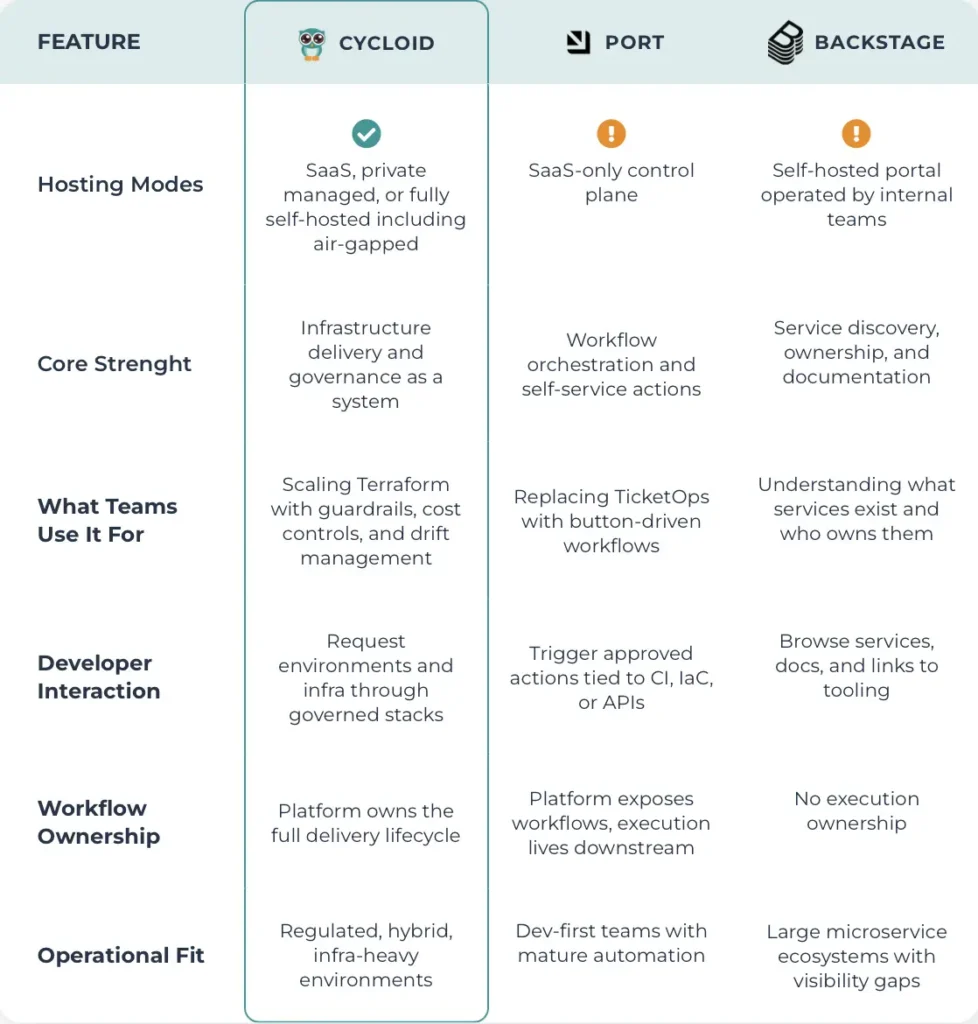
Takeaway: Cycloid offers the widest deployment flexibility, supporting SaaS, private managed instances, and fully self-hosted or air-gapped environments. This makes it a strong fit for teams that need to operate across regulated, hybrid, or security-constrained infrastructures while keeping infrastructure delivery standardized.


Port works best as a SaaS-based self-service and orchestration layer. It is well suited for teams that want to expose approved actions and workflows to developers without owning or operating the underlying platform infrastructure.


Backstage is strongest as a self-hosted discovery and documentation platform. Teams benefit most from Backstage when service visibility, ownership, and internal standards are the primary goals, and the organization is willing to operate and extend the portal itself.

FEATURE

CYCLOID

PORT

BACKSTAGE

Hosting Modes

SaaS, private managed, or fully self-hosted including air-gapped

SaaS-only control plane

Self-hosted portal operated by internal teams

Core Strenght

Infrastructure delivery and governance as a system

Workflow orchestration and self-service actions

Service discovery, ownership, and documentation

What Teams Use It For

Scaling Terraform with guardrails, cost controls, and drift management

Replacing TicketOps with button-driven workflows

Understanding what services exist and who owns them

Developer Interaction

Request environments and infra through governed stacks

Trigger approved actions tied to CI, IaC, or APIs

Browse services, docs, and links to tooling

Workflow Ownership

Platform owns the full delivery lifecycle

Platform exposes workflows, execution lives downstream

No execution ownership

Operational Fit

Regulated, hybrid, infra-heavy environments

Dev-first teams with mature automation

Large microservice ecosystems with visibility gaps

2. Infrastructure & Resource Management

This is usually where platform teams feel pain first. As environments multiply, Terraform stacks diverge, and ownership becomes unclear, teams need a reliable way to see what infrastructure exists, how it is changing, and whether it still matches what was approved. Without this, drift accumulates quietly and operational risk increases over time.

This category compares how Cycloid, Port, and Backstage approach infrastructure state, resource visibility, and control as scale increases.


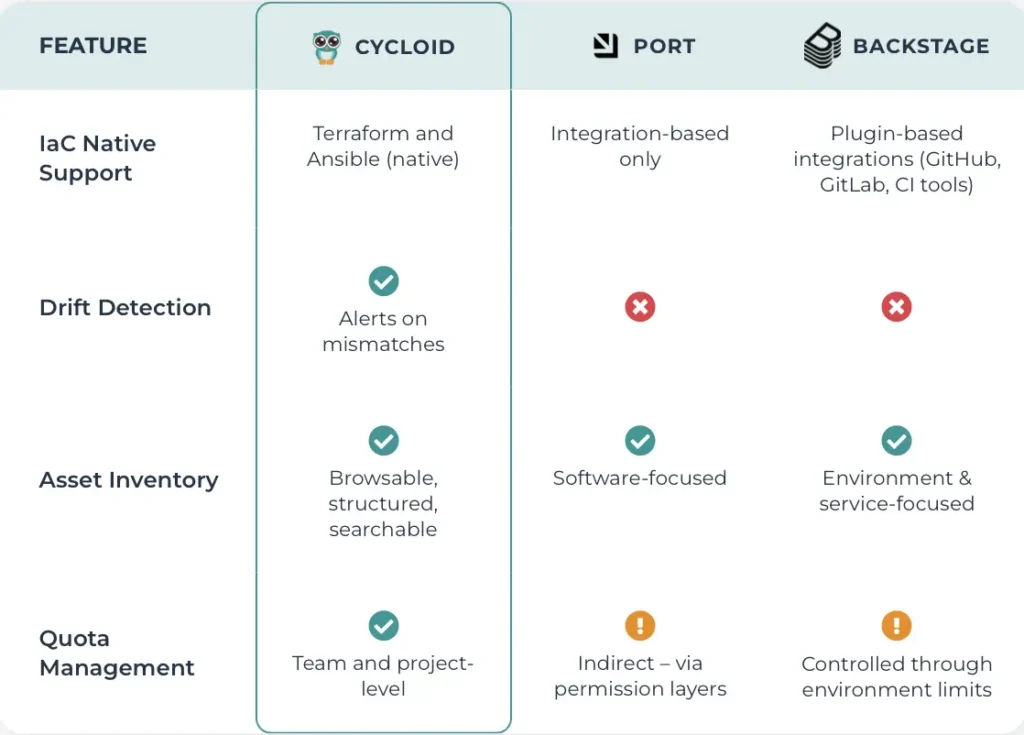
Takeaway: Cycloid treats infrastructure management as a first-class platform responsibility. It manages Infrastructure as Code end to end, with native visibility across environments, drift detection, and asset-level tracking built directly into the delivery lifecycle.


Backstage provides infrastructure visibility only through links and plugins, acting as a reference layer rather than a control plane.


Port focuses on modeling services and environments, while infrastructure state, drift handling, and enforcement remain entirely within downstream automation such as CI pipelines and Terraform workflows.


FEATURE

CYCLOID

PORT

BACKSTAGE

IaC Native Support

Terraform and Ansible (native)

Integration-based only

Plugin-based integrations (GitHub, GitLab, CI tools)

Drift Detection

Alerts on mismatches

Asset Inventory

Browsable, structured, searchable

Software-focused

Environment & service-focused

Quota Management

Team and project-level

Indirect – via permission layers

Controlled through environment limits

3. Self-Service & Developer Enablement

Once infrastructure standards exist, the next challenge is making them usable without turning the platform team into a ticket queue. Developers want clear, predictable ways to provision environments, deploy services, and make routine changes without needing deep platform knowledge or manual approvals.

This category examines how each platform enables self-service, how structured those workflows are, and how much responsibility the platform takes for execution versus delegation.


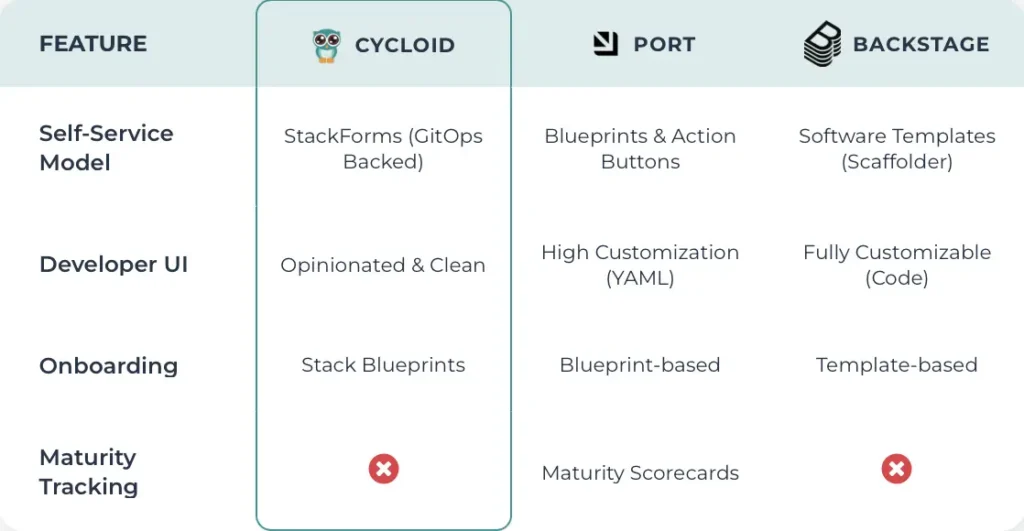
Takeaway: Port is strongest when teams are buried in Jira tickets for routine operations like environment creation, redeployments, or access requests. Its action-based model lets developers trigger approved CI jobs or Terraform workflows directly, while platform teams keep control in the underlying automation.


Cycloid fits teams struggling with inconsistency across environments. By enforcing Git-backed stacks, Cycloid ensures every environment is created, updated, and governed the same way, reducing drift, review overhead, and “snowflake” infrastructure over time.


Backstage helps when the main problem is service sprawl and ownership confusion. It improves onboarding and discovery by centralizing metadata and documentation, but it stays out of the execution path and does not replace operational workflows.

FEATURE

CYCLOID

PORT

BACKSTAGE

Self-Service Model

StackForms (GitOps Backed)

Blueprints & Action Buttons

Software Templates (Scaffolder)

Developer UI

Opinionated & Clean

High Customization (YAML)

Fully Customizable (Code)

Onboarding

Stack Blueprints

Blueprint-based

Template-based

Maturity Tracking

Maturity Scorecards

4. Access Control, Security & Governance

As platforms scale, informal controls break in very specific ways. Platform teams start seeing production changes applied from the wrong branch, Terraform plans run with elevated permissions, and environment boundaries enforced only through convention. Approval logic lives in people’s heads or Slack threads, and a missed review becomes a security or cost incident rather than a process exception.

At this stage, platform teams need explicit answers to operational questions i.e., who is allowed to provision production infrastructure, which inputs they can change, which policies must pass before applying, and where those checks are enforced. When governance depends on manual reviews or shared understanding, delivery either slows down or rules are bypassed under pressure.

This section looks at how each tool approaches role-based access control (RBAC), policy enforcement, and guardrails.


This section compares how Cycloid, Port, and Backstage handle access control, enforcement, and guardrails in real delivery workflows.


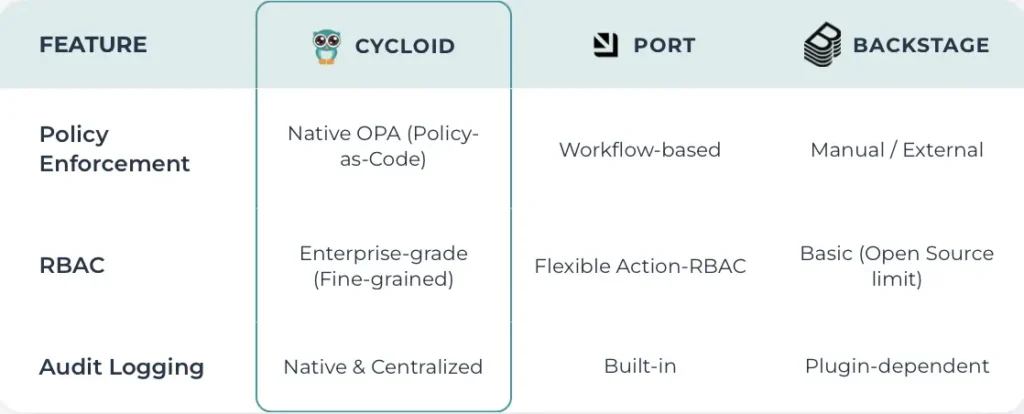
Takeaway: Cycloid enforces governance directly in the delivery path. When a developer requests an environment or infrastructure change, Cycloid updates Git-backed configuration and runs policy checks, approvals, and Terraform plans before anything reaches the cloud. This prevents scenarios like unapproved instance sizes, cross-environment access, or production changes from unreviewed branches.


Port governs how requests are initiated rather than how infrastructure is applied. Platform teams control who can trigger actions, what inputs are allowed, and whether approvals are required, but enforcement happens inside the CI pipelines or Terraform code those actions invoke. This works well when teams already have strong pipeline-level controls and want to standardize access without changing execution logic.


In Backstage, a developer may discover a service, follow links to pipelines or Terraform state, and execute changes in external systems. Governance depends entirely on those downstream tools, which makes Backstage suitable for visibility and ownership clarity, but not for enforcing security or compliance rules.

FEATURE

CYCLOID

PORT

BACKSTAGE

Policy Enforcement

Native OPA (Policy-as-Code)

Workflow-based

Manual / External

RBAC

Enterprise-grade (Fine-grained)

Flexible Action-RBAC

Basic (Open Source limit)

Audit Logging

Native & Centralized

Built-in

Plugin-dependent

5. FinOps & GreenOps Capabilities

Cost and sustainability are no longer side concerns. Platform teams are increasingly expected to provide visibility into cloud spend, enforce budgets, and help teams understand the impact of their usage before changes go live.

This category evaluates whether cost and environmental considerations are built into the platform or treated as external concerns.


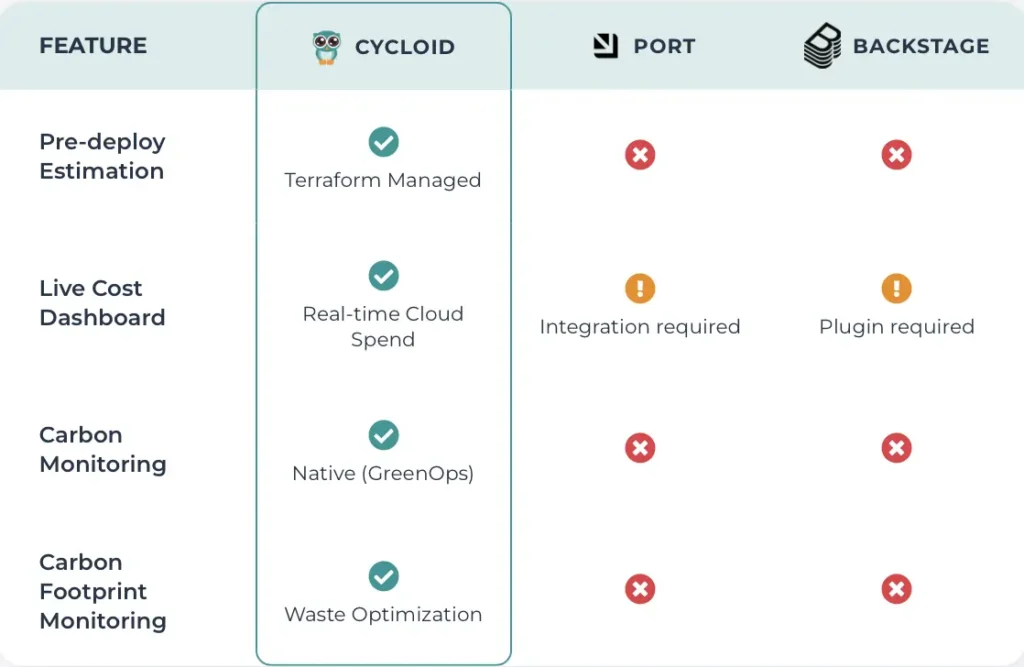
Takeaway: Cycloid integrates FinOps and GreenOps directly into infrastructure delivery. Cost estimation, budget thresholds, and optimization signals are evaluated as part of Git-backed workflows, which helps teams catch oversized resources or inefficient patterns before apply, not after billing closes.


Port enables FinOps workflows through actions and automation. Teams can expose cost checks, budget approvals, or optimization tasks as self-service actions backed by existing tools or agent-driven automation. This works well when organizations already run FinOps tooling and want developers to interact with it through structured workflows rather than dashboards.


Backstage surfaces cost and sustainability data through its ecosystem of plugins and integrations. Backed by a large open-source community, Backstage commonly aggregates cost dashboards, reports, and ownership context in one place, helping teams understand spend and accountability. Enforcement and optimization, however, continue to live in external systems.

FEATURE

CYCLOID

PORT

BACKSTAGE

Pre-deploy Estimation

Terraform Managed

Live Cost Dashboard

Real-time Cloud Spend

Integration required

Plugin required

Carbon Monitoring

Native (GreenOps)

Carbon Footprint Monitoring

Waste Optimization

Final Thoughts on the Comparison

Platform teams struggle to understand what is running across dozens of services and environments. Some spend their time responding to tickets for routine changes. In regulated or cost-sensitive environments, risk often appears during experiments, such as a proof of concept where an oversized Dataproc or Hadoop cluster is spun up and left running without visibility, ownership, or budget limits.

This comparison is meant to clarify what each platform takes responsibility for in these situations. It highlights where control is enforced, where workflows are coordinated, and where visibility stops. These boundaries help teams choose a platform that fits how they operate day to day, not just how the architecture looks on paper.

Conclusion – Choosing the Right Platform

Cycloid, Port, and Backstage solve platform engineering problems at different layers, and choosing between them comes down to where your platform is currently breaking.


Cycloid fits teams that are already paying the price for unmanaged infrastructure change. If proofs of concept routinely spin up oversized Dataproc or Hadoop clusters, Terraform plans run with too much freedom, or cost and compliance issues are discovered only after billing cycles close, Cycloid addresses that directly. It is built for platform teams that own the full infrastructure lifecycle and need delivery paths that are standardized, auditable, and enforced by default.


Port works best when the core problem is operational drag, not infrastructure correctness. If developers are blocked on Jira tickets for routine actions like environment provisioning, redeployments, or access requests, and the automation already exists, Port helps expose those workflows safely. It is a good fit when execution is trusted, but access to it is fragmented and slow.


Backstage is strongest when teams cannot answer basic questions about their systems. If no one knows who owns a service, where documentation lives, or which repositories are still active, Backstage brings order through discovery and metadata. It improves visibility and onboarding, but it does not solve delivery, enforcement, or cost control on its own.


The right choice depends on what problem your platform team is trying to solve today, and how much responsibility you want the platform itself to own as your organization grows.


If you’re looking for an all-in-one platform engineering tool that meets real-world infra needs-without compromising on automation, governance, or cost visibility – Cycloid is the clear winner.
Want to see how Cycloid can help you achieve your goals?

If the information above is inaccurate or outdated, please contact us at marketing@cycloid.io and we’ll set it right straight away!