The Future of Developer Efficiency with Internal Developer Platforms

TL;DR An IDP provides a centralized, self-service interface that automates complex tasks, including infrastructure provisioning, CI/CD pipelines, testing, and deployments. This allows developers to focus on writing code and delivering features without worrying about managing servers, configurations, or environment setups. IDPs support Development, Staging, and Production environments, enabling teams to test new features safely in … Read more

Top 11 Internal Developer Platforms (IDPs) in 2025

TL;DR Internal Developer Platforms (IDPs) have become the foundation of today’s engineering teams, not just automating deployments but bringing developers, infrastructure, and governance together to turn scattered delivery pipelines into secure and manageable systems. IDPs have moved far beyond their earlier form as tools that only standardized environments. They are now full platforms that coordinate … Read more

How to Evaluate and Choose the Right IDP

TL;DR Selecting and evaluating Internal Developer Platforms (IDP) is no longer about picking a tool with the longest feature list; it’s about finding the right fit for your team’s maturity, delivery speed, and governance needs. The best Internal Developer Platforms don’t just automate pipelines; they align with how your teams already build, ship, and secure … Read more

Why FinOps is Everyone’s Job: Embedding Cost Awareness into Developer Experience

TL;DR Cloud cost management has shifted from a finance-only function to a shared engineering responsibility. The 2025 FinOps Foundation report highlights that 82 percent of enterprises cite cloud waste as a critical blocker, making cost awareness as essential as observability and security in modern delivery workflows. Finance-owned dashboards fail developers because they deliver cost data … Read more

Le GreenOps : une approche indispensable

Compte tenu de la chaleur qui a étouffé l’Europe l’été dernier, il faut reconnaître que des mesures urgentes doivent être prises par tout le monde. Oui, tout le monde, pas seulement les gouvernements et les acteurs du secteur de l’énergie. L’univers des technologies informatiques ne déroge donc pas à la règle et a son propre rôle à jouer. Pour ceux d’entre nous qui travaillent dans ce secteur, ce rôle implique notamment l’adoption du GreenOps. Alors, en quoi consiste cette approche, et pourquoi le monde en a-t-il besoin?

AdobeStock_541719389

Read more

Cloud Cost Optimization: best practices for reducing your cloud bill

The tech industry is not having a great time at the moment. The 5 US tech giants – Microsoft, Google, Apple, Meta, and Amazon – have reported losses in 2022 for the first time in years, and announced massive job layoffs. Of course, they’re by no means going bankrupt, still having earned a combined $243 billion, but seeing as this figure is slightly lower than in 2021, this is sending executives (and the tech industry as a whole) into panic mode (as if it’s not at all a sign of people getting fed up with living in late-stage capitalism).

With major companies bringing back efficiency and profitability, more and more businesses are talking about squeezing budgets in light of the cost of living crisis and the slowing global economy. If you’re considering cutting excess weight in your spreadsheets, here’s a suggestion – why not take a look at your cloud spending?

If 2023 is supposed to be “the year of efficiency”, optimizing your cloud usage is one to start. Not only do cloud costs make up almost 41% of the IT budget according to Gartner –  meaning cutting it would make a real difference to your overall finances – in most cases, a lot of the cloud ends up being wasted. Our founder Benjamin Brial has written on the subject of cloud waste before, but the TL:DR is this: despite the cost of the cloud going down, companies’ spending on it has doubled in the last few years, with over $26 billion wasted on inefficient cloud usage. For a hyper-efficient IT world, it’s terribly below the mark. 

If any of this rings true, don’t despair – there are ways to cut your spending and optimize cloud usage.
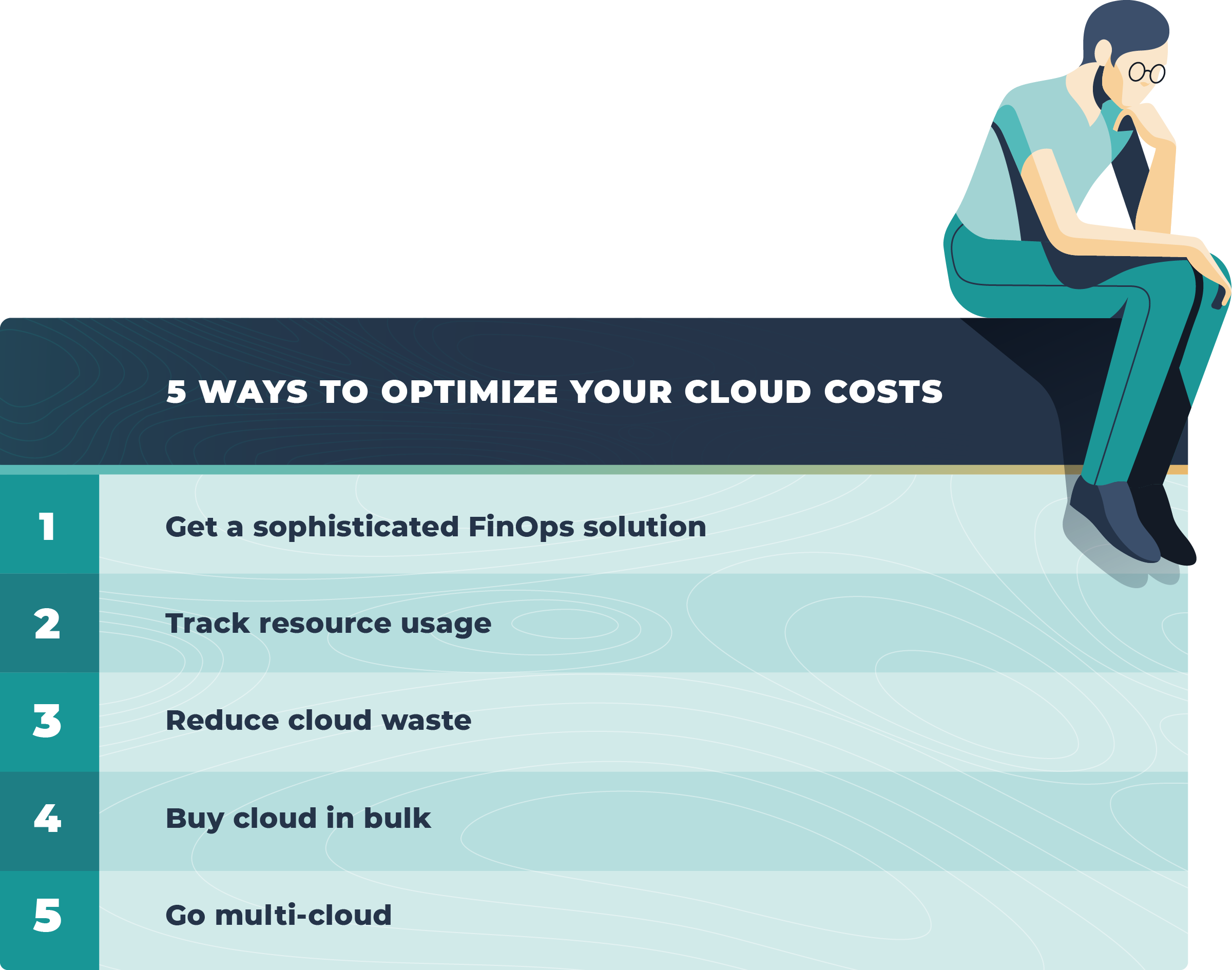
ways to optimize cloud costs

Get good FinOps software to track your costs

One of the reasons cloud spending keeps rising is the fact that cloud costs are shrouded in complexity and mystery, and traditional ways of monitoring them just don’t cut it anymore. Tracking with spreadsheets can get really complicated really fast while chasing data around multiple cloud cost management solutions across your cloud providers is already unnecessarily complex and can mask the real culprits.

What you must be looking for in a FinOps tool is the level of data granularity. You must be able to see the cost breakdown by project, region, provider, date range, or even team, to identify blindspots and money suckers, which would normally be overlooked.

Centralization and ease of access also play a part: the faster you can get a bird’s eye view of your cloud usage, the easier it is to correct course in case of errors. Marketing departments have ruined the word “holistic” for the world, but it’s exactly what you should be aiming for because getting the big picture, trends, and predictions for cloud resources can be the real missing piece to your financial strategy.

This is perhaps where we could plug our own FinOps module Cloud Cost Management, which does all of the above, but the consumer choice is really up to you – we can only advise on what to look out for. 

Resource management

Read more

Why the world needs GreenOps

With COP27 just around the corner, the world is once again set to come together to try to
find a solution to the climate emergency. Given the heat we saw this summer in Europe, it’s
fair to say that urgent action needs to be taken, not just by governments or those in the
energy industry, but by all of us. The IT world is no different and has its own role to play –
for those of us working in IT, that role comes partly in the form of adopting GreenOps. So
what is GreenOps, and why does the world need it?

AdobeStock_541719389

According to the University of Oxford, a single standard desktop computer operated over a
period of 6 years produces an annual carbon footprint of 778kg of CO2. Emissions from cloud computing are often overlooked, but they actually range from 2.5% to 3.7% of all global greenhouse gas emissions, thereby exceeding emissions from commercial flights (about 2.4%) and other existential activities that fuel our global economy.

Read more