







TL;DR
- Ticket queues treat every infrastructure request as a custom job with unbound variables. This lack of constraint turns manual debugging sessions into undocumented baselines that break downstream environments.
- Storing infrastructure templates separately from environment parameters prevents production defaults from bleeding into testing tiers. Collapsing these layers into one path guarantees oversized test instances and untraceable billing spikes.
- Binding self-service inputs to pre-approved dropdowns kills non-compliant requests before they reach the planning stage. Developers lose the freedom to spin up edge cases, but standard environments deploy without manual review.
- Evaluating policy-as-code during the plan phase blocks out-of-bounds resources before they exist. Relying on post-deployment alerts forces platform teams to fix divergence that a pre-execution guardrail could have stopped outright.
- Surfacing cost estimates inside the request flow forces engineers to justify their instance sizing immediately. This moves financial accountability from a delayed invoice review to the exact moment of decision.
- Executing code on shared SaaS runners hands internal network credentials to an external control plane. Moving the execution path to isolated on-premises workers keeps state files and keys entirely inside the corporate perimeter.
When Dev Environments Become an Infrastructure Problem
A developer joins your team on Monday. By Thursday, they’re still waiting on a Jira ticket to get a working environment. That’s not a staffing problem; it’s what happens when the provisioning and governance layers were never decoupled. Gartner projects that 60% of cloud workloads will be built and deployed using CDEs by 2026, yet most organizations still route every environment request through a DevOps engineer, even when the underlying Terraform modules have been written, tested, and version-controlled for months.
The failure isn’t a missing tool. It’s that Terraform ensures infrastructure is reproducible, but it doesn’t enforce who can request what configuration, at what cost threshold, or in which region. Governance sits outside the IaC execution path: in a review queue, a spreadsheet, or a mental model held by two senior engineers who happen to know the naming conventions. When those engineers are at capacity, the queue grows. When a junior engineer bypasses it, the resulting environment becomes an undocumented baseline that six teams quietly depend on within a month.
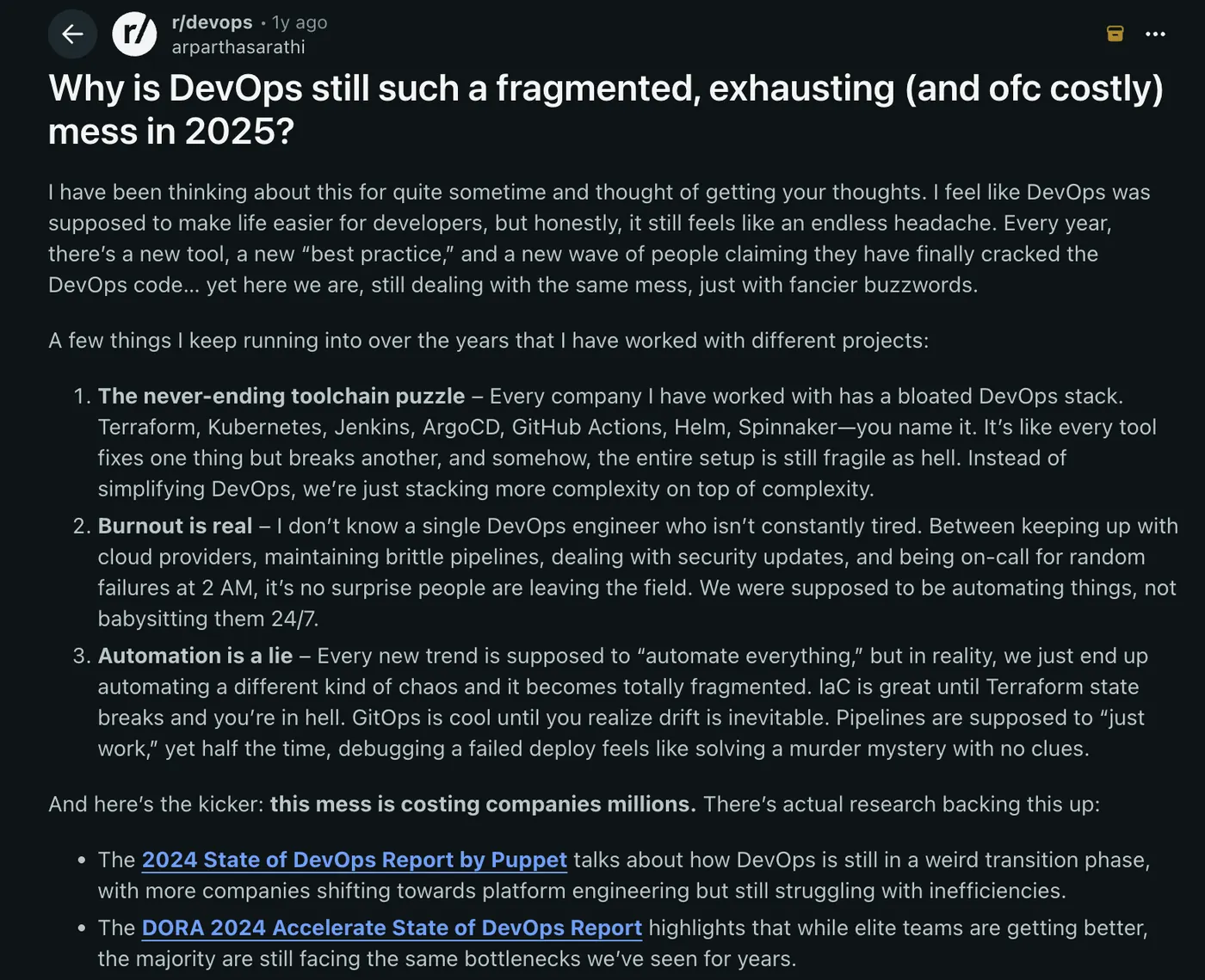
On r/devops, engineers describe this pattern as a “never-ending toolchain puzzle” in which automation exists, yet fragile pipelines and manual debugging still consume available capacity. The bottleneck isn’t technical; it’s structural.
This article covers how to fix the structure: specifically, how to provision cloud development environments through Git-backed stacks with environment-scoped configs, enforce pre-deployment constraints via InfraPolicies, expose self-service through StackForms, and make cost governance part of the request flow rather than the invoice review.
Why Environment Provisioning Breaks Before It Reaches Developers
Ticket-based provisioning doesn’t fail because engineers are slow. It fails because it converts every infrastructure request into a one-off execution with no audit trail, no bounded inputs, and no repeatable output. The first H3 below examines where that failure starts; the second covers how drift compounds it over time.
The Ticket Queue Is a Governance Gap, Not a Process Choice
When a developer requests a dev environment through Jira or Slack, the provisioning event is custom by default. The engineer who handles it picks the region, sizes the instance, sets the IAM scope, and applies tags, or doesn’t, based on whatever context they have at the moment. The same Terraform module produces a different environment every time it’s run this way, not because the module is wrong, but because the inputs are unconstrained.
Cycloid’s stack/config architecture separates the IaC template (stored in the stacks Git branch) from the environment-specific parameters (stored in the config branch). A staging environment and its production counterpart run the same Terraform module; only the instance sizing and config parameters differ. Without that separation enforced at the platform level, both sides collapse into the same repository path. The practical result: a senior engineer’s one-off terraform apply with custom flags becomes the undocumented baseline for six subsequent environments. No one tracks it. No pipeline enforces it. It becomes institutional knowledge with a single point of failure.
Manual review does catch edge cases, but at scale it introduces inconsistency proportional to the team’s size. A review process with five approvers produces five interpretations of the same tagging policy.
Configuration Drift Between Dev and Staging Environments
Drift doesn’t arrive as a single breaking change. It accumulates: a developer adds a security group rule manually during debugging. A DevOps engineer bumps an instance type at 2 AM during an incident and doesn’t update the IaC. A staging database receives a manual index that improves query performance, but it never makes it into the Terraform module. Each change is small and locally justified. Collectively, they produce a staging environment that no longer resembles the configuration the pipeline was built against.
By the time the discrepancy surfaces, it’s usually a failed production deployment that triggers a two-hour postmortem to trace the divergence back to its source.
The architecture of Cycloid’s drift detection matters here. Because the platform owns the execution path (not just state ingestion), it compares the live infrastructure against the declared Stack configuration for each environment and Stack. Platforms that ingest Terraform state from external pipelines only know about drift if the external tooling reported state correctly and if someone built an alert on top of that data. Ownership of execution is what makes drift detection proactive rather than reactive.
Onboarding Takes Days Because Environment Setup Is Not Self-Service
When self-service provisioning is absent, developers run terraform apply with personal credentials against a shared state file. Both risks are real: the shared state becomes a concurrency problem the first time two developers provision environments simultaneously, and personal credentials for accessing a shared-state backend are an IAM audit failure waiting to be written up.
Cycloid’s getting-started flow documents the provisioning sequence from stack selection through a live environment: the developer selects a stack, fills in the StackForms inputs, estimates cost, and deploys. Credentials, remote state configuration, and cloud provider setup stay inside the platform layer. The developer doesn’t see a Terraform backend config or an AWS access key.
Structuring Cloud Development Environments Around Git-Backed Stacks
Two conditions must be met simultaneously for developer self-service to work safely: developers must be able to provision environments without platform team involvement, and platform teams must retain full control over what those environments can look like. A Git-backed stack architecture is the mechanism that ensures both conditions hold simultaneously.
Stack and Config Branch Separation as an Operational Baseline
The stack/config split is not a Cycloid-specific convention. It’s a GitOps pattern that applies to any IaC-driven provisioning workflow: the template (what the infrastructure looks like) lives separately from the parameters (how large and where). Cycloid implements this by storing the stack in one Git branch and the config in another, with the .cycloid.yml file providing stack metadata (name, description, keywords) and the .forms.yml file defining the StackForms input schema.
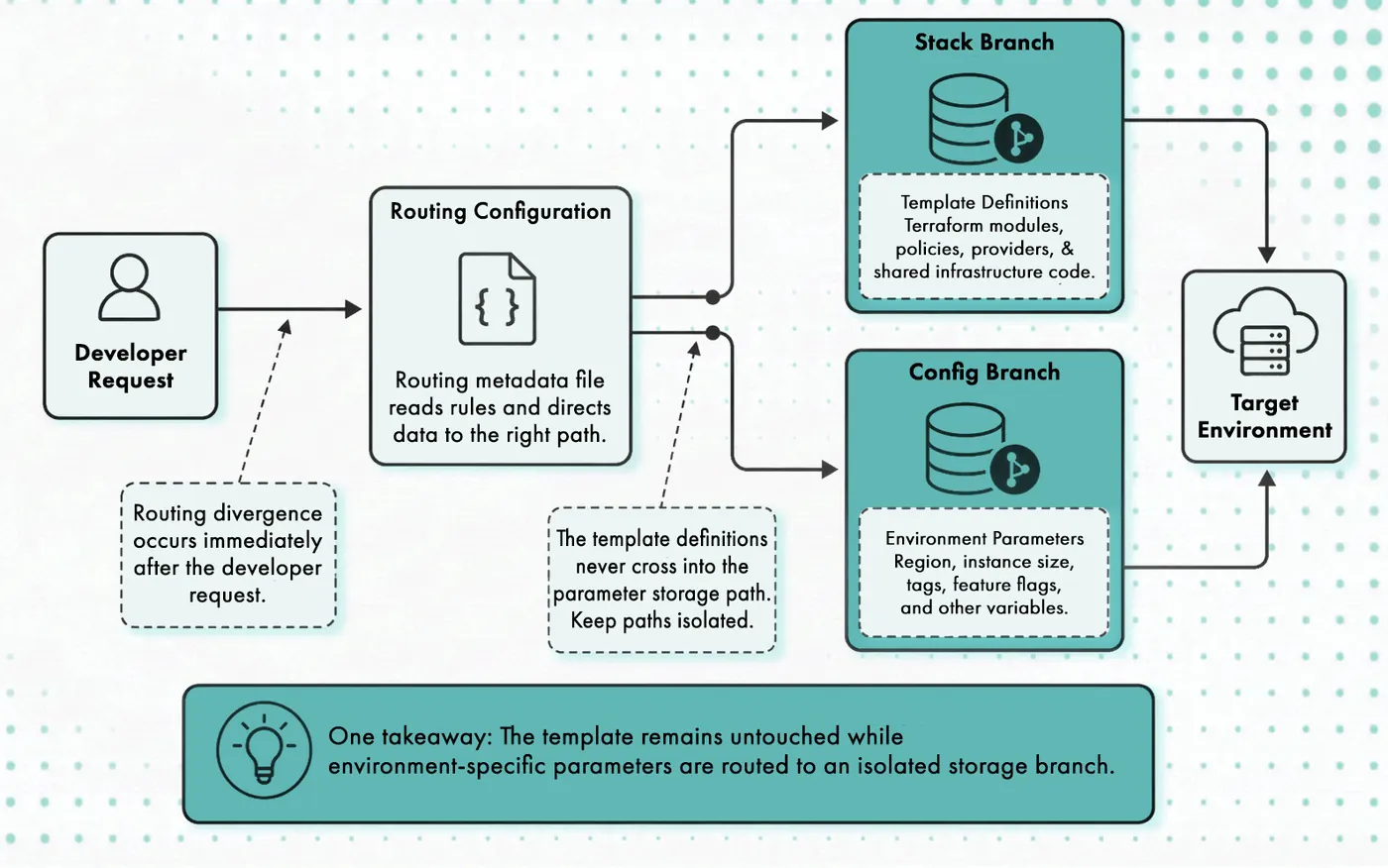
The failure mode when teams skip this separation is predictable. The Terraform module and its production-sized defaults get applied to dev environments. An m5.4xlarge, which is appropriate for production, becomes the instance class for a developer’s test environment because no one constrained the input. The dev environment costs four times what it should, and when the developer forgets to tear it down before a long weekend, the bill arrives without any team-level tag to trace it.
Here’s what that stack definition structure looks like in practice, from Cycloid’s stack definition reference:
# .cycloid.yml -- stack metadata file stored in the stacks branch
name: "LEMP Stack"
description: "Nginx, PHP, and MySQL on configurable compute"
keywords:
  - terraform
  - aws
  - lemp

config:
  default:
    terraform:
      instance:
        path: 'terraform/main.tf.sample'
        destination: '($ project $)/terraform/($ environment $)/main.tf'
The destination path uses Cycloid’s template variables ($project$) and ($environment$), which are resolved at provisioning time, so each environment gets its own config file at a predictable path in the config branch. Every subsequent provisioning request against the same stack writes to that path with whatever parameters the developer supplied through StackForms.
StackForms as the Bounded Input Layer for Developer Self-Service
StackForms aren’t a form builder layered on top of Terraform. They’re the constraint mechanism. A developer filling out a StackForm doesn’t see a Terraform variable file; they see a dropdown bound to the instance classes the platform team has approved, a region selector restricted to compliant zones, and a slider for disk size capped at the maximum allowed by policy. The platform validates those inputs before generating a plan. If a value falls outside the allowed set, it’s rejected before Terraform is invoked.
The StackForms widget library includes text fields, text areas, sliders, dropdowns, radio buttons, auto-complete fields, and multi-select with min/max validation. Platform engineers use this library to shape what’s exposed without modifying the underlying Terraform module. The developer interface changes; the IaC doesn’t.
The mechanics behind this: StackForms reads the .forms.yml file, collects the developer’s inputs, and writes a main.tf.sample-formatted output to the config branch at the path defined in .cycloid.yml. The developer never touches the sample file directly.
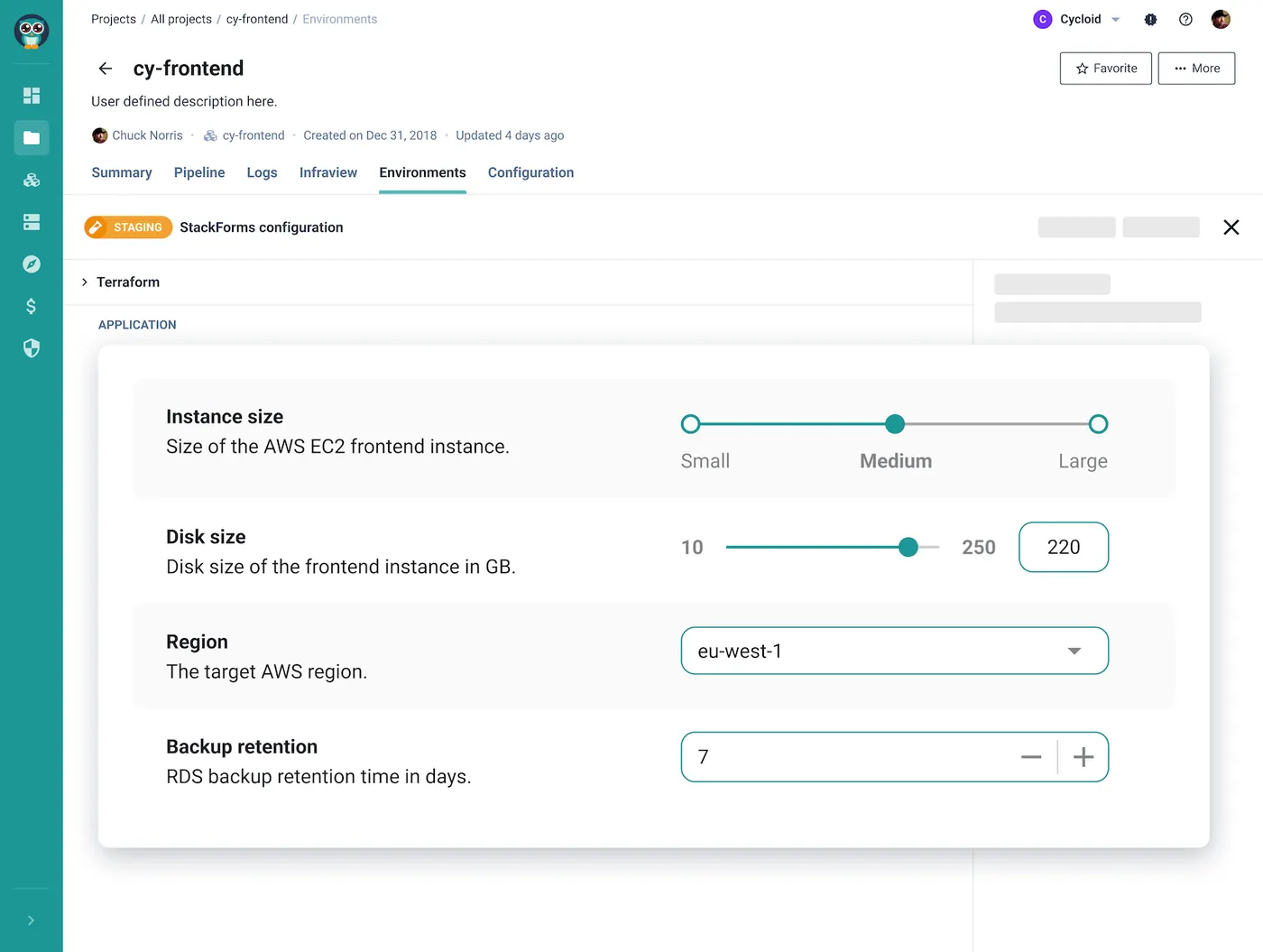
Notice the values array in each widget definition: a developer can only select from what the platform team pre-approved. There’s no free-text input that could produce an out-of-policy instance class or an unlisted region. The constraint isn’t advisory; the platform validates inputs before generating a Terraform plan.
When a developer submits the form, StackForms reads the .forms.yaml mapping, takes the submitted values, and writes a rendered output to the config branch at the destination path declared in .cycloid.yml. The developer never touches the sample file directly; the platform handles the translation from form input to IaC-ready configuration.
The tradeoff is real: highly constrained forms create friction for edge cases that fall outside the pre-approved set. A developer who needs a GPU instance for a one-off experiment can’t get it through StackForms if the platform team hasn’t built that option into the catalog. Those edge cases are exactly what a ticket queue should handle, while the 80% of standard provisioning requests move without any platform team involvement.
Catalog Repositories and Stack Versioning for Multi-Team Environments
Cycloid supports three visibility scopes for stacks: organization-private (available only within the current organization), shared, and public. For organizations with multiple business units, this means a security-hardened database stack can be restricted to the teams that need it while a generic web application stack is available org-wide.
Stack versioning is the mechanism that prevents a platform engineer’s update from silently breaking running environments. Cycloid’s stack versioning feature maintains a clean production-stable branch alongside development branches for testing changes. An environment deployed against stack version 1.2 continues to run against 1.2 until explicitly updated; it doesn’t inherit any breaking changes from the platform engineer working on 1.3.
The failure mode without version pinning is that a stack update modifies the Terraform module’s network configuration. Two environments were deployed before the update run against the old networking model; three were deployed after the run against the new one. The difference doesn’t surface until a service in the first group tries to reach a service in the second, and the failure appears to be a networking issue rather than a stack version mismatch.
Public community stacks reduce the time to build a catalog from scratch, but they require active auditing. An upstream Terraform module that changes its variable interface breaks every StackForms definition that depends on it.
Enforcing Governance Before a Terraform Plan Runs
Pre-deployment enforcement is architecturally different from post-deployment detection. Detection tells you what went wrong after a resource exists; enforcement prevents the misconfigured resource from existing. That distinction determines whether your governance model scales with team count or degrades as teams grow.
InfraPolicies as Pre-Deployment Guardrails
InfraPolicies are Cycloid’s Policy-as-Code layer, built on Terraform and evaluated before a plan executes. A Rego policy blocks production workloads in unapproved regions before Terraform generates a plan. Instance types outside the allowed range for a given environment tier get rejected at the same stage. A service marked as internal can’t expose a public endpoint because the policy engine rejects the configuration before it reaches the apply step.
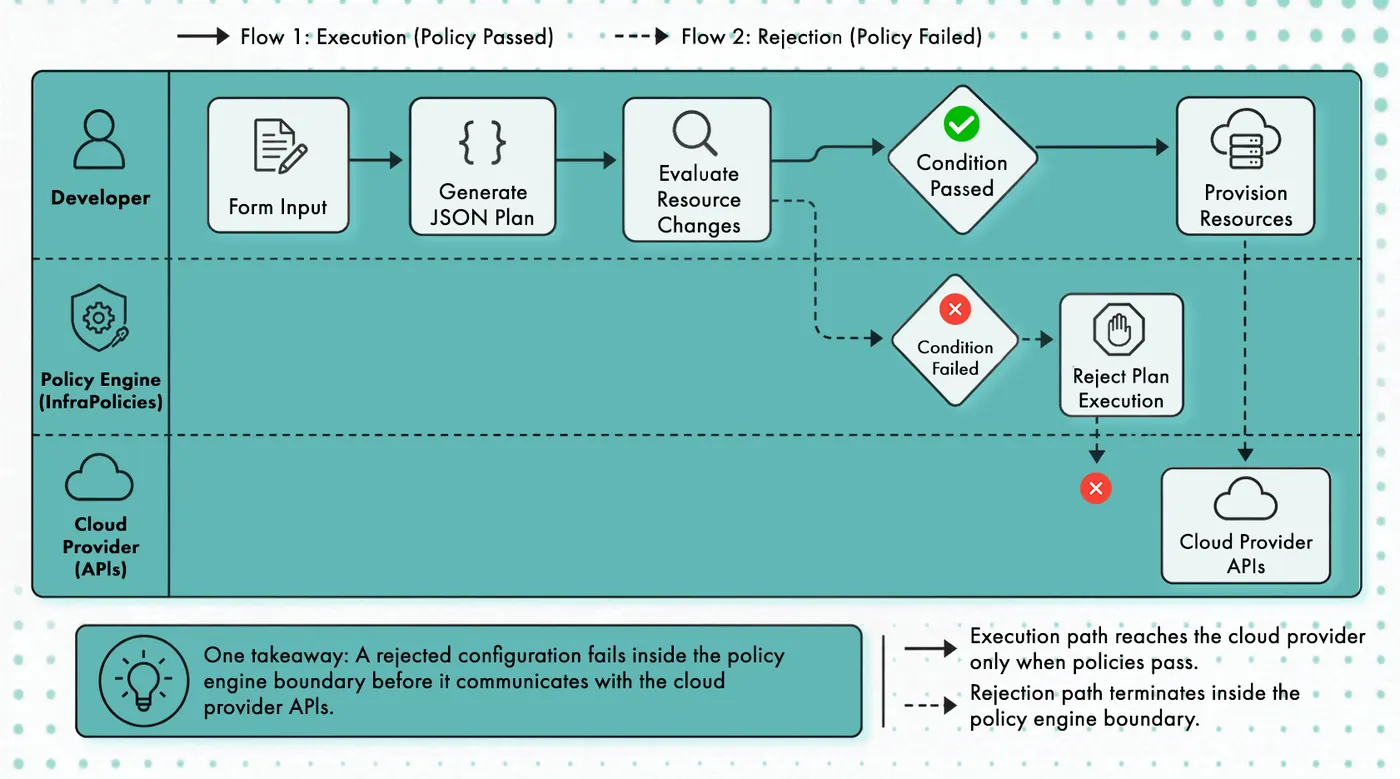
The operational consequence is that platform engineers no longer have to review the same classes of Terraform diff repeatedly. If the platform can’t produce an invalid configuration, the review work for that class of error disappears entirely. What remains in the review queue are genuinely novel requests, not routine checks for tagging compliance or regional placement.
Without pre-deployment enforcement, a platform team with four engineers reviewing infrastructure changes for thirty development teams spends most of its capacity on work that could be automated. The review queue grows in proportion to the team count; the engineering team doesn’t.
Cycloid’s InfraPolicies documentation describes the Terraform-based implementation of Policy-as-Code, along with validation rules that apply at the organization level. Here’s the Rego structure for a regional placement policy:
# InfraPolicy: enforce approved regions for production workloads
package cycloid.infrapolicies

deny[msg] {
  input.resource_changes[_].change.after.tags.environment == "production"
  region := input.resource_changes[_].change.after.region
  not allowed_production_regions[region]
  msg := sprintf("Production workloads blocked in region: %s", [region])
}

allowed_production_regions := {
  "eu-west-1",
  "eu-central-1"
}
The input.resource_changes object is a Terraform plan in JSON format. The policy evaluates it before terraform apply runs. Any request targeting an unapproved region is rejected with the message: no plan is generated, no ticket is opened, and no reviewer has to catch it manually.
RBAC and Approval Workflows Tied to Stack Execution
Cycloid’s RBAC model is hierarchical: organization, sub-organization, team. Approval requirements are configured per Stack and per environment tier, meaning a junior developer can request a provisioning event for a standard dev environment without sign-off, whereas a request for a production-sized database requires approval from a defined set of reviewers before the plan proceeds.
The approval mechanics are documented in Cycloid’s comparison material against Port: a plan does not proceed until required approvers act. The request enters a waiting state; approvers can act via the platform UI or the API; Slack notifications require a separate automation integration.
The tradeoff between blanket and selective approval requirements is concrete. Requiring approval on every dev environment request eliminates the value of self-service: the ticket is gone, but the wait for a human is the same. Requiring no approval on any request creates an audit gap that compliance teams will flag. The hierarchical model resolves this by applying stricter requirements at the production environment tier without adding friction to standard dev provisioning paths.
InfraView for Drift Detection Across Active Environments
InfraView generates a visual diagram of your infrastructure by reading the Terraform state file per environment, and it does this within the platform’s execution context rather than from an external state ingestion pipeline. Each cloud provider is handled differently within InfraView’s logic to display only relevant resources and their dependencies. The interactive schema lets engineers click individual resources to see IP addresses, VM sizes, and all Terraform-tracked properties, without opening the cloud console.
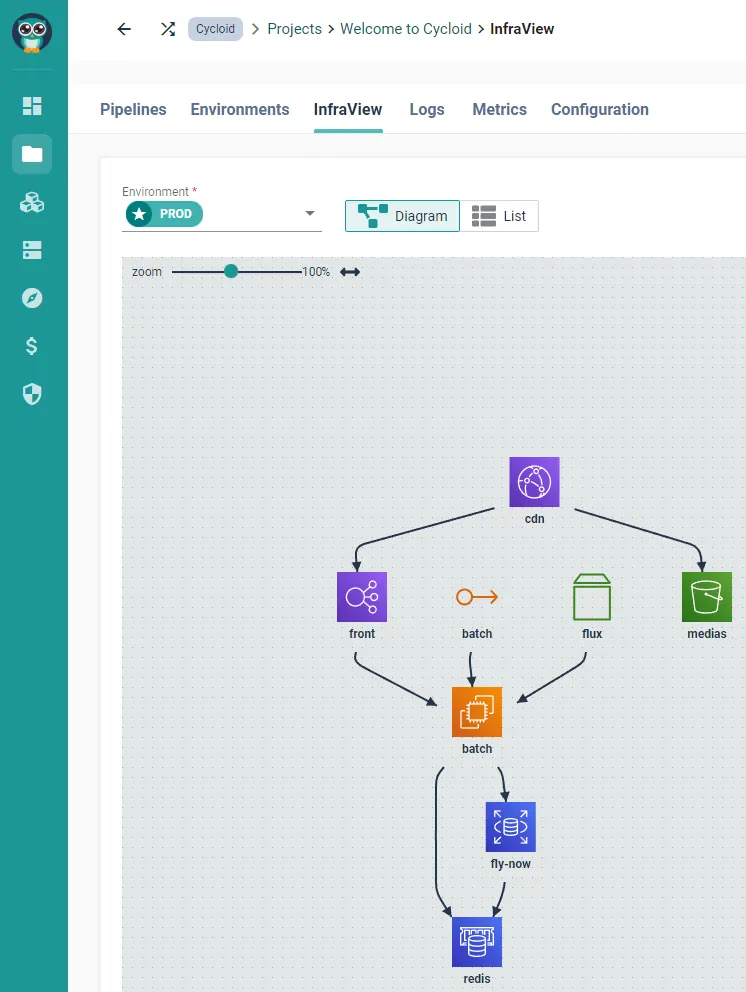
The environment selector in the top navigation is what matters operationally: switching between dev and staging shows immediately whether the two environments’ declared resource topology matches, or whether one has nodes the other doesn’t. A resource that appeared through an out-of-band change shows in the live diagram but has no corresponding declaration in the Stack. That’s the drift indicator, visible before it propagates downstream.
Cycloid’s open-source InfraMap project underlies InfraView’s diagram generation, reading directly from tfstate or HCL files and building a graphical representation without manual input. Non-technical team members can use the output to understand what’s running; platform engineers use it to validate that running state matches declared configuration.
Cost Governance Inside the Environment Request Flow
The cost governance problem in most organizations isn’t analytical; it’s temporal. By the time finance traces an oversized database to the team that provisioned it, the resource has been running for six weeks, and the engineer who requested it may not remember why. Moving cost visibility to the moment of the provisioning request changes the accountability model entirely.
TerraCost Estimation Before the Developer Hits Deploy
Cycloid’s TerraCost engine estimates infrastructure cost at the Terraform plan stage, before any resource is provisioned. Inside StackForms, after the developer fills in the required variables, clicking “Estimate cost” returns a planned cost versus prior cost per resource. The decision to choose an r5.2xlarge over an r5.xlarge happens when the cost difference is visible, not six weeks later on a cloud bill.
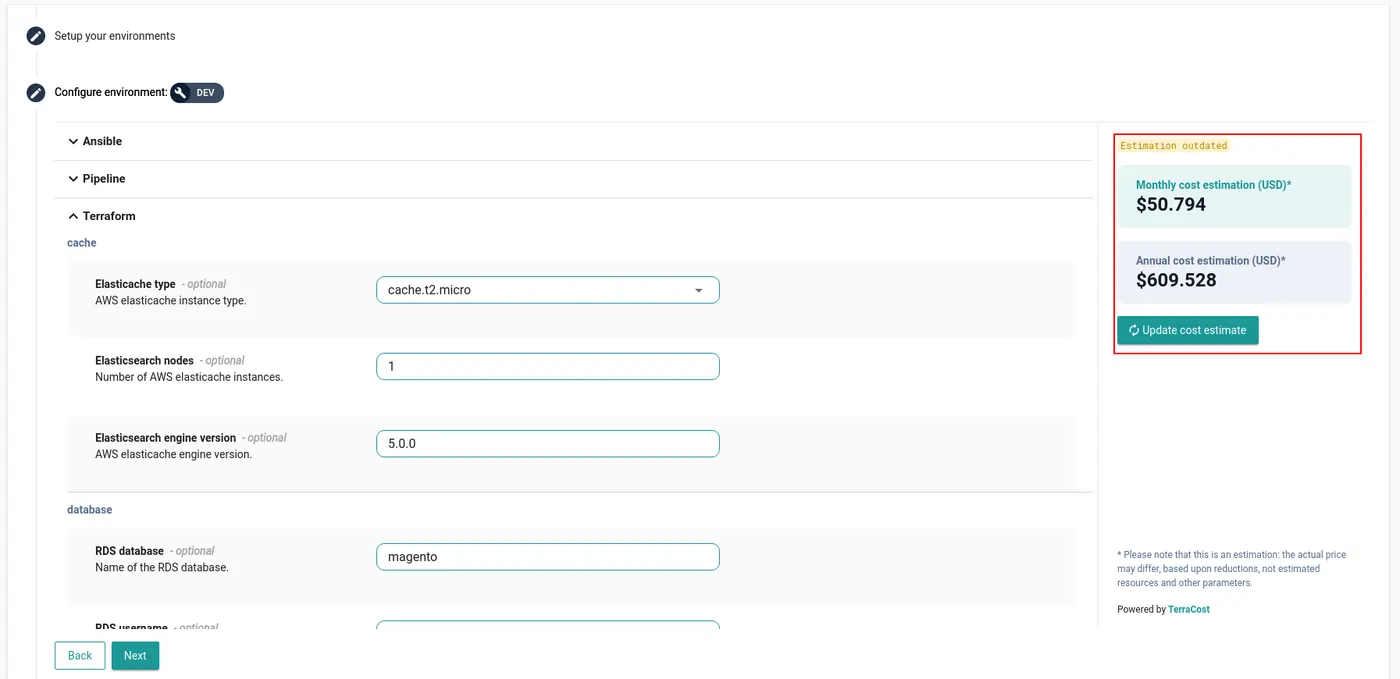
The “Estimate cost” button appears in the StackForms configuration view, on the same screen where the developer configures instance type and size. The cost impact of changing a form field is one click away at exactly the moment the developer is still deciding between options.
Cycloid’s CLI integration for TerraCost makes this usable in any CI pipeline, independent of the StackForms flow. The command sequence is documented there:
# Generate a Terraform plan and export it as JSON
terraform plan -out=./plan
terraform show -json ./plan > plan.json

# Run cost estimation against the exported plan
cy terracost estimate --plan-path plan.json
Output:
PLANNEDCOST   PRIORCOST   RESOURCEESTIMATES
71.71         53.24       3
PRIORCOST reflects the current state before the plan applies; PLANNEDCOST is the projected cost after. A plan adding an RDS read replica shows the delta before any engineer approves the apply.
For teams running Concourse as their CI tool, TerraCost integrates as a pipeline resource that sits between the terraform plan step and the notification step, so cost estimation runs automatically on every plan without any developer action.
Cloud Cost Management and GreenOps for Development Environments
Cycloid’s Cloud Cost Management module aggregates AWS, Azure, and GCP spend in a single dashboard, filterable by project, environment, region, tag, and provider. Development environments are the primary source of cloud waste in most organizations: idle instances that no one tore down, staging databases provisioned for a feature branch that shipped three months ago, and untagged compute that no team claims ownership of.
Flexera’s 2025 State of the Cloud Report puts average cloud waste at 27% of IaaS and PaaS spend. A significant share of that waste is in development tiers, where environments are created frequently and deleted inconsistently.
Cycloid’s GreenOps module adds carbon footprint data alongside cost metrics. Unlike most platform features, it cannot be disabled. Every cost view includes the associated emissions data, computed using a bottom-up methodology that accounts for cloud energy conversion, power usage effectiveness, and grid emissions metrics by region.
The tagging model is worth examining specifically. StackForms-provisioned environments automatically inherit tags from the Stack definition. Cost allocation by team, project, and environment doesn’t depend on individual engineers remembering to apply tags at the time of the request. The tags are present because the provisioning path enforces them, not because a tagging policy document exists somewhere in Confluence.
Multi-Cloud and Hybrid Environments Without Provider Lock-In
Provider-agnostic provisioning and hybrid deployment aren’t the same problem, but they fail in the same way when the platform layer doesn’t cleanly abstract them. The first forces teams to maintain parallel workflow implementations per cloud; the second exposes execution-layer credentials to SaaS runners that weren’t designed to hold them.
Provider-Agnostic Stack Definitions for AWS, Azure, and GCP
Cycloid’s StackForms layer is provider-agnostic: the self-service interface works against AWS, Azure, GCP, and private cloud because the abstraction sits above the Terraform provider, not inside it. A platform engineer writes Terraform modules per provider; StackForms surfaces the same developer-facing form regardless of which cloud backs the deployment. The developer selects an environment and fills out the form; which provider executes it is determined by the Stack configuration, not by the developer’s knowledge of provider-specific APIs.
The operational problem this solves for mixed-cloud organizations is concrete. A team that standardized on AWS is asked to deploy a workload to Azure for data residency compliance. Without a provider-agnostic provisioning layer, the platform team builds a parallel catalog for Azure, or the developer team builds their own workflow. Either path creates a second governance gap that diverges from the first over time.
The tradeoff is explicit: provider-agnostic abstraction works well for standard compute, networking, and managed database workloads. It requires deliberate Stack design for provider-specific features. An AWS spot fleet request, an Azure Dedicated Host allocation, or a GCP preemptible node pool configuration each requires a Stack written for that specific feature. The StackForms layer can surface it once built; it can’t substitute for the underlying IaC definition.
On-Premises and Hybrid Deployments with Cycloid Workers
Cycloid’s architecture separates the control plane from execution. The SaaS control plane manages orchestration; execution runs inside the organization’s infrastructure via Cycloid workers. For regulated industries with data residency requirements, this means the Terraform execution, credential handling, and state storage never leave the private network.
The gap this fills in most IDP evaluations: teams compare portal features and integration counts without examining where the IaC runs. A Terraform apply executing on a shared SaaS runner accesses production credentials. If that runner is multi-tenant and a misconfiguration exposes the execution context, the blast radius extends beyond the organization’s network boundary.
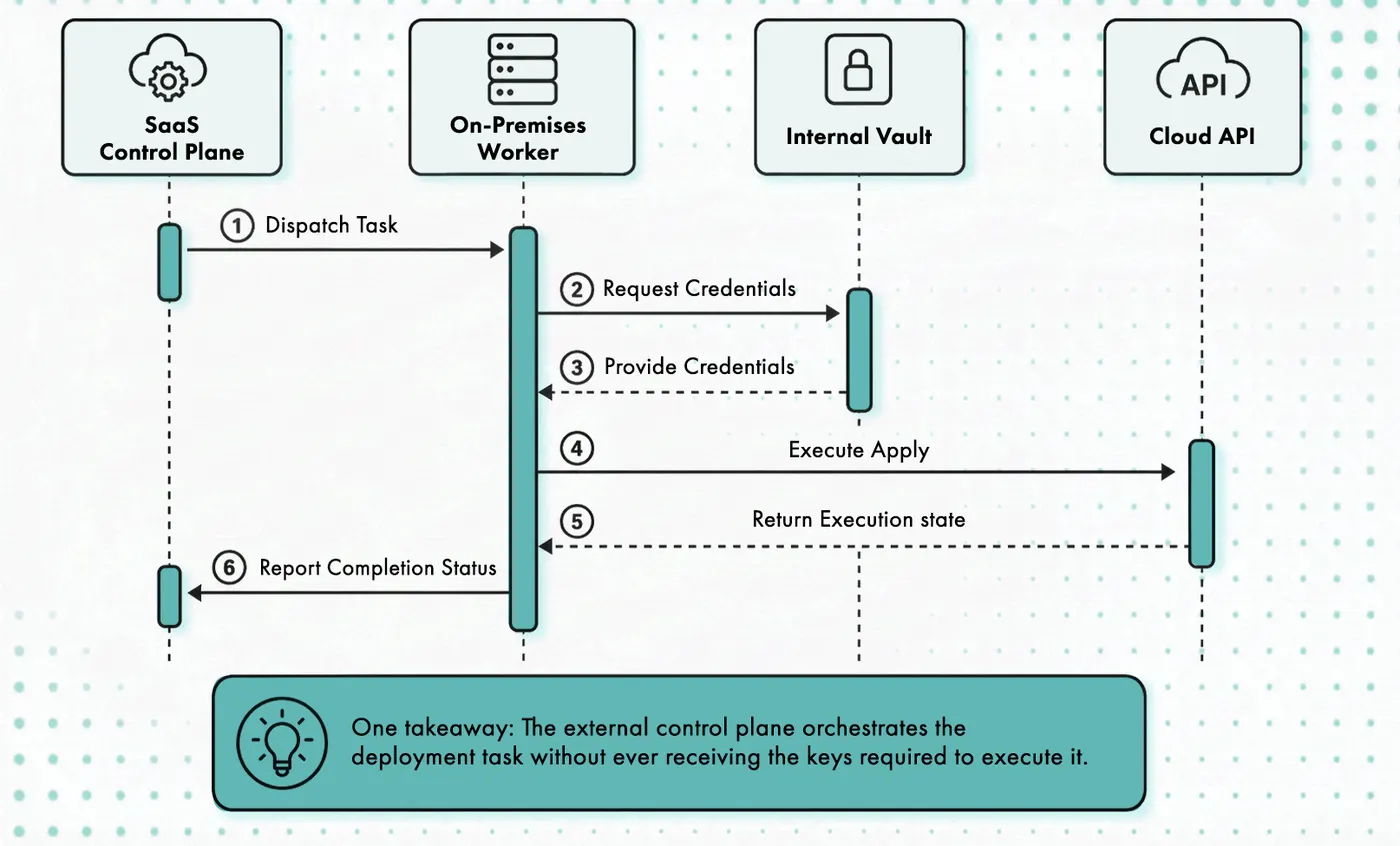
Cycloid’s deployment model documentation describes the architecture as SaaS with optional on-premises workers: the control plane is managed, and execution occurs on the customer’s infrastructure. Cloud provider credentials, Terraform state files, and IAM access never pass through the shared control plane. The isolation model holds even when using a managed orchestration layer.
For organizations operating in financial services, healthcare, or EU-regulated environments, this architectural separation is often a procurement requirement. The self-service and governance features operate identically in both deployment modes; only the execution boundary changes.
Governing Cloud Environments Before They Govern You
The articles covered four distinct failure modes in the CDE provisioning lifecycle: ticket queues that convert every request into an unaudited one-off execution; environment drift that accumulates from out-of-band changes with no pipeline tracks; cost governance that arrives weeks after the spending decision; and provider-specific workflows that fragment the catalog when multi-cloud becomes a requirement. Each of these fails for the same underlying reason: the governance layer sits outside the provisioning execution path rather than inside it.
The framework described here, Git-backed stack/config separation, StackForms-bounded inputs, InfraPolicies pre-deployment enforcement, and TerraCost cost estimation at the plan stage, puts governance inside the path. Developers provision environments without tickets. Platform teams stop reviewing the same Terraform diffs for tagging and regional compliance. Cost accountability shifts from the invoice review to the provisioning request.
If your platform team is still catching instance-type violations in manual plan reviews, the governance layer is in the queue, not in the platform. That’s the thing to fix first.
FAQs
1. What is a cloud development environment?
A cloud development environment (CDE) is a remotely hosted workspace where developers write, test, and run code without configuring a local machine. The environment is pre-provisioned with the required runtimes, dependencies, and tooling.
2. How do cloud development environments differ from local development setups?
Local setups require each developer to install and maintain their own dependencies, SDKs, and configurations. Environment inconsistencies between developers and between development and production are the default outcome.
3. How do you prevent environment drift in cloud-hosted developer environments?
Drift prevention requires the platform to own the IaC execution path, not just ingest state data. When a platform executes every provisioning event, it maintains the authoritative declared state and can continuously compare the live infrastructure against it.
4. Can cloud development environments work in regulated or air-gapped infrastructure?
Yes, with the right execution architecture. The key requirement is separating the control plane from the IaC execution layer. If Terraform runs on a shared SaaS runner, credentials and state are exposed outside the organization’s network boundary.
Check our Comparisons: Cycloid vs Backstage / Cycloid vs Port / Cycloid vs Humanitec