







Self-service infrastructure
Everything developers need. Without the wait.
Blueprints turn every approved architecture into versioned infrastructure as code your developers self-serve in minutes, day-2 operations included. Your platform team sets the rules once and gets the platform it needs without starting from scratch.
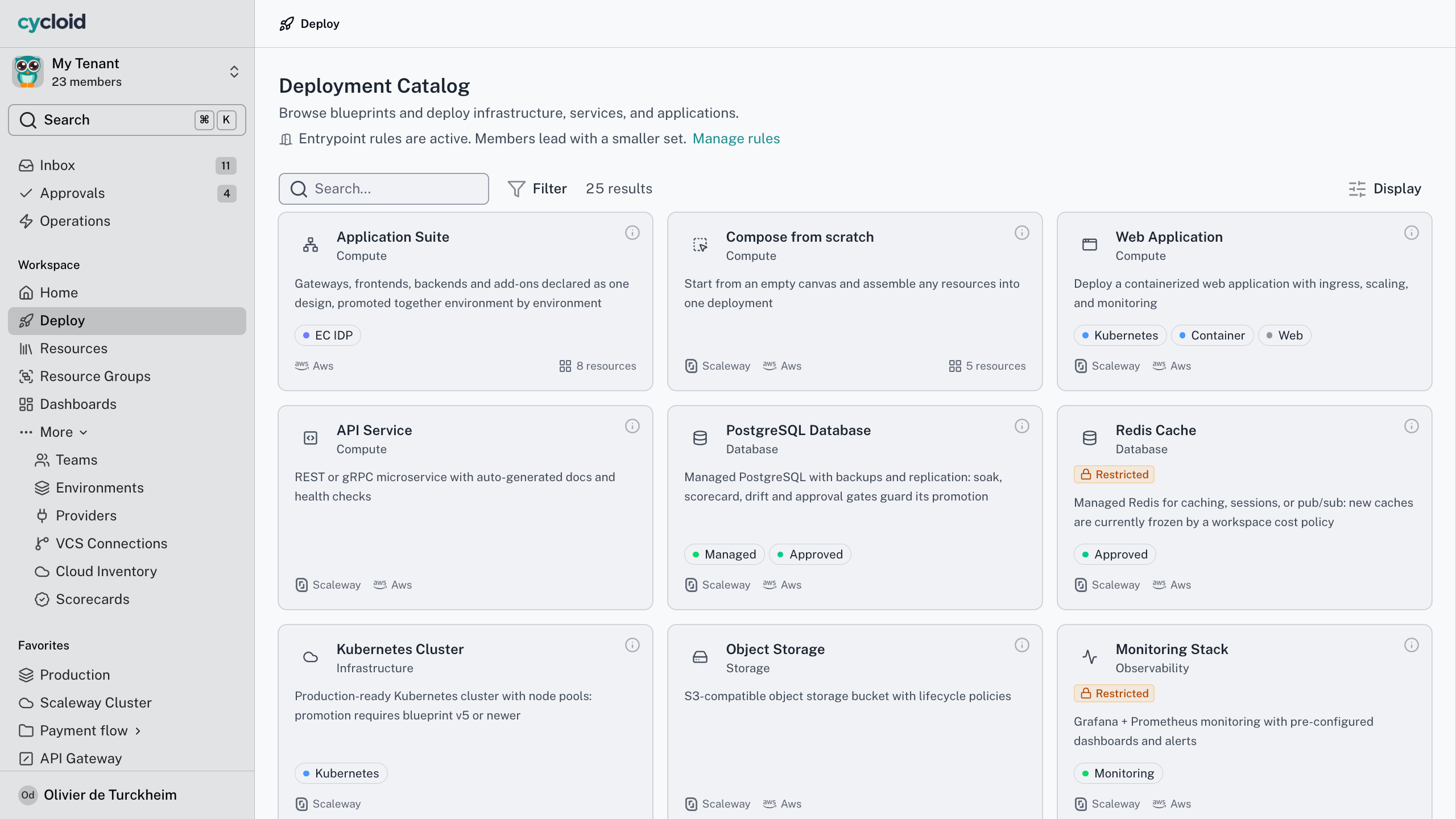
Blueprint catalog + Form
The real cost
The ticket queue is a workflow problem, not a staffing problem
Demand outpaces capacity, planned work loses to emergency work, the team tightens the process again, and the queue is still growing six months later, however it is staffed. The cost lands in three places at once.
Developers wait instead of building
Atlassian’s 2025 survey of 3,500 developers: half lose 10+ hours a week to organisational friction, and developers spend just 16% of their time writing code.
The platform team becomes the bottleneck
When every environment and every Day-2 change routes through one small team, that team stops building the platform and starts servicing the queue.
Governance arrives too late
Policy enforced by review is policy enforced after the resource exists – the wrong region found in an audit two weeks later, when the fix is a migration.
One platform, three views
What self-service looks like for your team
Stop being the approval step
The problem
Every environment routes through your team. The queue keeps growing.
With Cycloid
Define a Blueprint once, and developers self-serve inside your rules.
The outcome
You own the platform, not the queue.
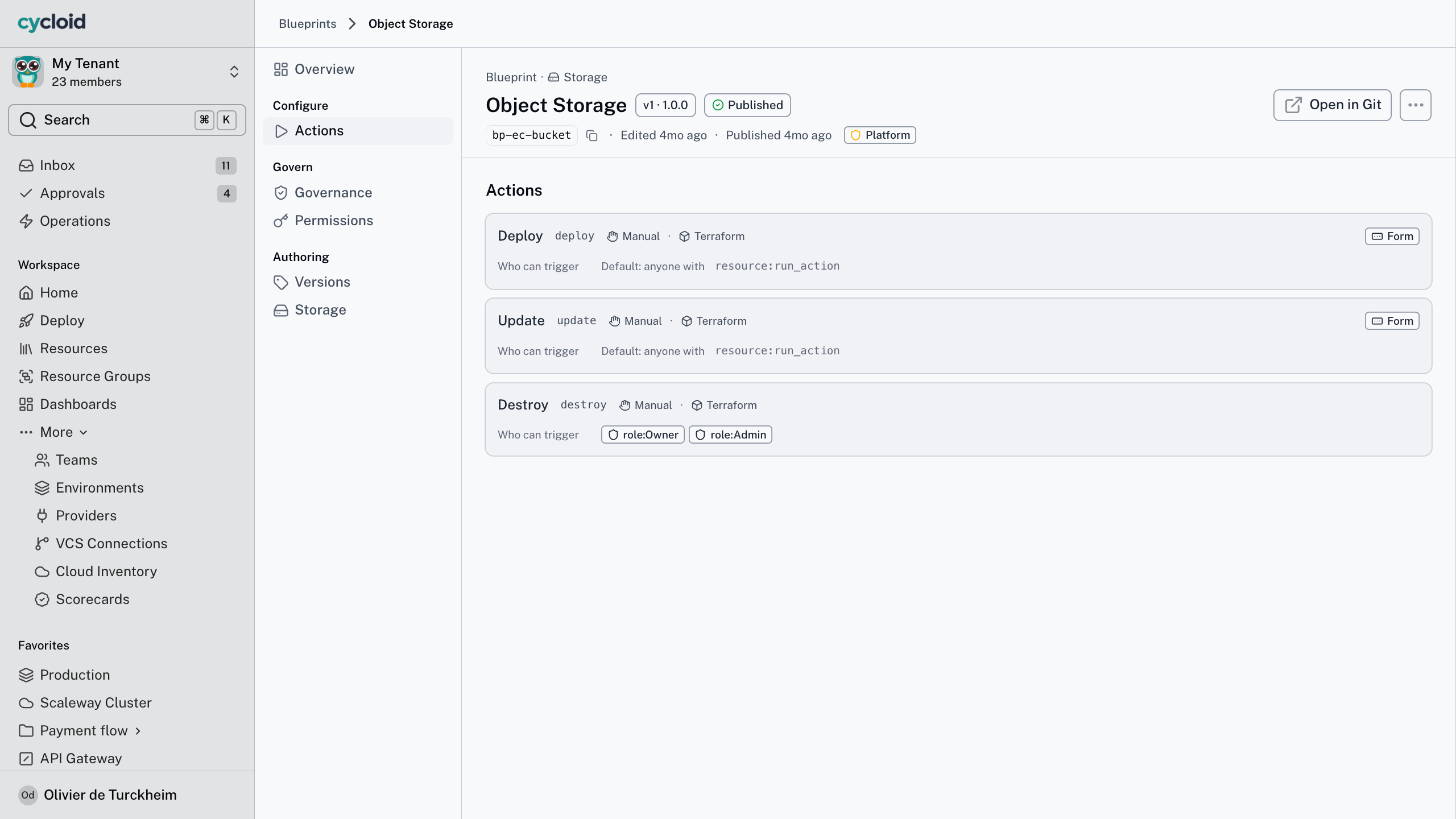
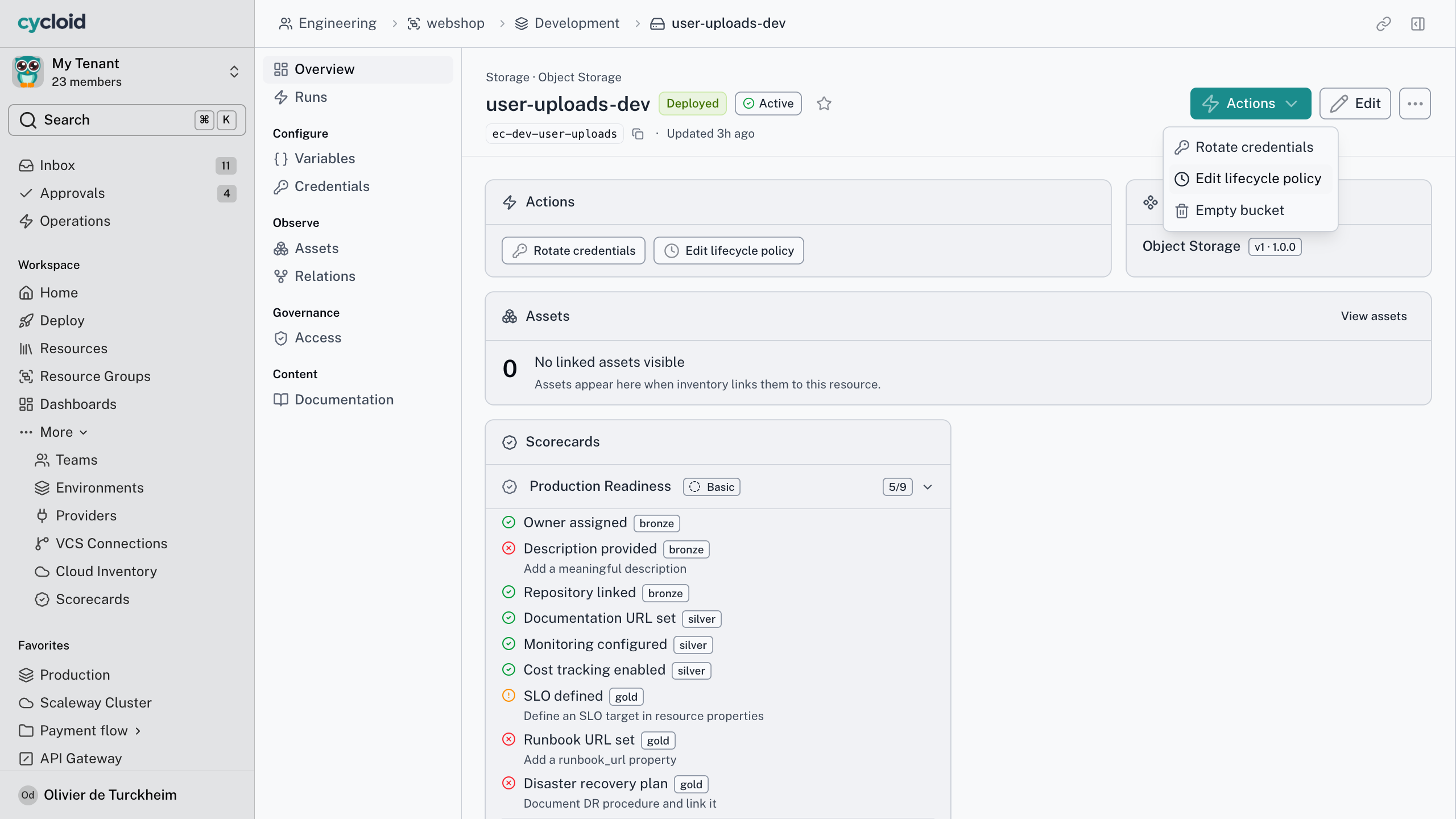
Deploy, query and fix. No ticket.
The problem
Days of waiting for an environment, then again for every change.
With Cycloid
Pick a Blueprint, fill a form, deploy. Day-2 actions are buttons.
The outcome
Minutes to an environment. Zero tickets. Terraform optional.
Speed your auditors accept
The problem
Delivery speed and governance pull against each other.
With Cycloid
Same authorisation chain and audit trail, Day-1 and Day-2.
The outcome
Faster delivery, provable control. Self-hosted or sovereign.
How it works
How a Blueprint replaces the request
01 · Browse the catalog
Landing zones, infrastructure, applications. Each Blueprint encodes the architecture decision, so what a developer is offered is what’s permitted.
02 · Fill the Form
Forms shows only the fields that apply to this stack. Nobody hands the developer someone else’s Terraform.
03 · It gets checked first
The Form validates, then the request passes the four-layer authorisation chain. A wrong region is rejected here, not found in an audit.
04 · The environment exists
On the Native Runner or the CI you already use. Nobody sent a ticket.
05 · Day 2 is self-service too
Rotate credentials, extend a TTL, run a plan. Actions run from the resource page, with the same audit trail as day one.
A catalog lists what exists. A Blueprint deploys it, checks it at submission and carries its day-2 actions, so self-service doesn’t stop the moment the environment is running. It’s the self-service platform engineering tools promise, without the year of assembly.
How a Blueprint replaces the request
The short version
What changes when the queue goes
<1h
for a new environment at Alchemy, down from over a day
~5h
a week back at Hotel Spider
4
authorisation layers, day one and day two
2
places the Form checks your input
I need a Postgres database for checkout, in staging.

That matches the PostgreSQL Blueprint. I’ve filled what I could infer. Check it and confirm.
Form · PostgreSQL, staging
Rendered as you
Blueprint
PostgreSQL
Filled in
Team, environment, region
Needs you
Instance size
Nothing runs until you do
Working with your assistant
Ask an assistant, get the same governed Form
Does the assistant get its own permissions?
No. There’s no service account and no elevated assistant role. If you can’t deploy to production, neither can the assistant you’re talking to, in Cycloid’s own assistant or any compliant MCP host.
Some developers would rather not open a portal at all. Cycloid’s built-in AI assistant, and the MCP host your team already works in, reach the same catalog under the same rules.
Ask for a Postgres database in plain language. The assistant finds the matching Blueprint, renders its Form inline, fills the defaults it can infer and waits for you to confirm. It isn’t a route around the platform. It’s another client of it, acting as you, and the audit log records the assistant session and the person it acted for.
Tenant admins can give the assistant less than its user has, read-only or never destroy, while people keep full rights in the portal. Day-2 works the same way. “Scale my staging cluster” is the same governed Action as the button, and anything consequential shows a preview before it runs.
“
The goal was for everyone internally or externally to be able to deploy a new project in a few clicks respecting best practices, scalability, and automation.
Guillaume Maubert
CEO, Alchemy
Frequently asked questions
No. Forms shows a Blueprint as a web form, and the Terraform, Ansible or Helm stays inside it, maintained by the platform team. Developers fill in fields. Anyone who wants the code keeps full access.
A portal gives developers a place to find things. Self-service lets them deploy and operate those things, governed, without a hand-off. Cycloid does both, and the portal page covers the other half.
The Form validates every submission, then the four-layer authorisation chain checks it before anything exists. It’s fail-closed, so an unresolved check is a denial, and AI assistants go through the same chain as people.
Discovery gives you a read-only inventory of what already runs in your cloud, so an existing estate is visible alongside what you deploy. Bringing it under a Blueprint is on the near-term roadmap.
Bring your worst provisioning flow
The most tickets, or the longest wait. In twenty minutes we’ll show you where the Blueprint Form replaces it, and whether your pattern actually fits.