







TL;DR
- Choosing between platforms starts by identifying whether the engineering bottleneck is execution or visibility. A portal that catalogs services but hands every request to a ticket queue preserves the same operational friction under a different interface, so developer adoption plateaus despite successful deployment.
- Measuring success through portal logins alone hides whether developers actually changed behavior. Comparing ticket volume, provisioning time, and golden-path usage reveals whether the platform replaced manual coordination or simply exists alongside existing workflows.
- Encoding security policy, cost controls, and deployment targets inside reusable templates removes infrastructure decisions from every individual deployment. That tradeoff shifts responsibility from developers to the platform team, producing consistent environments without requiring engineers to interpret governance rules repeatedly.
- Bypassing standardized workflows becomes expensive only when the organization cannot recover unmanaged infrastructure afterward. Platforms that continuously discover existing resources and convert them back into infrastructure-as-code restore governance without forcing teams through disruptive rebuilds.
- Selecting a platform by feature count leads to predictable architectural mismatches. Backstage favors organizations prepared to own a portal as an engineering product; Port optimizes catalog-driven self-service; Humanitec prioritizes workload portability; Qovery accelerates Kubernetes environments; while Cycloid targets organizations that need governance and execution within the same platform.
- Treating governance as an afterthought breaks the very workflows developers were expected to adopt. Platforms that integrate policy enforcement directly into provisioning avoid the later retrofitting that commonly fragments golden paths and pushes engineers back toward manual infrastructure management.
What Is a Developer Experience Platform?
A developer experience platform (DXP) is the layer between developers and the infrastructure they depend on. Rather than requiring engineers to navigate cloud consoles, file tickets, or maintain their own deployment scripts, a DXP gives them a self-service interface backed by automation that runs the actual provisioning, pipeline execution, and policy enforcement on their behalf.
The term covers two architecturally distinct components that are often sold as one thing. The internal developer platform is the backend engine: the automation, IaC execution, CI/CD orchestration, and policy enforcement that runs when a developer makes a request. The internal developer portal is the interface developers interact with: the catalog, the forms, the dashboards. A portal without a platform underneath is a UI that collects inputs and routes them to a human. A platform without a portal forces developers to the CLI or leaves them without visibility into what the platform is doing.
Mature engineering organizations like Spotify and Netflix built both layers in-house starting around 2012, when the category’s foundational concepts (golden paths, paved roads, platform-as-product) were established. The commercial tooling market didn’t catch up until the early 2020s, and the platform-vs-portal distinction still isn’t consistently drawn in how vendors market their products, which is the first thing an evaluating team needs to resolve before shortlisting anything.
The IDP Terminology Problem and Why It Keeps Teams Stuck
Forty-five percent of large engineering organizations had dedicated platform teams in 2022. Gartner projects that number hits 80% by the end of 2026, a near-doubling in four years. The category is no longer niche, but the failure rate inside it remains stubbornly high, and the reason is almost always the same: teams buy or build a portal and call it a platform.
Developer experience platforms sit at the intersection of platform engineering, DevOps tooling, and organizational design. The discipline was formalized in academic literature around 2012, but the tooling category only matured once teams at Spotify and Netflix proved that paving standardized paths through complex infrastructure could cut deployment friction without stripping away developer autonomy. What’s now marketed as a developer experience platform spans two distinct layers: the internal developer platform (the backend engine automating infrastructure and deployment pipelines) and the internal developer portal (the self-service interface developers use day-to-day). Mature orgs ship both. Most vendors, and most early-stage buying decisions, conflate them.
The breakdown happens at adoption. A platform team deploys tooling and watches utilization stall at 30%. The structural reason: the solution addresses the portal layer (a service catalog, some documentation, a dashboard) without wiring up the platform layer underneath. Developers hit a form that triggers a ticket instead of a pipeline. The cognitive load doesn’t drop; it shifts. As practitioners who’ve built IDPs for Salesforce and others note in post-mortems published on InfoQ, forcing developers to accept a platform that doesn’t work for them doesn’t produce adoption. It produces malicious compliance. A second failure mode hits enterprises specifically: governance requirements (RBAC, audit trails, policy-as-code, SSO) get bolted on after initial rollout, breaking golden paths that were already fragile.
The five platforms below are assessed on the specific problem each solves well, where each hits its ceiling, and the deployment context where it makes sense.
The Portal vs. Platform Split That Breaks Most Evaluations
Why “Just Deploy Backstage” Keeps Failing Mid-Rollout
Backstage is a framework for building a developer portal, not a finished developer portal. It ships a service catalog, a TechDocs documentation system, and a plugin architecture covering CI/CD, Kubernetes status, and cloud cost visibility across 200+ community-contributed extensions. What it doesn’t ship: authentication, infrastructure execution, cloud provisioning, or any orchestration layer connecting the portal UI to actual automation. Those require custom plugin development or third-party wiring on top of the framework. The reported setup-to-meaningful-absorption timeline is six to eighteen months, with ongoing maintenance consuming 30-40% of platform team capacity thereafter. One documented fintech deployment with 150 engineers and two dedicated platform engineers reached 12% internal adoption after eight months while the platform team spent 60% of its time on Backstage maintenance rather than building golden paths.
The average Backstage adoption rate across organizations outside Spotify is reported by The New Stack as stuck at approximately 10%. That figure isn’t a product indictment. It’s a signal that most teams deploy Backstage expecting a platform and receive a portal skeleton. The connector-maintenance overhead that kills adoption six months in isn’t a bug in the implementation; it’s structural to the architecture.
Where the Ticket Queue Resurfaces After Portal Launch
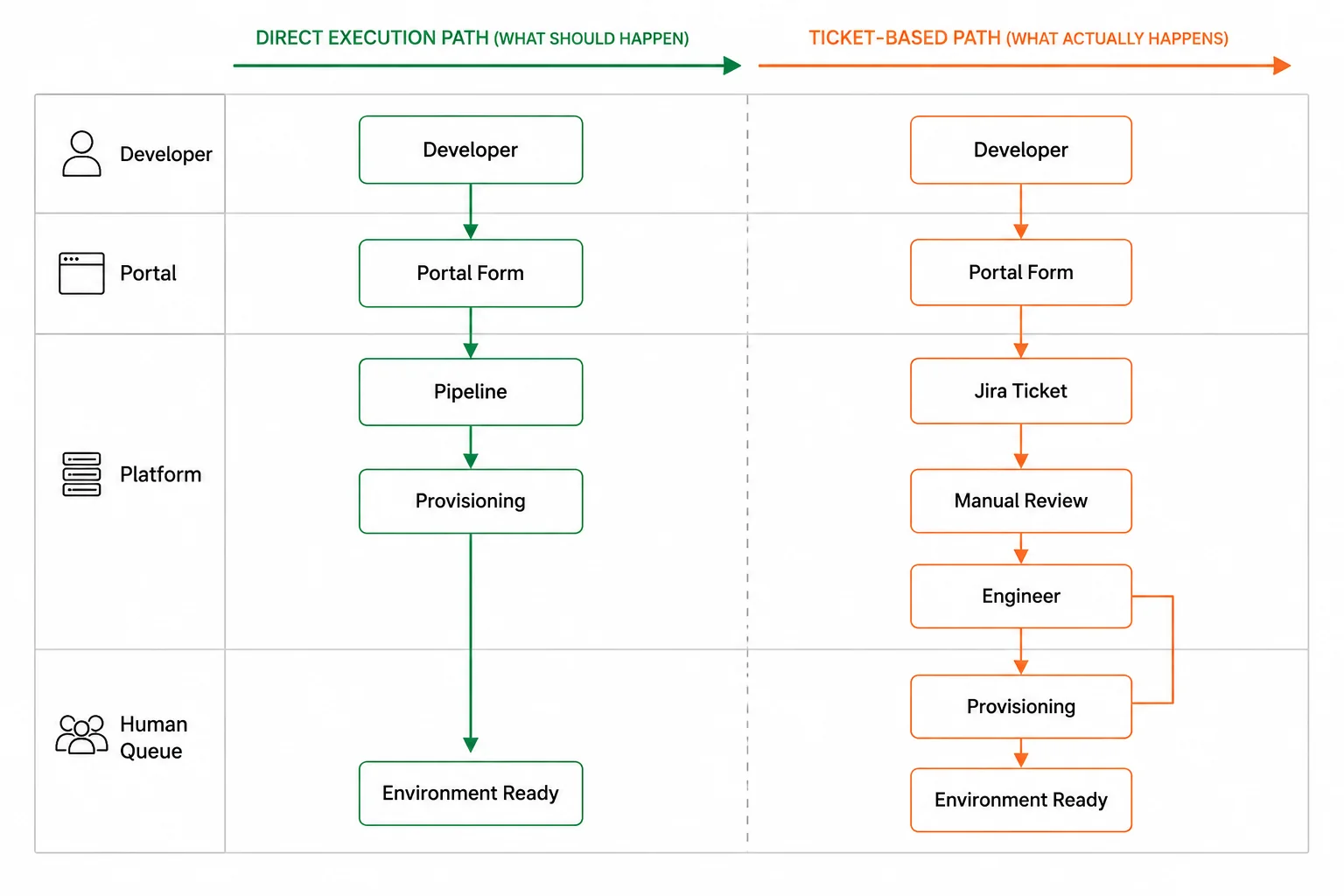
A developer experience platform that routes self-service requests back through a ticketing system has failed at its core job. The workflow break is specific: a developer uses the portal UI, fills in an input form, and the form submission creates a Jira ticket rather than triggering a CI/CD pipeline. Two conditions produce this. First, the orchestration layer is missing: the portal has no wired connection to automation. Second, forms aren’t connected to execution at all. They collect inputs and hand them to a human.
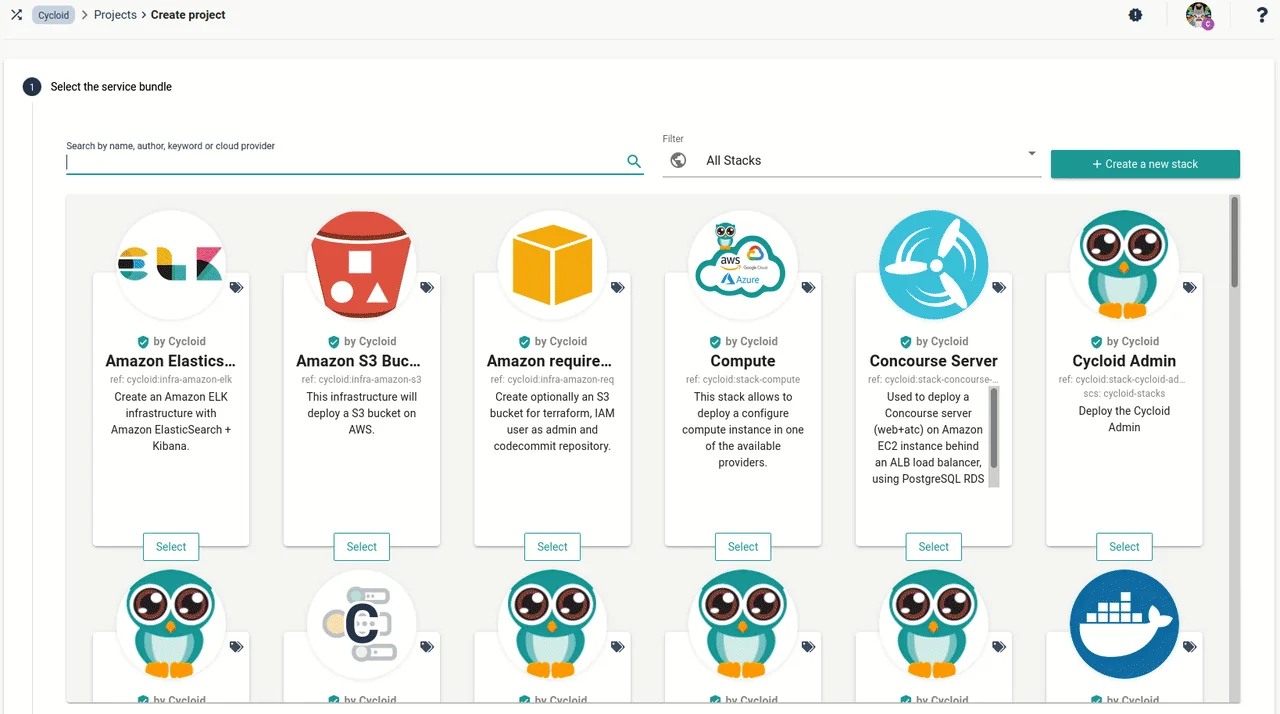
Cycloid’s StackForms address this directly, i.e., they’re configurable forms designed by platform teams that connect inputs to pipeline execution, not to a queue. A developer fills in the form; the platform runs the job. The distinction sounds obvious, but it’s where most portal implementations stop short.
Measuring Adoption Before Calling a Platform Successful
Three metrics distinguish a functioning developer experience platform from a deployed one: portal login rate versus ticket volume over the same period, mean time from developer request to provisioned environment, and golden path usage versus off-path manual work. A platform where ticket volume stays flat after launch hasn’t absorbed developer workflows. It’s running alongside them.
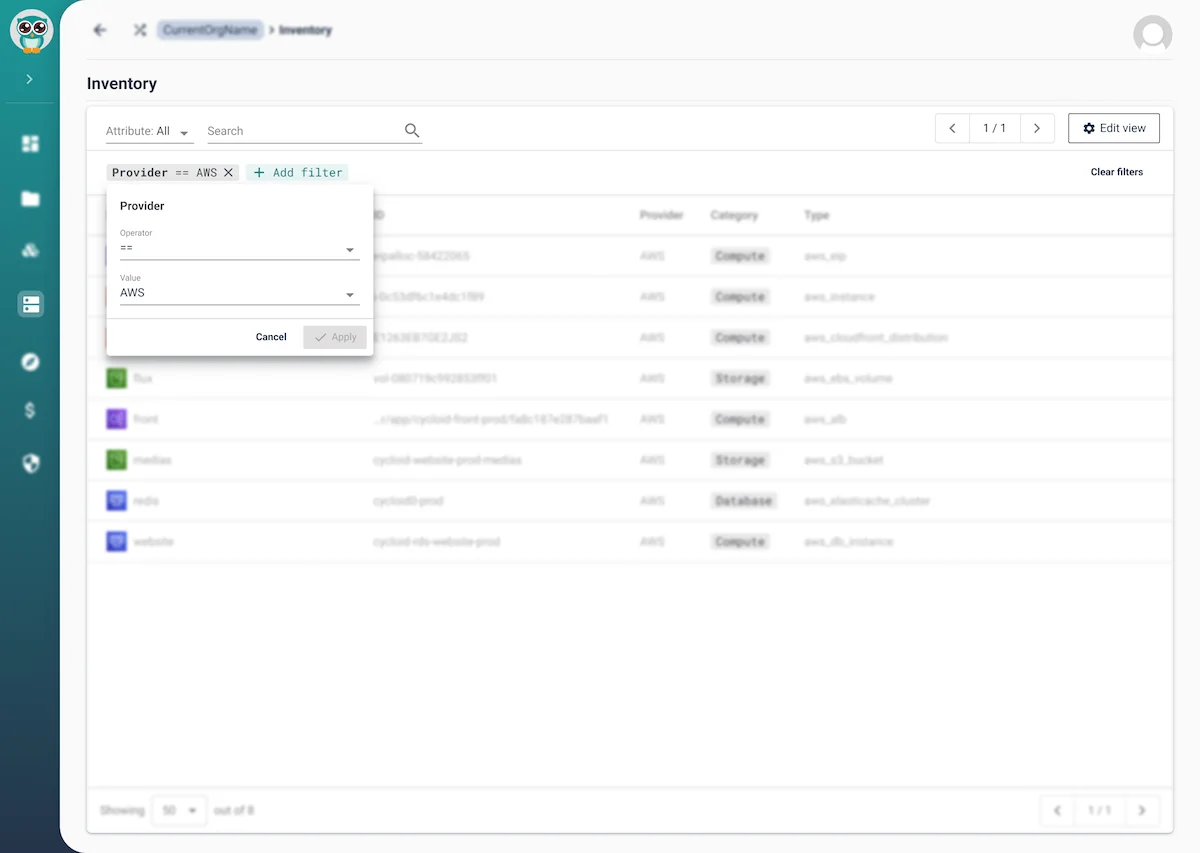
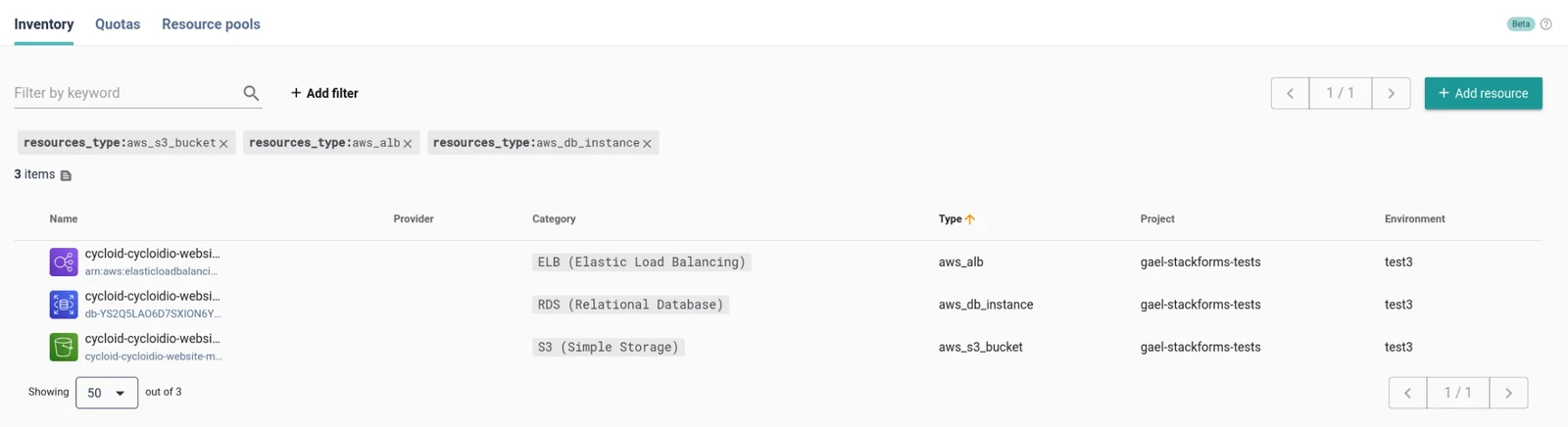
Cycloid’s Events and Asset Inventory features give platform teams this visibility. Events log every action across the platform by user, team, and timestamp. The Asset Inventory shows what’s running, who deployed it, when it changed, and what it costs. Together they make adoption measurement concrete rather than anecdotal.
To access the asset inventory dashboard, navigate to Resources > Inventory in the left menu. This will display an overview of all resources associated with your current organization.
What Golden Paths Require to Work at Enterprise Scale
The Three Infrastructure Decisions Golden Paths Must Encode
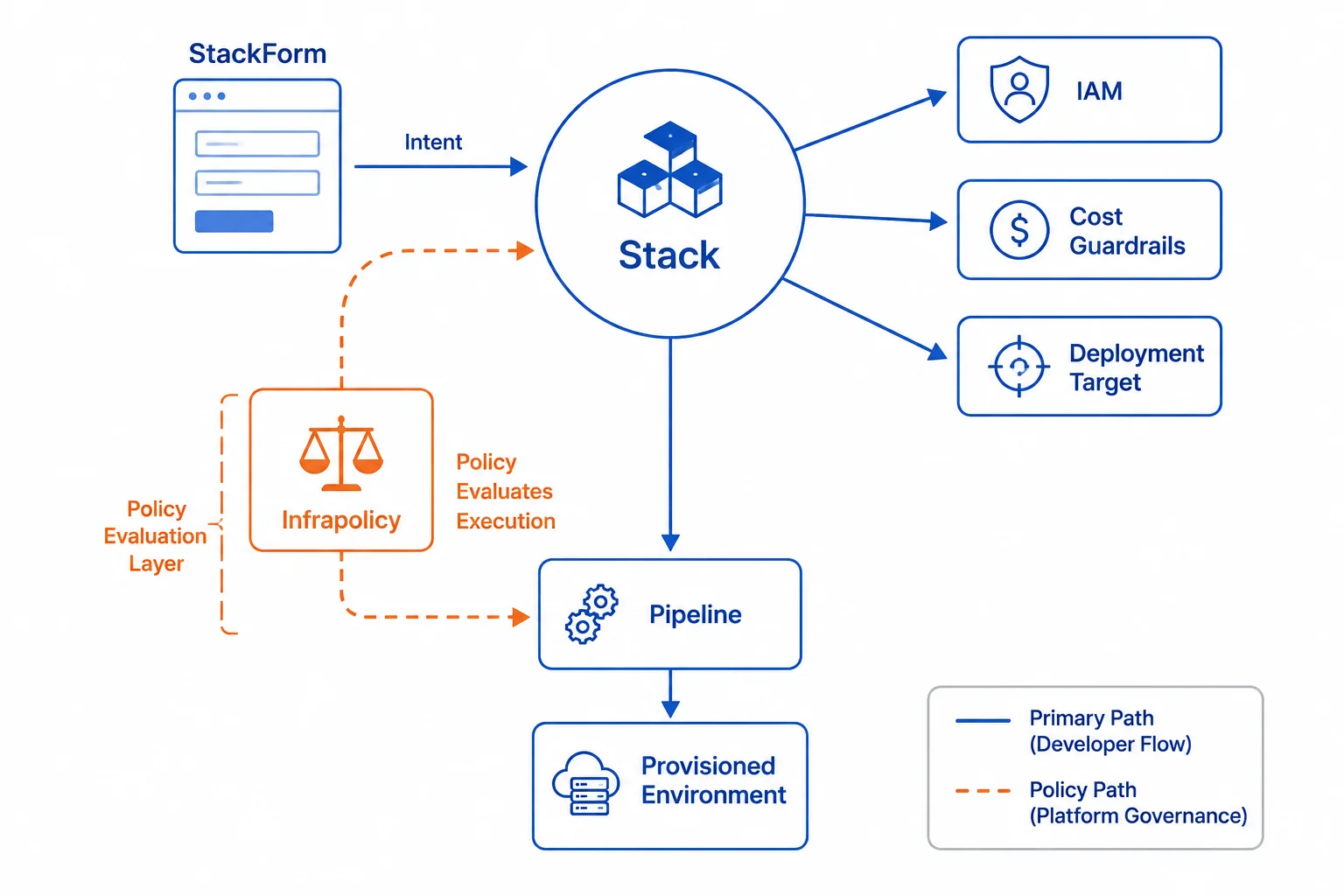
This is where platform engineering moves operational decisions away from individual developers. Instead of selecting security settings, cost controls, and deployment targets for every request, developers submit intent once while the platform injects standardized governance before infrastructure is provisioned.
A golden path that doesn’t encode security policy, cost guardrails, and deployment target in the template itself forces the developer to make decisions the platform should have already made. A well-formed golden path packages IAM configuration, pre-deployment cost estimation, and environment scaffolding: not just a scaffold of directory structure and boilerplate code.
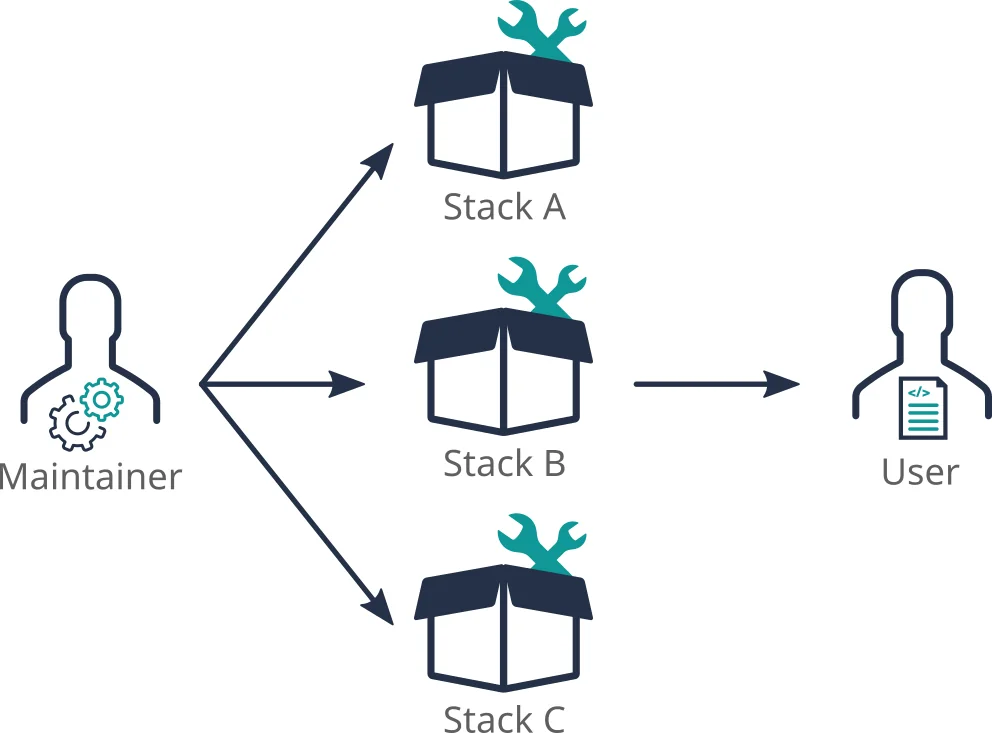
In the above scenario, the infra team serves as stack maintainers, while the app team acts as stack users.
Cycloid’s Stacks and Infrapolicies handle this at the platform layer. Infrapolicies are policy-as-code rules that run against every infrastructure change across the organization, not just against new deployments. A Stack defines what gets provisioned; an Infrapolicy defines what’s allowed. The developer doesn’t see the policy enforcement. They fill in a form, and the platform handles the rest.
When Teams Go Off-Path and What That Costs
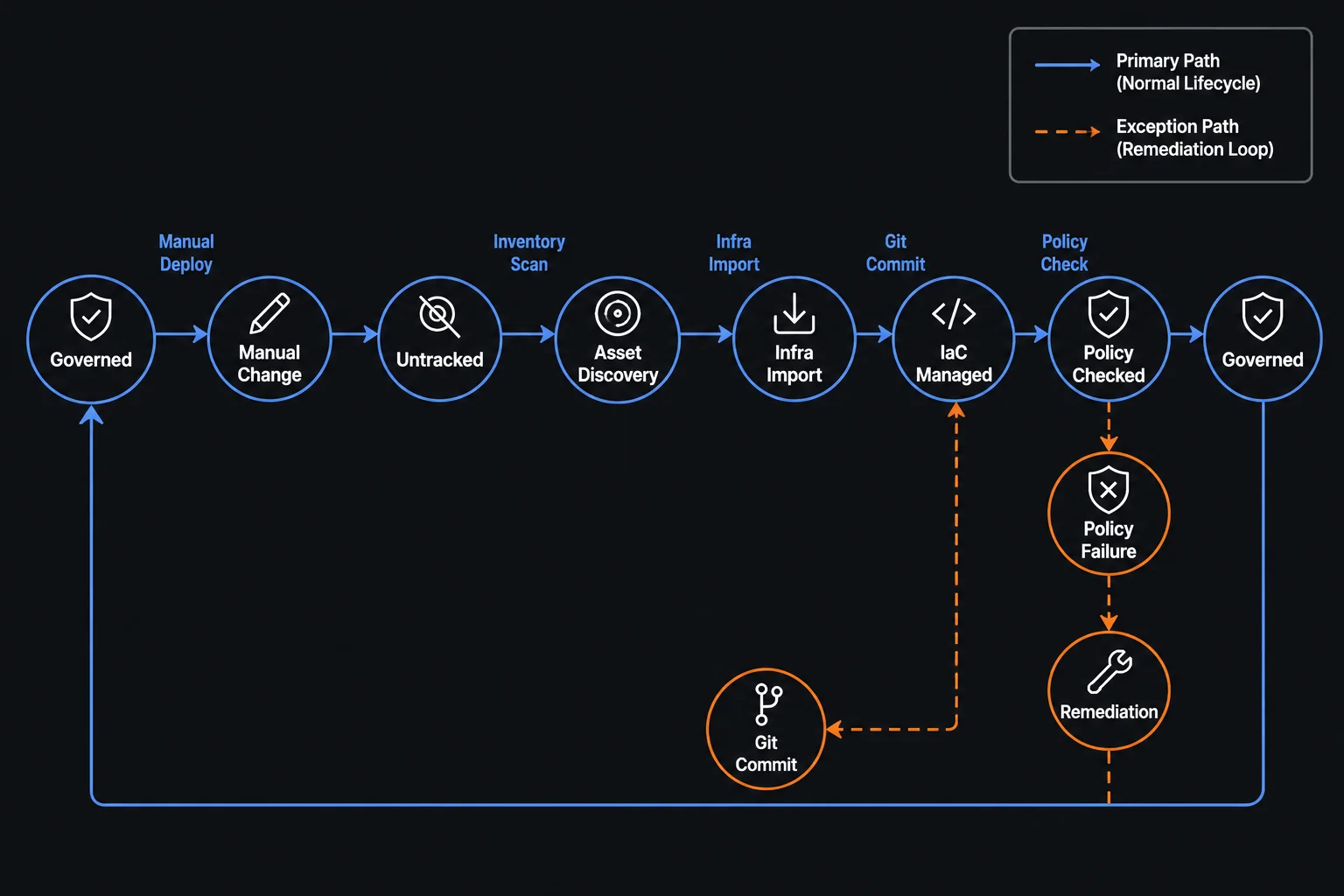
Not every infrastructure resource is created through an approved golden path, and that’s where governance often starts to drift. This lifecycle shows how unmanaged resources can be discovered, converted into Infrastructure as Code, validated against policy, and brought back under centralized control without rebuilding the environment.
Golden paths are convention, not mandate. Developers with sufficient permissions will bypass them, sometimes for legitimate architectural reasons, sometimes because the path doesn’t fit their use case, and occasionally because nobody told them it existed. The cost accumulates as asset sprawl: untracked infrastructure, cloud waste, and security posture drift that doesn’t surface until a FinOps audit or an incident.
Cycloid’s Infra Import addresses the remediation side. It identifies manually deployed infrastructure and converts it to IaC, letting platform teams bring off-path resources under governance without a full re-platform. The Asset Inventory, running in parallel, surfaces what’s running where, who owns it, and what it costs, so sprawl becomes visible before it becomes expensive.
5 Developer Experience Platforms That Will Reduce Team Friction
1. Cycloid: The Unified IDP and Portal Built for Governance at Scale
What Cycloid Ships
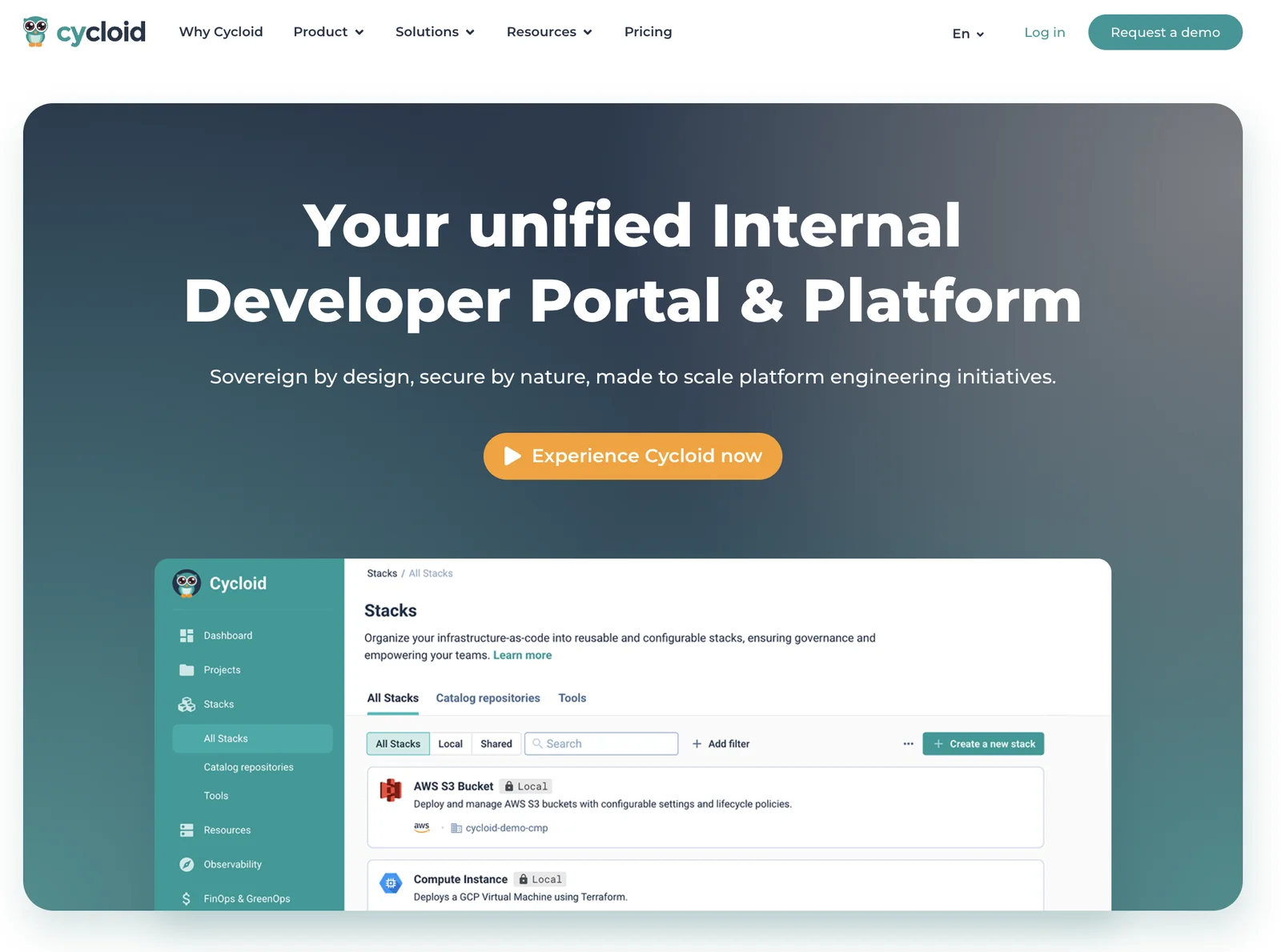
Cycloid delivers both the platform layer and the portal layer in one product, with no feature parity difference across SaaS, dedicated SaaS, and fully self-hosted deployment models. Golden paths are defined through Stacks (reusable infrastructure and application templates stored in Git) and StackForms (configurable forms that capture developer inputs and wire directly to pipeline execution, not to a ticketing queue). Infrapolicies implement policy-as-code at the pipeline layer; RBAC and approval workflows are configured before developers touch the platform. Pre-deployment cost estimation runs before infrastructure exists, and Cloud Carbon Footprint sits inside the Asset Inventory alongside cost and ownership data, not in a separate dashboard.
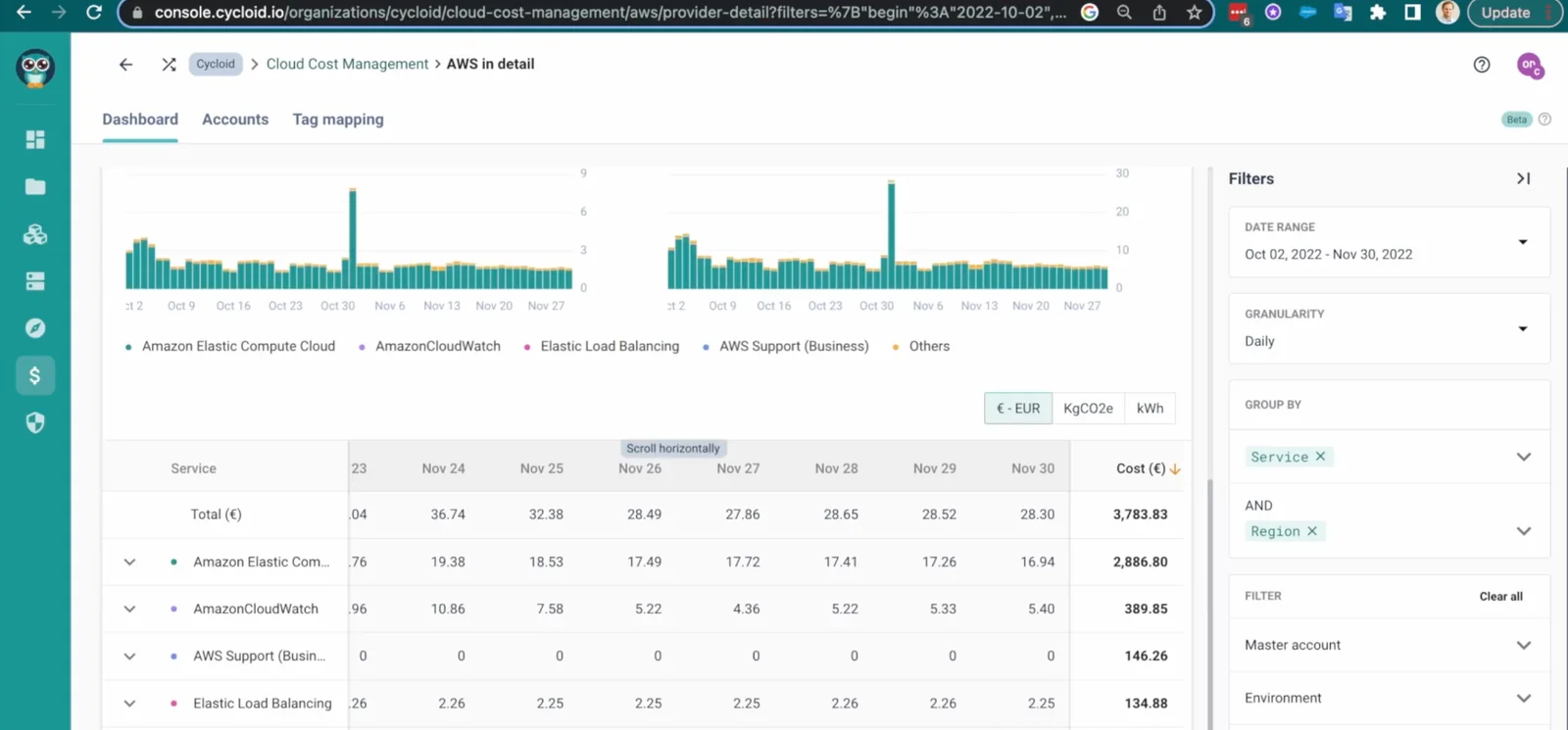
You can visualize your data with different granularities, as you would for cloud costs, but also in terms of real-world equivalents, e.g., comparing cloud footprint to a flight trip’s carbon emissions.
Where Cycloid Breaks
Cycloid’s GitOps-first model assumes teams are ready to treat Git as the source of truth for infrastructure. Organizations migrating off manual, ticket-driven provisioning workflows with no existing IaC discipline face a steeper onboarding curve than with portal-only tools like Port or Backstage, where a service catalog can be populated without changing deployment workflows at all. Infra Import mitigates this by automatically converting manually deployed infrastructure to IaC, but it doesn’t eliminate the cultural shift the platform requires.
Who Should Deploy Cycloid
Regulated, multi-cloud, and sovereignty-constrained orgs. The self-hosting option (no feature difference vs. SaaS) qualifies Cycloid for environments with data residency requirements, air-gapping constraints, or public sector procurement rules that disqualify SaaS-only vendors. Documented clients include the European Commission, Siemens, and CMA CGM. For orgs whose primary friction is governance depth, multi-team standardization, and FinOps visibility at the point of provisioning rather than in retrospective billing dashboards, Cycloid is the strongest fit in this list.
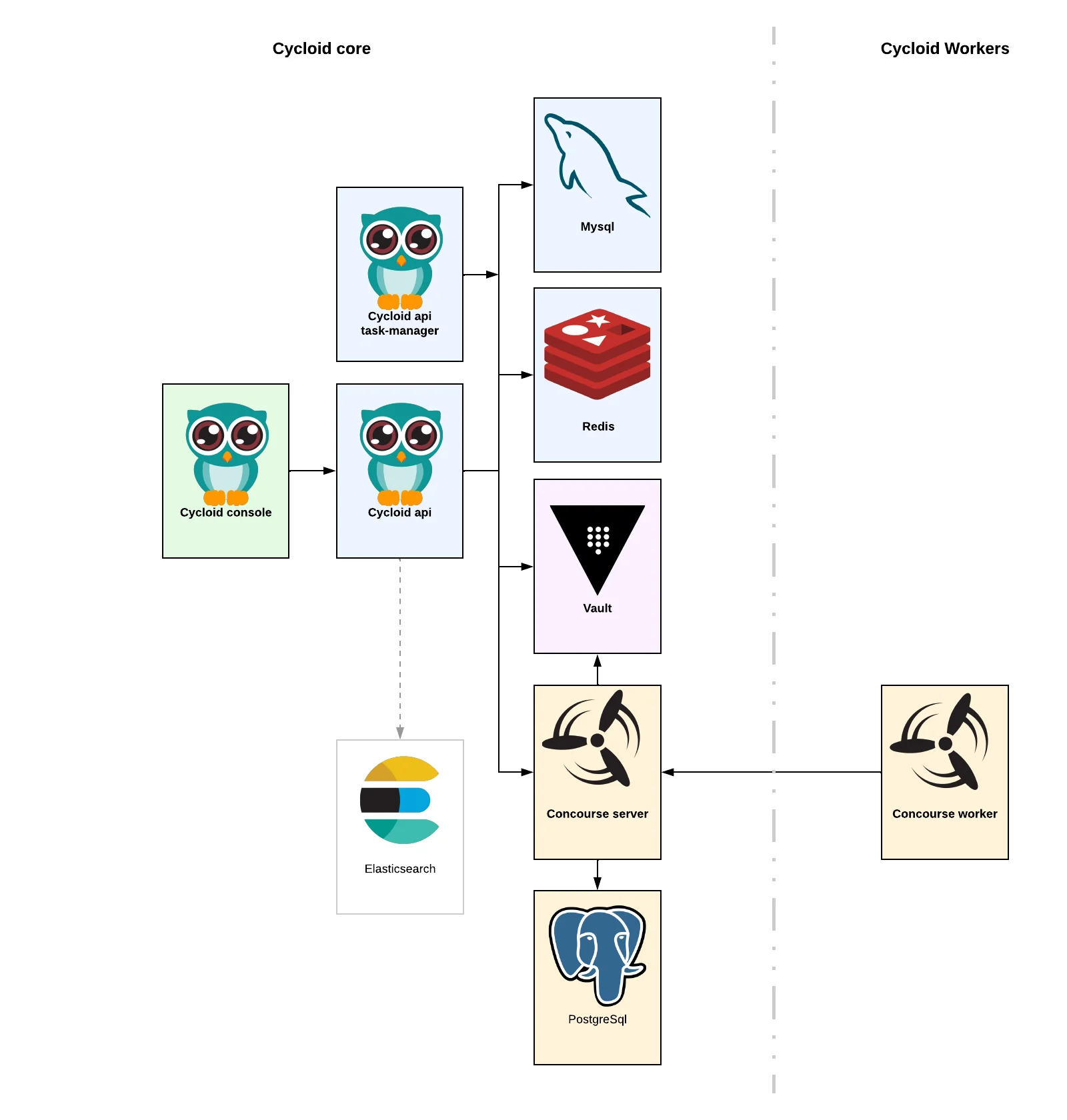
The Cycloid Dedicated platform is composed of multiple components, as illustrated in the following diagram.
2. Backstage: The CNCF Portal Framework That Demands a Dedicated Team
What Backstage Ships
Backstage delivers a service catalog, a TechDocs documentation system, and a plugin architecture with over 200 community-contributed extensions. Software Templates enable self-service infrastructure scaffolding. Authentication, infrastructure execution, and cloud provisioning all require custom plugin development or third-party wiring on top of the framework. It’s a portal framework, not a finished product, and the distinction is load-bearing for every team evaluating it.
Where Backstage Breaks
Plugin quality varies significantly across the community ecosystem, and version upgrades regularly break compatibility. Healthcare and fintech teams have documented multi-week remediation cycles after major Backstage releases. Setup to meaningful absorption runs six to eighteen months; ongoing maintenance consumes 30-40% of platform team capacity. The average internal adoption rate hovers around 10% for organizations outside Spotify, a consequence of the build burden rather than the portal concept itself.
Who Should Deploy Backstage
Large orgs with two or more dedicated platform engineers willing to treat the portal as a long-term internal product, and orgs where CNCF vendor independence is a hard procurement requirement. Outside those two conditions, the maintenance burden and adoption risk are hard to justify against SaaS alternatives. Spotify’s managed Portal for Backstage, which reached general availability in late 2025, reduces the ops burden while preserving the ecosystem by adding production-ready plugins and a maturity scoring system.
3. Port: The Catalog-First Portal With a Flexible Data Model
What Port Ships
Port centers on Blueprints: custom entity definitions that let platform engineers represent any asset (service, environment, cluster, database, compliance control) without writing frontend code. Native scorecards score every catalog entity continuously against platform-team-defined rules for quality, production readiness, and reliability. Over 100 pre-built integrations with GitHub, GitLab, Terraform, ArgoCD, Kubernetes, PagerDuty, and Jira reduce initial setup from months to days or weeks for most stacks. Self-service actions trigger external automation workflows directly from the portal.
Where Port Breaks
Port triggers external automation but doesn’t run Terraform or Helm itself. Teams that want the portal to own IaC execution end-to-end hit Port’s architectural ceiling: self-service actions are thin wrappers on external provisioning systems the org still owns and maintains. Multi-cloud governance requiring policy-as-code enforcement at the pipeline layer needs a separate orchestration tool running alongside Port.
Organizations with unusual entity structures requiring custom React plugin development will find Port’s configuration model constraining faster than Backstage’s open plugin system.
Who Should Deploy Port
Teams replacing Backstage maintenance overhead with configuration work. Port is a managed SaaS with no self-hosting burden and is the natural landing point for teams that built a self-hosted Backstage deployment, reached low adoption, and concluded that maintenance was consuming more platform engineer time than the portal saved developers.
The selection fork against Backstage: if the organization’s toolchain already has heavy Backstage plugin coverage and the team has existing Backstage familiarity, rebuilding in Port’s Blueprint model costs more than switching to managed Backstage via Roadie.
4. Humanitec: The Platform Orchestrator Built Around Workload Portability
What Humanitec Ships
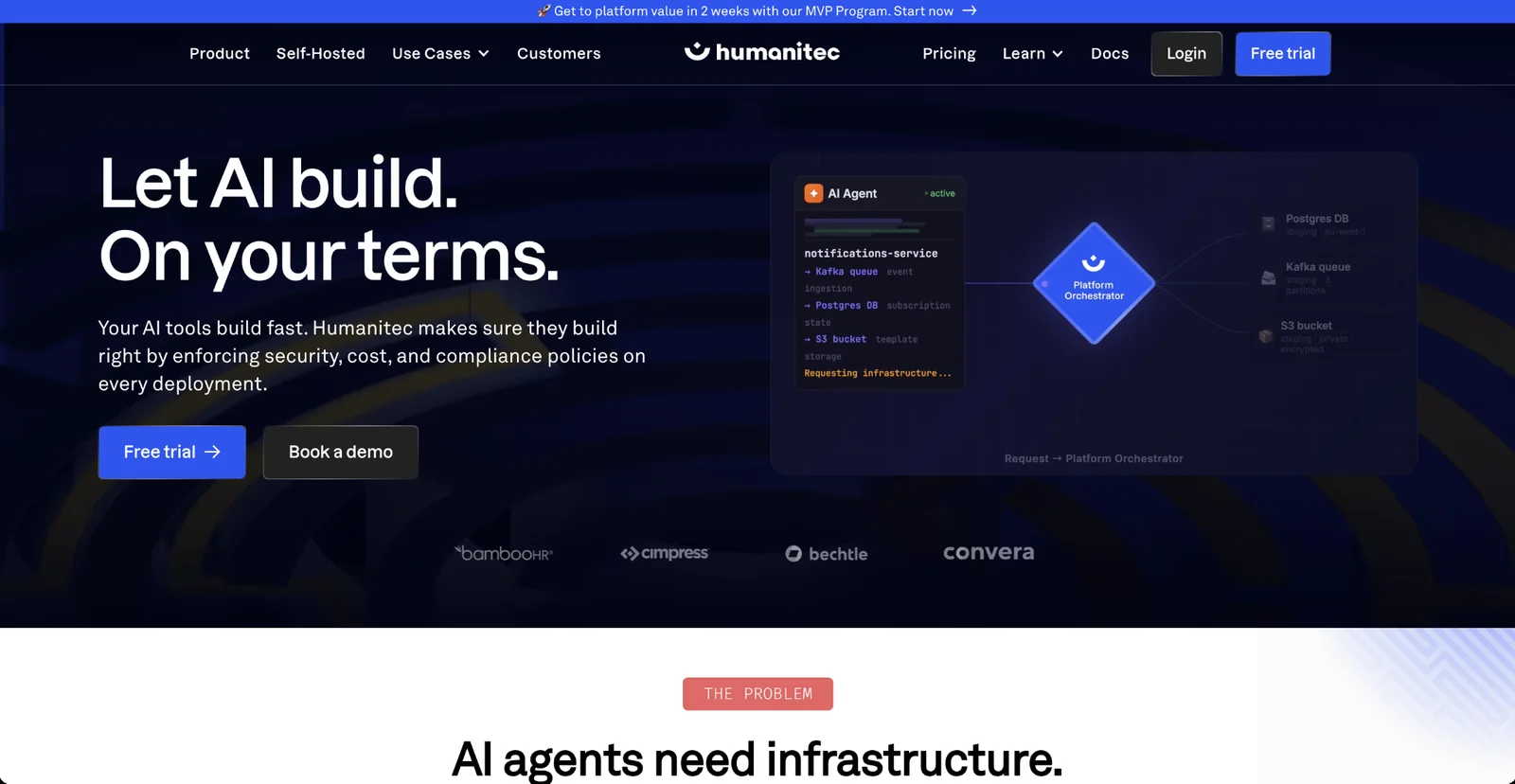
Humanitec’s Platform Orchestrator uses Score, an open-source CNCF sandbox workload specification format, as the primary developer interface. A developer writes a score.yaml declaring what their service needs (compute, a PostgreSQL database, a Redis cache) without writing Kubernetes manifests or Terraform.
The Orchestrator translates the spec into cloud-specific resources at deploy time using Resource Definitions written by platform engineers. Dynamic Configuration Management (DCM) separates what developers declare from how the platform resolves those declarations per environment.
Where Humanitec Breaks
Writing and debugging Resource Definitions is the platform’s steepest friction point. Understanding driver inputs and resolving why a definition isn’t matching a workload requires deep Humanitec-specific knowledge that doesn’t transfer from general Terraform or Kubernetes experience.
Teams that underestimate this ramp-up find their platform engineers blocked on configuration work rather than building developer-facing features. Humanitec isn’t a CI/CD platform, a deployment tool, or a Kubernetes UI; deploying it with any of those expectations produces immediate misconfiguration.
Who Should Deploy Humanitec
Funded startups or mid-to-large enterprises where developer productivity justifies configuration complexity and commercial licensing, and where workload portability across multiple cloud targets is a concrete requirement. Score’s portability matters most for orgs that need developers to describe workloads once and have the platform resolve them across different infrastructure targets without rewrites.
Teams that want to own their IDP end-to-end using open-source components can use Humanitec’s published reference architecture as a design model without licensing the product.
5. Qovery: Kubernetes Self-Service for Teams Without a Platform Team
What Qovery Ships
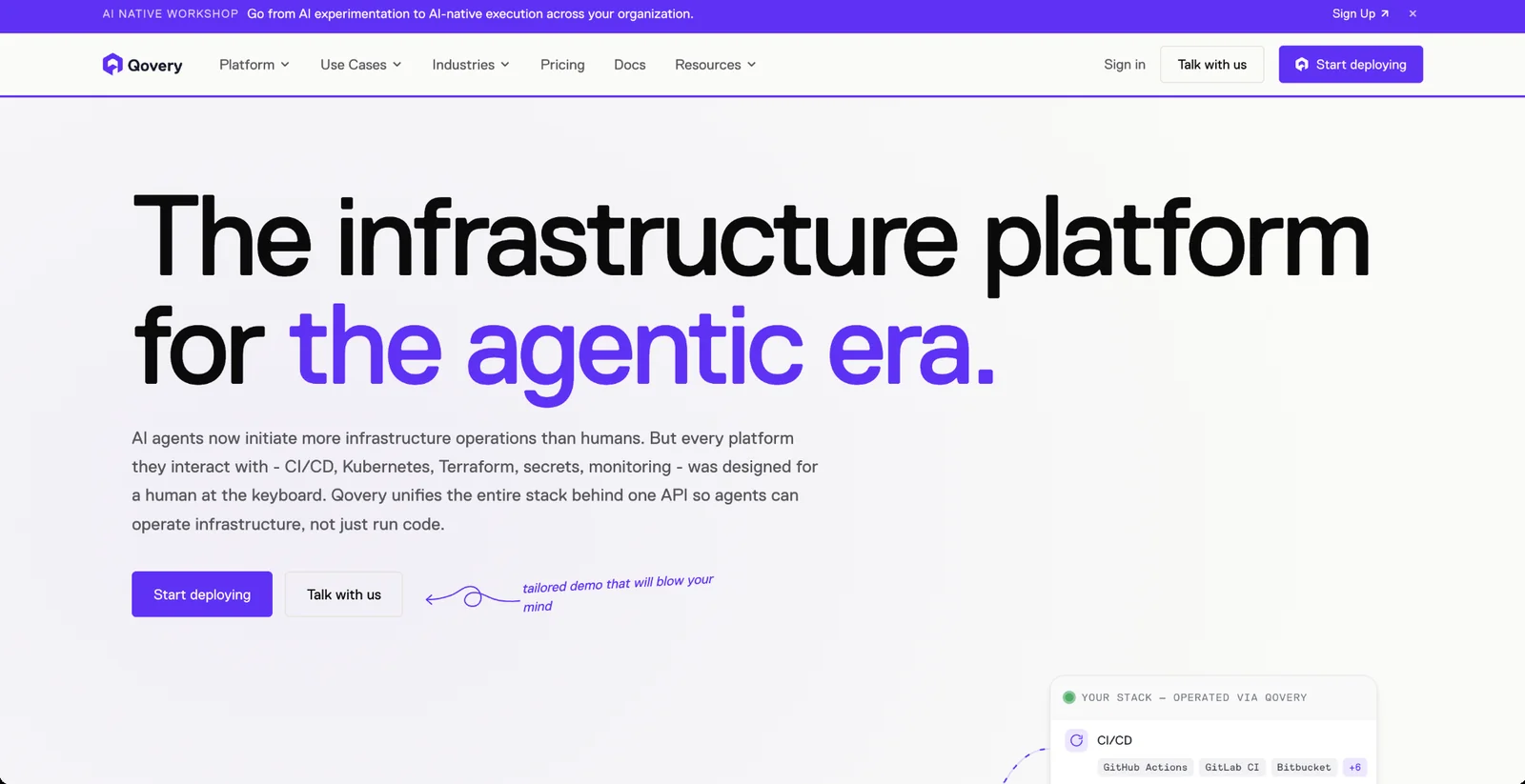
Qovery’s primary differentiator is ephemeral environment automation. Every pull request gets a full-stack, production-like environment spun up automatically: application code from the branch, supporting databases and services, networking configuration, and dedicated preview URLs per service. When the PR merges, the environment tears down.
The platform operates on a split-plane architecture, with the Qovery Control Plane handling orchestration and the organization’s cloud account serving as the Data Plane via BYOK across AWS, GCP, Azure, and Scaleway. RBAC, audit logs, CLI, Terraform, and API support exist for platform teams to enforce policy and build golden paths.
Where Qovery Breaks
Qovery is Kubernetes-centric; teams not running on Kubernetes aren’t its audience. Governance depth is the enterprise ceiling: RBAC and compliance enforcement exist but aren’t the product’s primary design axis. Organizations where policy-as-code, multi-team approval workflows, or data residency are the first-order problem will find the platform under-specified compared to Cycloid or Humanitec.
Teams needing multi-environment infrastructure provisioning beyond deployment, such as custom resource types or complex IaC blueprints, hit the ceiling of Qovery’s opinionated abstraction faster than on either of those platforms.
Who Should Deploy Qovery
Development-led teams whose primary friction is environment availability and staging bottlenecks, not infrastructure governance or cross-team standardization. The time-to-value advantage is real: teams reach a working self-service deployment experience without a dedicated platform team.
The fit condition is narrower than the marketing suggests. As the org scales and compliance requirements arrive, the governance gaps require either supplementing Qovery or migrating to a platform with policy enforcement built into the core architecture.
Choosing a Developer Experience Platform for Your Deployment Context
The decision that matters before any product evaluation is whether the primary gap is portal-layer visibility or platform-layer execution. Tools like Port and Backstage answer the first problem well; they don’t answer the second. Humanitec and Qovery answer specific execution problems (workload portability and environment automation, respectively) but carry governance ceiling conditions that show up at enterprise scale. Cycloid addresses both layers in a single product, which matters most for orgs where governance, cost control, and deployment sovereignty are requirements rather than aspirations.
This article covered the portal-vs-platform distinction that most evaluations skip, the specific failure modes golden paths produce when they don’t encode security policy and cost guardrails, and the fit conditions for five distinct developer experience platforms: Cycloid for governance-first and sovereignty-constrained deployments, Backstage for CNCF-committed orgs with dedicated portal teams, Port for SaaS-native catalog adoption without self-hosting burden, Humanitec for workload portability across cloud targets, and Qovery for Kubernetes-native teams prioritizing environment velocity. The right platform is the one that closes the gap your team is stuck at, not the one with the best demo.
FAQs
1. What is the difference between an internal developer platform and a developer experience platform?
An internal developer platform is the backend execution layer: infrastructure automation, deployment pipelines, and policy enforcement. A developer experience platform is a broader term covering both that execution layer and the portal interface developers use to access it. The two terms are often used interchangeably, but the distinction matters when evaluating tools: a portal-only product isn’t a platform.
2. How do you measure the success of a developer experience platform?
Three metrics give a concrete picture: portal login rate versus ticket volume over the same period, mean time from developer request to provisioned environment, and golden path usage versus off-path manual provisioning. A platform where ticket volume stays flat after launch hasn’t absorbed developer workflows. It’s running alongside them, which means the underlying friction hasn’t moved.
3. What are golden paths in platform engineering?
A golden path is an opinionated, pre-configured route from idea to production that a platform team maintains and supports. Originally associated with Spotify’s engineering culture, golden paths package security policy, deployment targets, and cost guardrails into a reusable template. Developers following the path get compliance and observability without having to configure them manually. Experienced engineers can go off-path, but they leave platform support behind when they do.
4. How do you get developers to adopt an internal developer platform instead of bypassing it?
Adoption follows the path of least resistance. A developer experience platform gets adopted when using it is faster and less frustrating than the alternative, not when it’s mandated. That means the golden path must cover the real workflow (not a simplified version), self-service actions must trigger automation rather than create tickets, and the platform team must treat developers as customers with standing feedback loops rather than a user base to instruct.
Check our Comparisons: Cycloid vs Backstage / Cycloid vs Port / Cycloid vs Humanitec