

Before you enter
What do you need today?
Choose a Cycloid homepage related to your need, or close this box for a general overview. You can always switch homepage with 1-click.
Here for the AI side? See how agents build on Cycloid ↗
More authority*. From Day-0.
* platform engineering on an internal developer platform (IDP): set the guardrails, environments and naming rules once. Developers self-serve inside them, and you stop maintaining the glue.
In production with



Platform engineering is the impossible job
Every new layer makes your job heavier. More tools to stitch together, more consoles to check, more things to be accountable for, and the same sized team. Six months later the queue is still growing.
You didn’t take the job to write glue, police naming conventions or rebuild CI that already works. That’s where the week goes, and every new request lands on the same team.
518 platform teams surveyed: 29.6% don’t measure success at all, and 47.4% run on under $1M a year. DORA has a name for where most of them end up: the “Ticket-ops” trap.
29.6%
Platform teams measure nothing
76%
Orgs with a platform team
80%
Large eng orgs with one by 2026
5%
Productivity from dev independence
Solutions
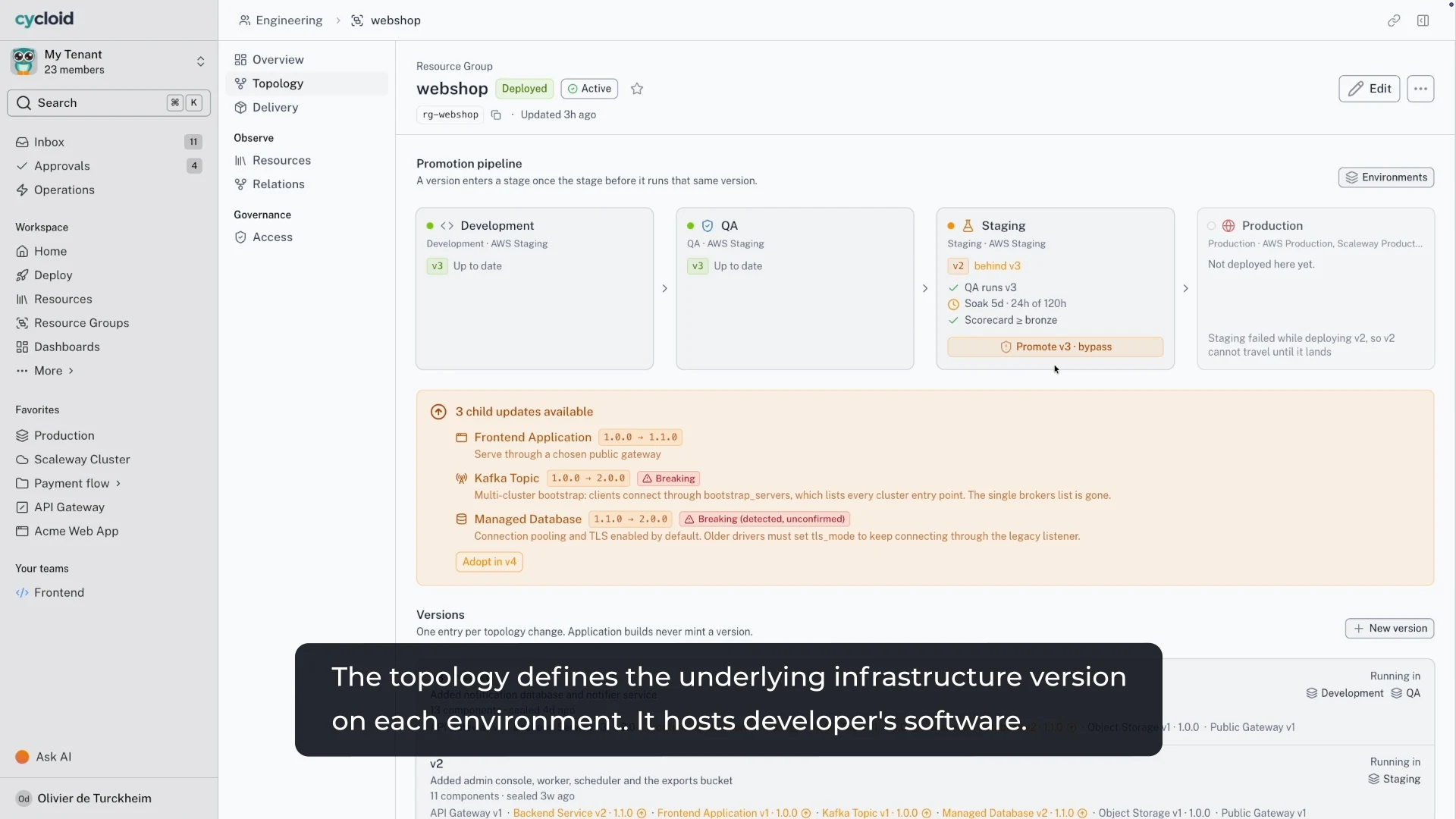
Set the guardrails, then open the doors
Governance comes first, so what developers self-serve is what you already approved. Visibility tells you whether it’s working.
01
Governance & platform
Deployment model, SSO, four-layer authorisation, environment types and naming rules. Set once, enforced everywhere.
02
Self-service
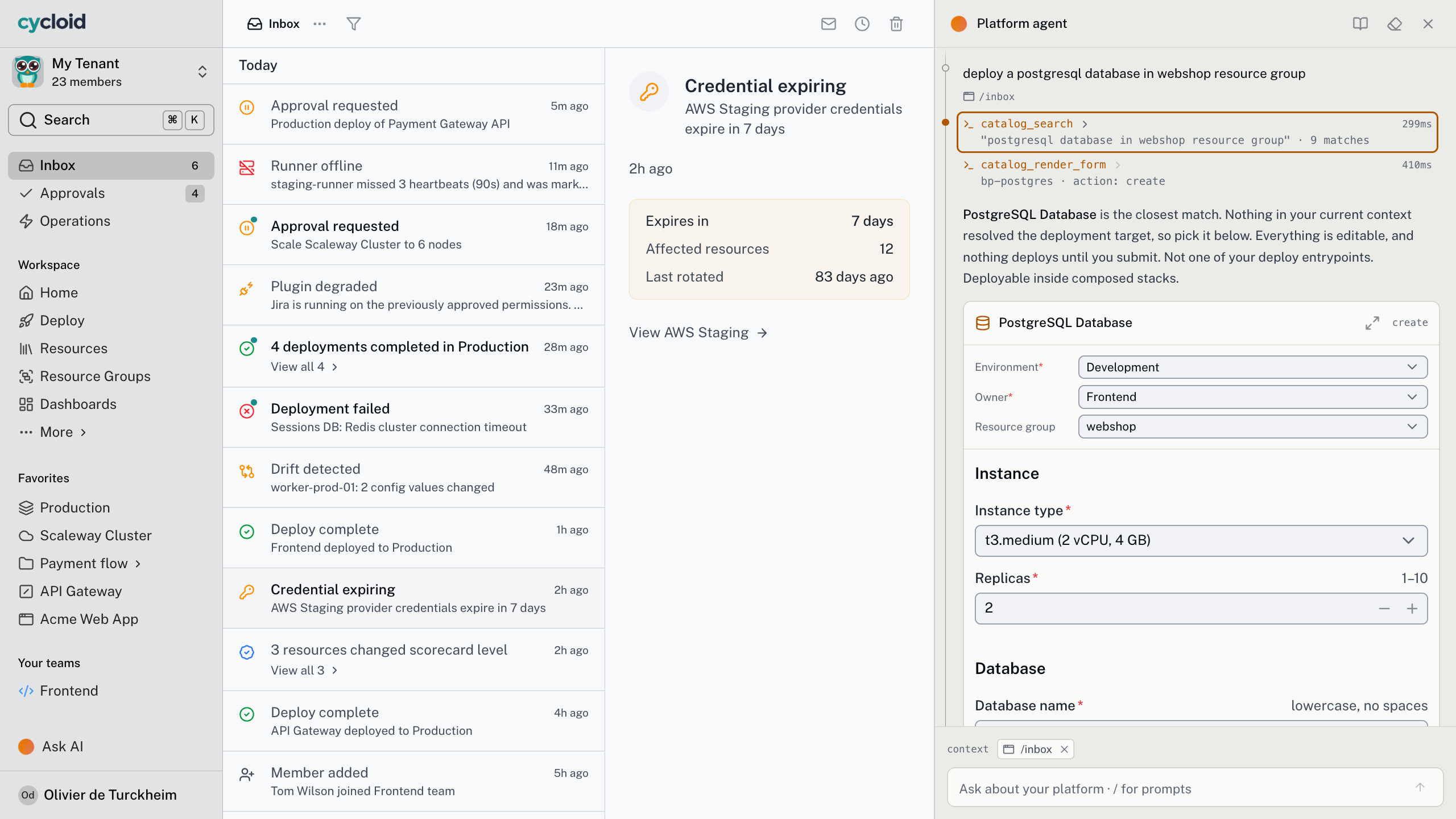
Publish Blueprints and Forms. Developers deploy, run and promote inside the rules you set.
03
Portal & visibility
The catalog, dependency graph and adoption analytics show whether the golden path is being used.
Design it yourself. Just not from scratch.
Platform engineering often follows a “J-curve” pattern: organizations may see initial performance gains, followed by a dip as complexity increases, before finally recovering and stabilizing at a higher level of performance as the platform matures.
DORA, Platform engineering capability, January 2026
Your organisation decides how much freedom a developer gets. A bank and an agency do not draw that line in the same place, and no vendor can draw it for either. That comes before any guardrail.
So you design it. The golden paths, the approval chain, the environment types, what a form will accept. You do not build the policy engine, the RBAC model or the audit trail underneath them.
An assistant meets the design you made. Same form, same checks, same approval, same record. An unresolved check is a denial.
An assistant will find any gap you leave in the design.
5 min
To configure a Stack at Alchemy
5–10
Deployments a day at Hotel Spider
4 weeks
To production at CloudXcelerate
50%
Faster project delivery
Under the hood
Swap any layer. Keep your stack.
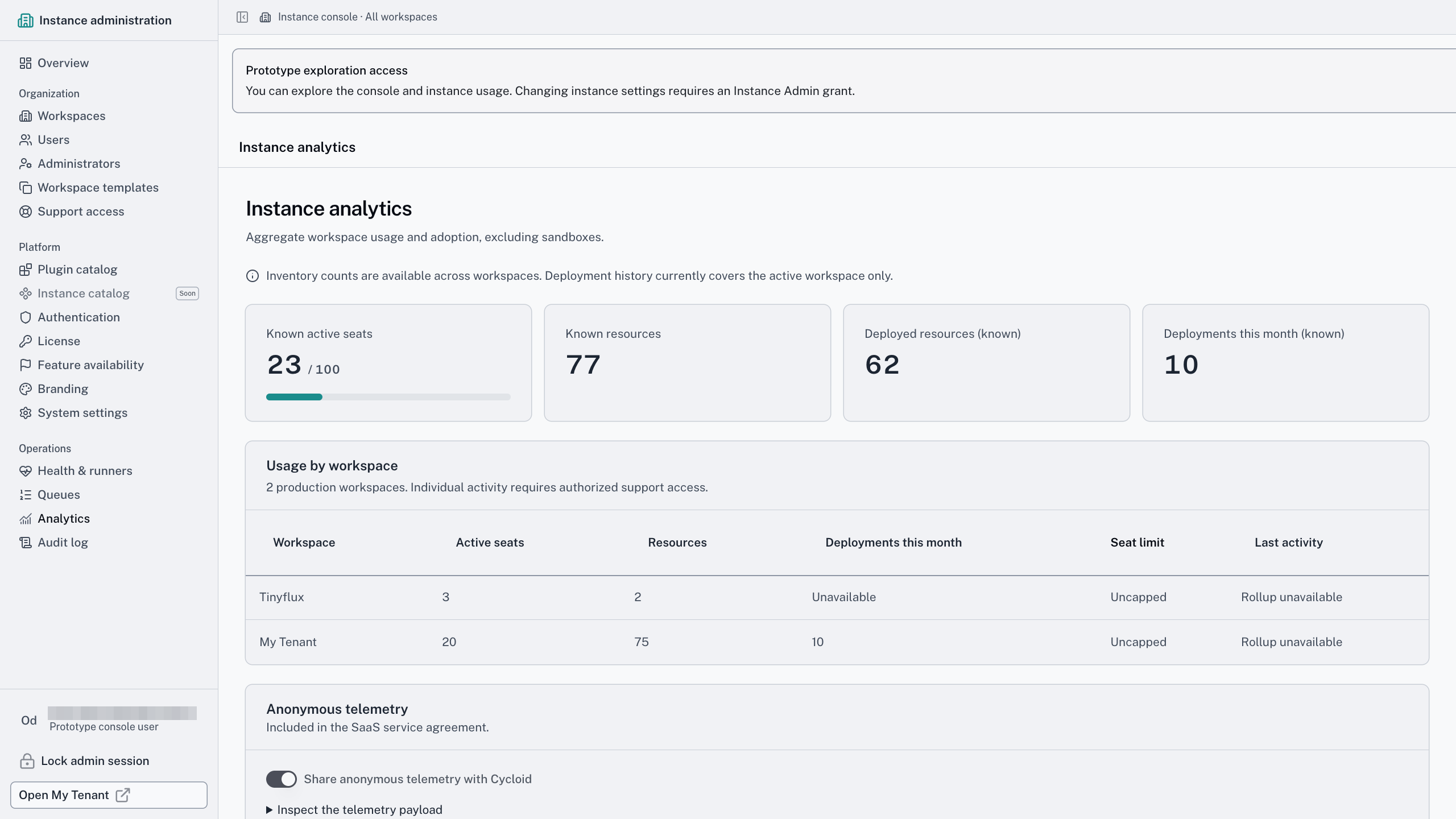
Your Terraform, Ansible, Helm and Argo CD stay yours. Each layer is documented and replaceable, and our two tools are open source, so you can see how the platform works before you trust it with yours.
Build vs buy
Build it? Price it first.
What your team builds, then maintains, for every layer.
In-house
Portal customisation
Fork the UI, then carry the fork
Sidebar, resource pages and branding set in the portal
Maintenance cost
You own and maintain everything you build.
We maintain it, you own Blueprints.
Governance enforcement
Advisory or bolt-on – issues found in audit, not prevented at the source.
Policy checks run at Form submission. A non-compliant resource is never created.
Day-2 operations
Separate runbooks and tooling. The audit trail is incomplete.
Day-2 Actions live in the Blueprint. Same chain, same audit trail as Day-1.
Portal customisation
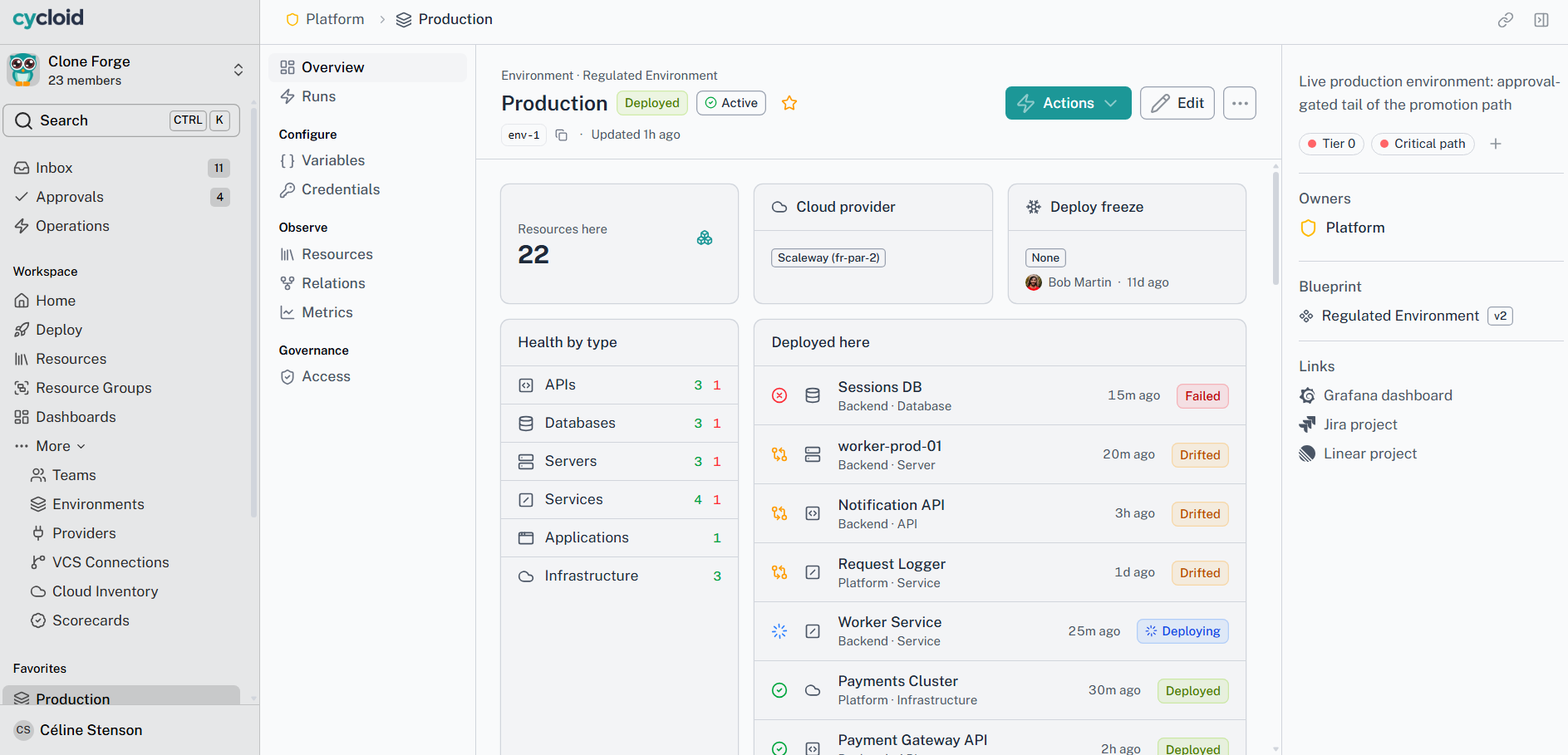
A portal shaped like your organisation
Compliance arrives with the form
ISO 27001 certified, B Corp score 95. Your team writes Blueprints instead of assembling the compliance case.

ISO 27001 Certified

HYPE CYCLE 2026
For Platform Engineering
B Corp Certified

IDC Market Glance
COOL VENDOR 2024
Cool Vendor 2024
The developer fills a Form.
The environment exists, named by your rules.
One IDP, five jobs
01
Your portal, your layout
Customise the workspace sidebar, resource pages, notifications and branding so the portal matches how your teams already work.
02
Plug-ins for the ecosystem you already run
Official and custom plug-ins, a documented API and an MCP server. Nothing to rip out first.
03
One identity model, people and assistants
Your organisation model and SSO through Okta, Entra ID or SAML 2.0, then four-layer authorisation on every Action. Fail-closed, and every change lands in the audit log.
04
Environments and names you define
Predefine environment types for every form, Blueprint and promotion path, and enforce naming rules. Nobody creates “staging-2-final”.
05
Runners you control
Native runners on your infrastructure, alongside the CI you already have. You don’t re-specify pipelines that work.
Deployment
Deploy it where your infrastructure already lives
Works with your Terraform, Ansible, Helm and Argo CD, and the CI/CD you already run. TerraCognita and InfraMap are open source.
What it means
Where your data sits
Self-hosted, on-prem or bare metal
Every module on your infrastructure, next to your runners and CI.
Your network. Air-gapped, OIDC-first.
Dedicated SaaS
We run every module in an account you pick. You keep the Blueprints.
Isolated account on AWS, Azure, GCP, Scaleway, OVH or Outscale.
Hybrid
Control plane managed by us, native runners in your environment.
Workloads and runners stay local.
SaaS
Fully managed, nothing to upgrade.
EU-hosted available.
“
The Cycloid platform is easy to use, interoperable with our existing setup, and lets us centralise all our open source tools because it is agnostic to any provider. There’s no lock-in.
Abraham Gaougaou
Head of Managed Services, Valiantys
Watch a step disappear from your week
Bring your worst provisioning flow. Most tickets, or the longest wait. In twenty minutes, see where the Blueprint Form replaces it, and whether your pattern actually fits.