


Build vs buy an internal developer platform
Build on it, but don't start from scratch
Your platform team could build an IDP. The real question is who maintains it in year three, while delivery still has to happen. Cycloid gives you the portal, the guardrails and the Day-2 plumbing, so you build what’s yours on top.
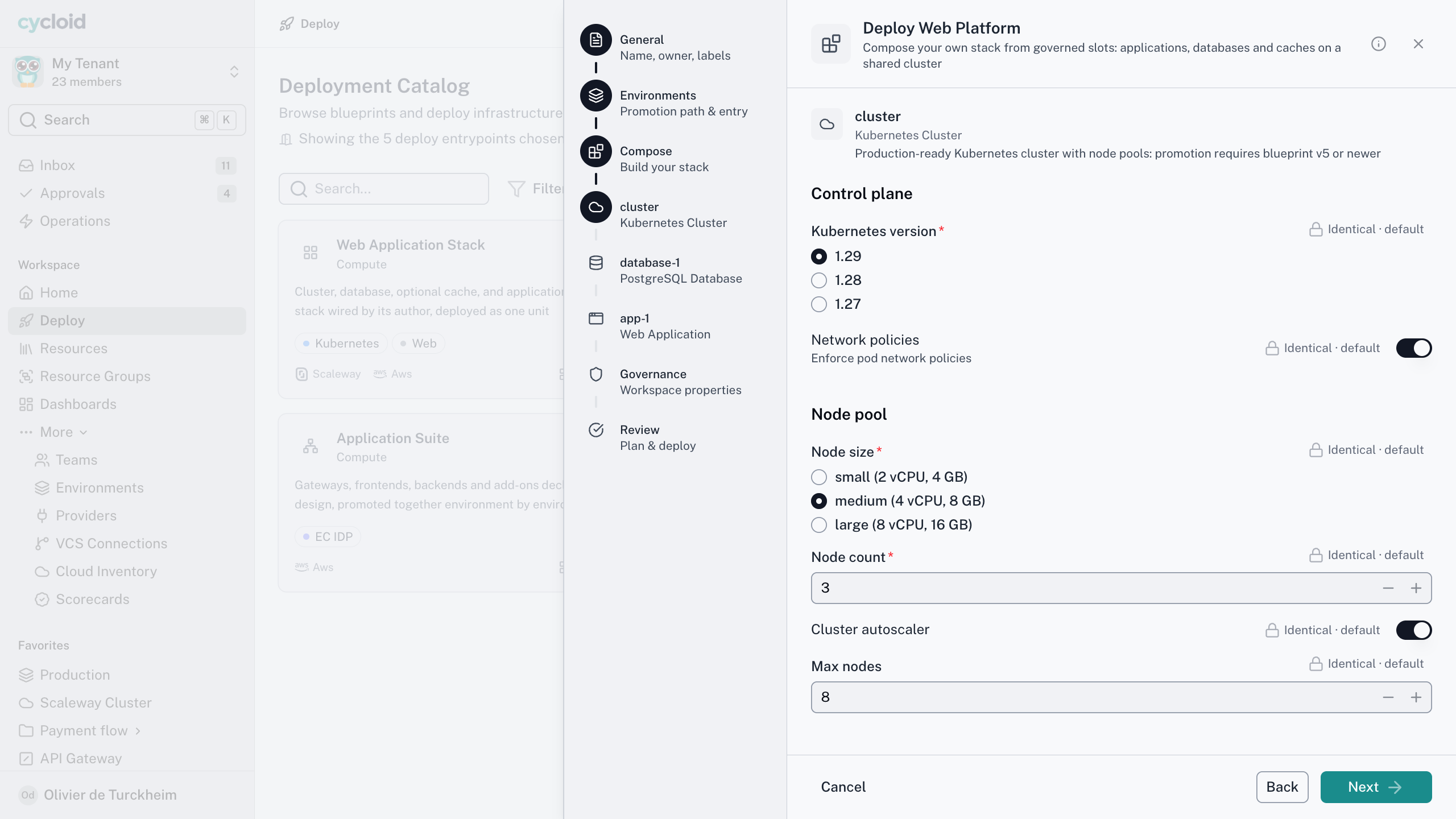
A finished portal, shaped like your organisation
The real cost
The build is the cheap part
Sprint one is a portal and a couple of golden paths. Year three is upgrades, policy, RBAC, audit and Day-2 runbooks, and the person who built it has moved on. No independent study prices any of this. Every figure out there comes from someone selling a platform, so here’s a sum you can rerun with your own salaries.
$236k
Year 1
$472k
Year 2
$708k
Year 3
Two platform engineers, cumulative salary
Two engineers at $118,028 each, cumulative salary only. Illustrative. Input: State of Platform Engineering Vol 3, 2024.
What the research says
Platforms pay off. Badly built ones cost you.
IDP users vs non-users. DORA, Accelerate State of DevOps 2024, p.5 and p.49.
+8%
Individual productivity
+10%
Team performance
+6%
Delivery and ops performance
−8%
Throughput
−14%
Change stability
IDP users vs non-users
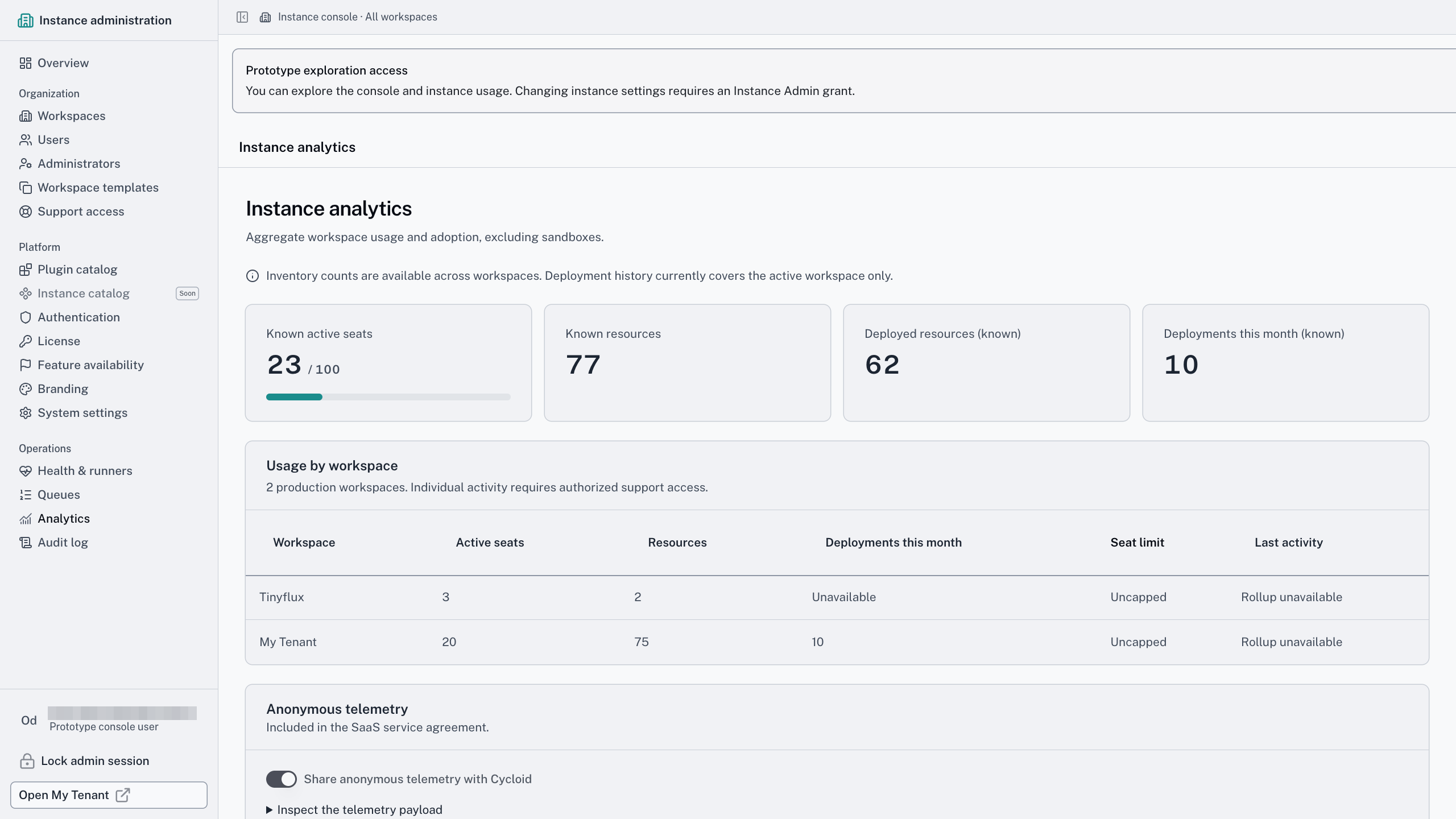
90%
of organisations have adopted at least one platform (DORA, 2025)
<4 weeks
from cloud migration to full production at cloudXcelerate, on Cycloid
<1 hour
for a new environment at Alchemy. It used to take more than a day.
One decision, three views
Who the build lands on
Set the guardrails, skip the upkeep
The problem
You’d build it, then maintain every layer yourself.
With Cycloid
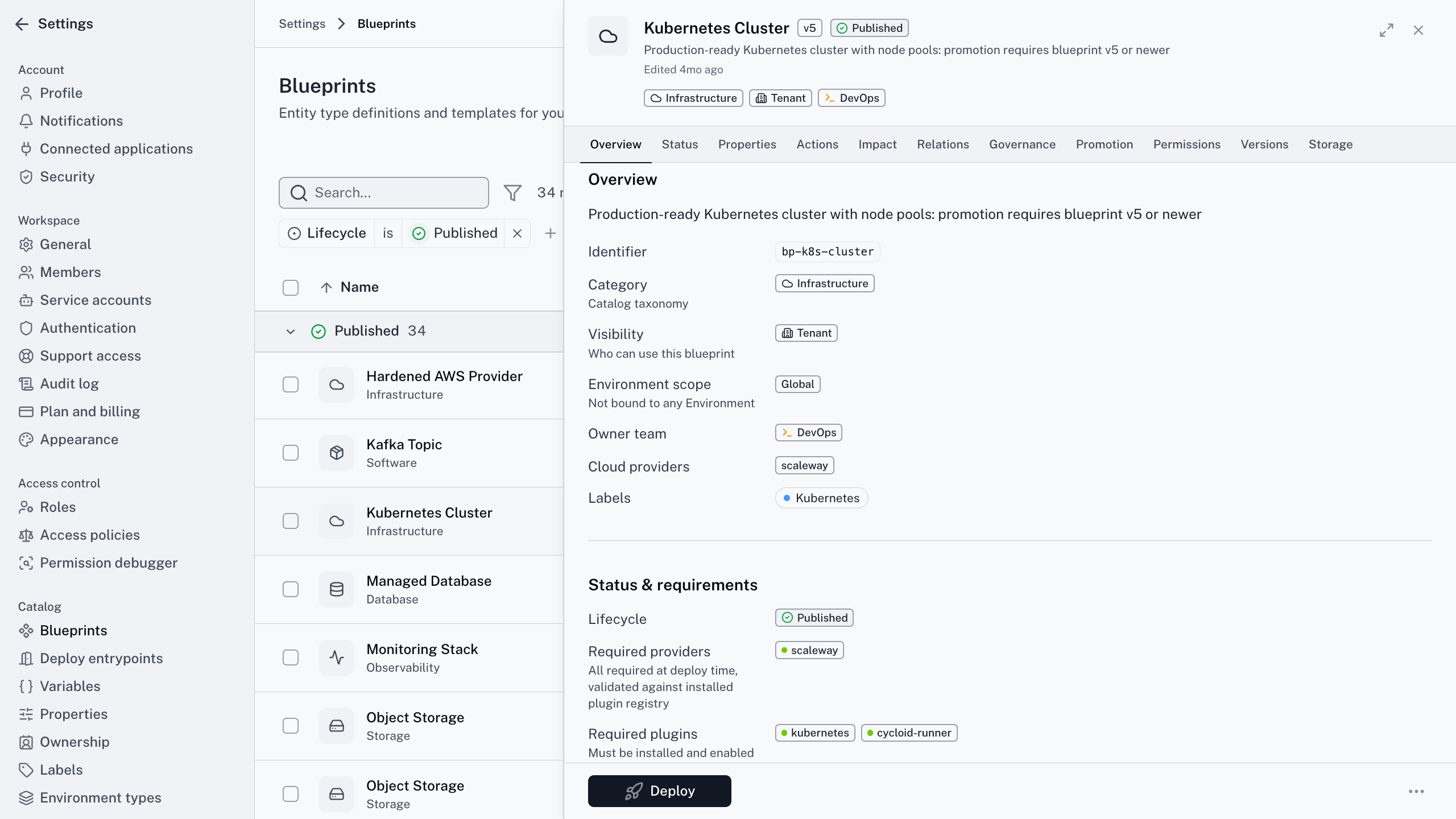
Start from a finished portal, set the guardrails and publish your own Blueprints and plugins.
The outcome
Less to maintain, and delivery keeps moving.
Paths that work this week
The problem
A portal due next quarter won’t help with Thursday’s staging environment.
With Cycloid
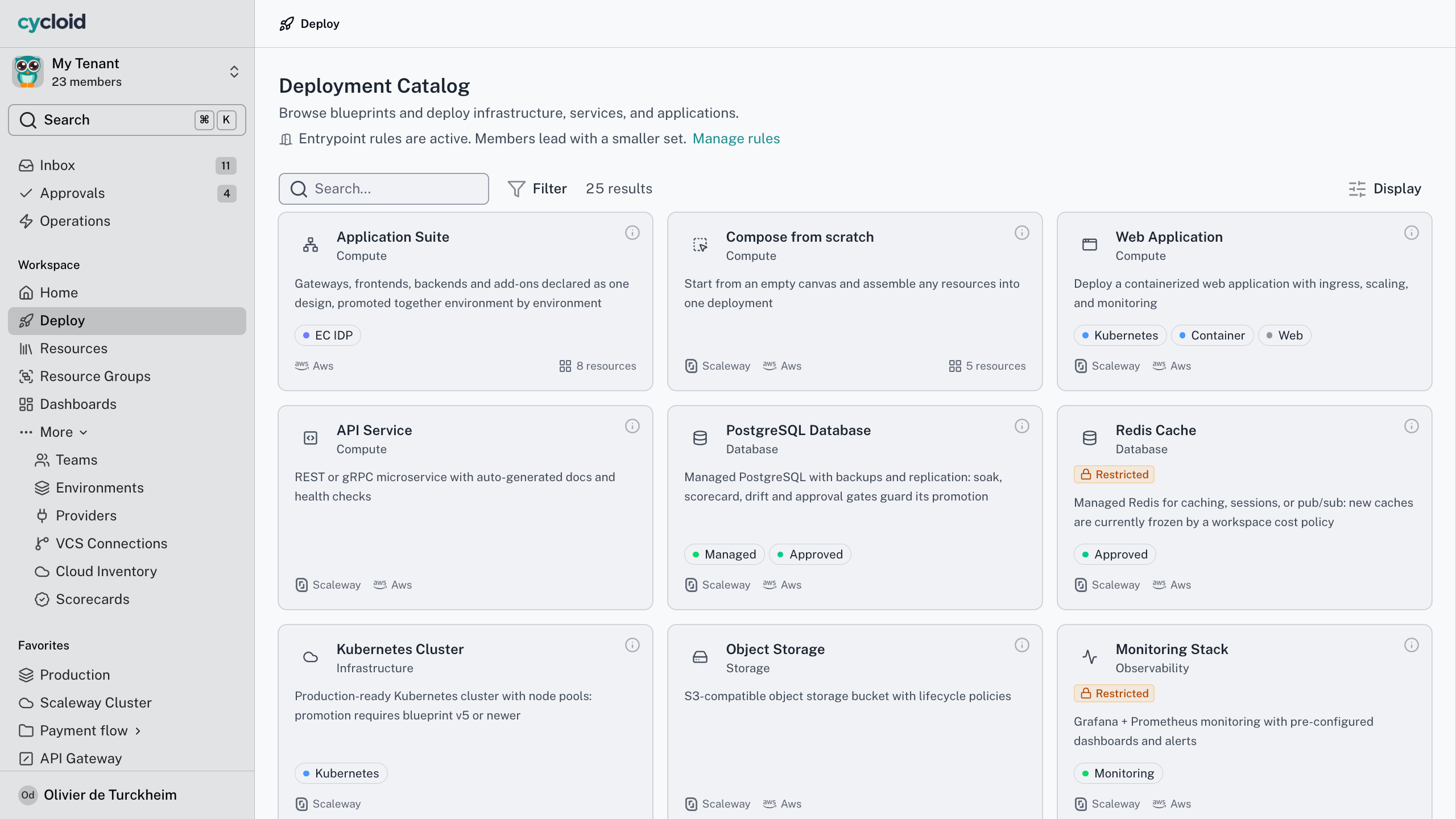
Pick a golden path or compose from scratch inside the rules, then run and promote it.
The outcome
No ticket queue on the structured paths. Approvals still apply where the risk calls for them.
A platform that just works
The problem
A platform build is a headcount line with no end date.
With Cycloid
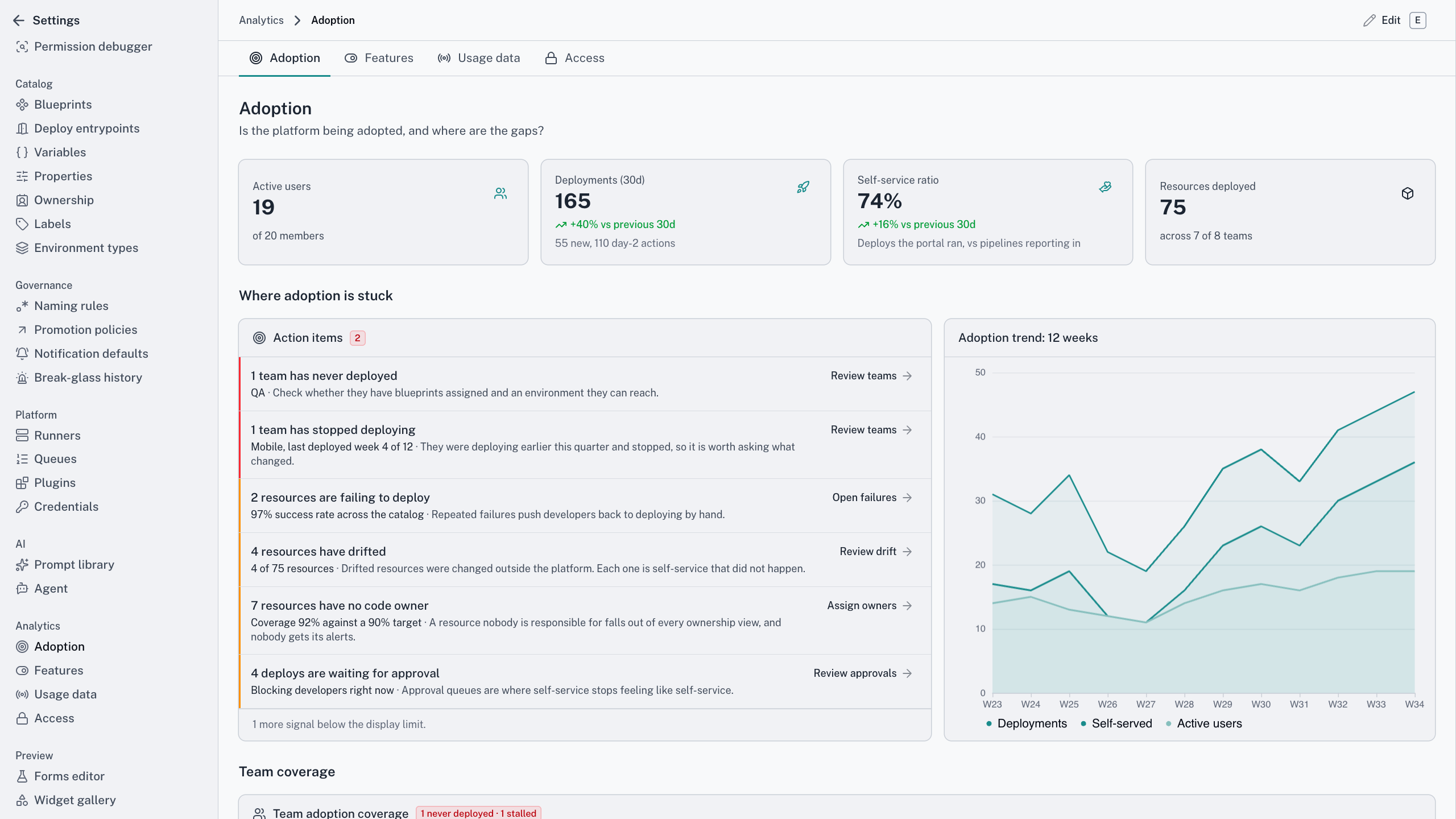
A product from €39 per user per month, with live dashboards on adoption and deployments.
The outcome
It works, and you can show that it works.
Build or build on
Who maintains what
Building gets you an exact fit and no vendor. Building on Cycloid gets you the same top layer, without carrying the six underneath.
Build in-house
Build on Cycloid
Golden paths
Your golden paths. You build and maintain them.
Your golden paths, as Blueprints, Forms and plugins. Still yours.
Day-2 operations
Day-2 runbooks. You maintain them.
Day-2 Actions, on the Blueprint. We maintain them.
Audit
An audit trail. You maintain it.
An audit log: every action, one trail. We maintain it.
Policy and access
A policy engine and RBAC. You maintain them.
Four-layer authorisation, checked at submission, plus SSO. We maintain it.
Catalog
A catalog. You maintain it.
A catalog of services, owners and dependencies. We maintain it.
Portal
A portal UI, and its fork. You maintain them.
A customisable portal: sidebar, pages, branding. We maintain it.
Hosting
Hosting and upgrades. You run them.
Runs where you choose: SaaS, self-hosted, air-gapped. We maintain it.
Exit: open formats (Terraform, GraphQL, JSON Schema, OpenFGA). Your IaC keeps running.
How to decide
Four questions before you commit headcount
01
Price year three, not sprint one
Put your own salaries in the sum above.
02
List what's truly yours
Your golden paths are. The portal around them isn’t.
03
Decide where it has to run
Sovereign and air-gapped rules narrow the field fast.
04
Test the exit before you sign
Ask what happens to your infrastructure code if you leave.
Your golden paths make your platform yours. The portal, the policy engine and the audit log don’t. Build on Cycloid and your team spends its time on the part that matters, as Blueprints on the Terraform, OpenTofu, Ansible or Helm you already run. Weighing Backstage?
Working with your agent
Ask what's already built before anyone builds it
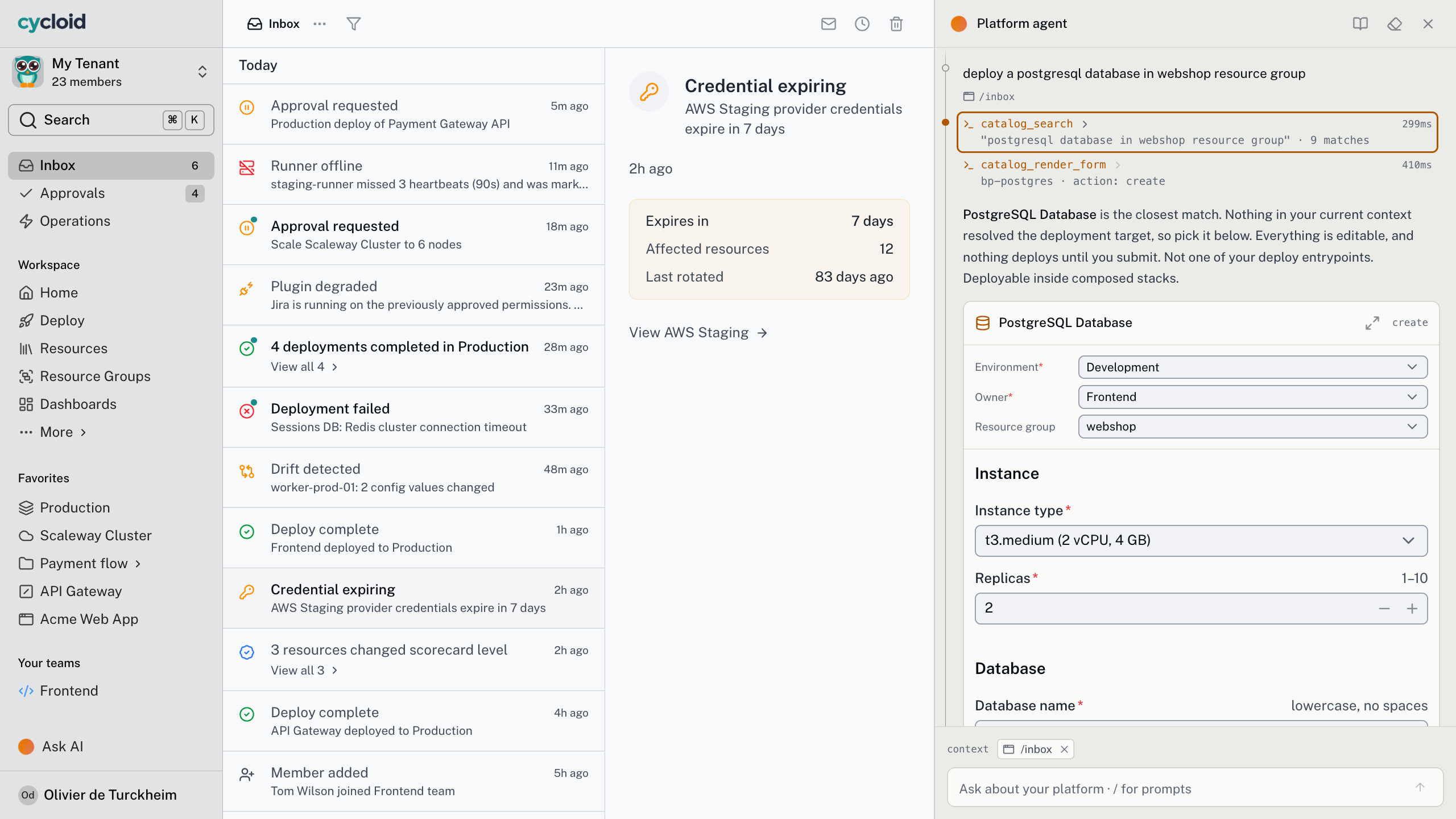
Before your team starts a new pipeline, ask your agent. It searches the Blueprints you’ve published and renders the Form a Blueprint declares. The answer is what your platform already offers.
It can’t write a Blueprint, so no conversation invents a golden path your platform team never approved.
Does the agent get its own permissions?
No. There’s no service account and no elevated agent role. If you can’t deploy to production, neither can the agent you’re talking to, in Cycloid’s own agent or any compliant MCP host.
We need preview environments per pull request. Do we have something, or do we build it?

One published Blueprint matches: Preview environment, owned by Team Platform. Here’s its Form. Pick the repository, the branch and how long it should live, then confirm.
Frequently asked questions
Buy what every platform needs and build what only you need. Every team rebuilds the portal, policy engine, authorisation and audit log. Nobody else has your golden paths, so build those as Blueprints on a platform you didn’t write.
The licence is. Running it isn’t. Backstage is an open-source framework, so your team assembles, hosts, upgrades and maintains the portal and its plugins. Cycloid is a finished product you run where you choose.
No independent study has measured it. Start with headcount: platform engineers in Europe average $118,028 a year (State of Platform Engineering, 2024). Multiply by the team you’d need and the years you’d run it.
Not with Cycloid. Blueprints wrap the Terraform, OpenTofu, Ansible or Helm you already have, and the platform runs on open formats like GraphQL, JSON Schema and OpenFGA. If you leave, your infrastructure code keeps running.
Bring your build plan
In twenty minutes we’ll map it against Cycloid, so you leave knowing what’s already done and what’s left for your team.