






CLOUD COST MANAGEMENT PLATFORM
Control Multi-cloud Spend Before It Happens
See exactly how, where, and when your cloud budget is being spent across AWS, Azure, and GCP – with pre-deployment cost visibility built into your platform engineering pipeline. No extra FinOps tools needed.
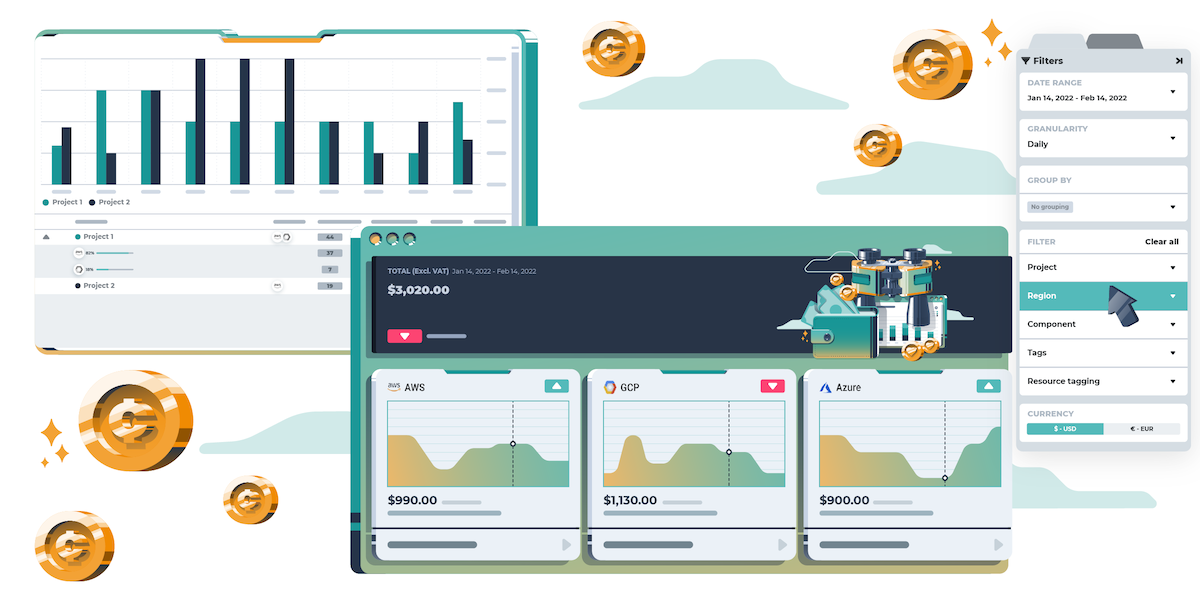
Say goodbye to manual reporting, low visibility, and unexpected cloud bills. And hello to Cycloid’s Cloud Cost Management, a one-of-a-kind built-in FinOps module for DevOps and Hybrid Cloud.
Benjamin Brial, Founder, Cycloid
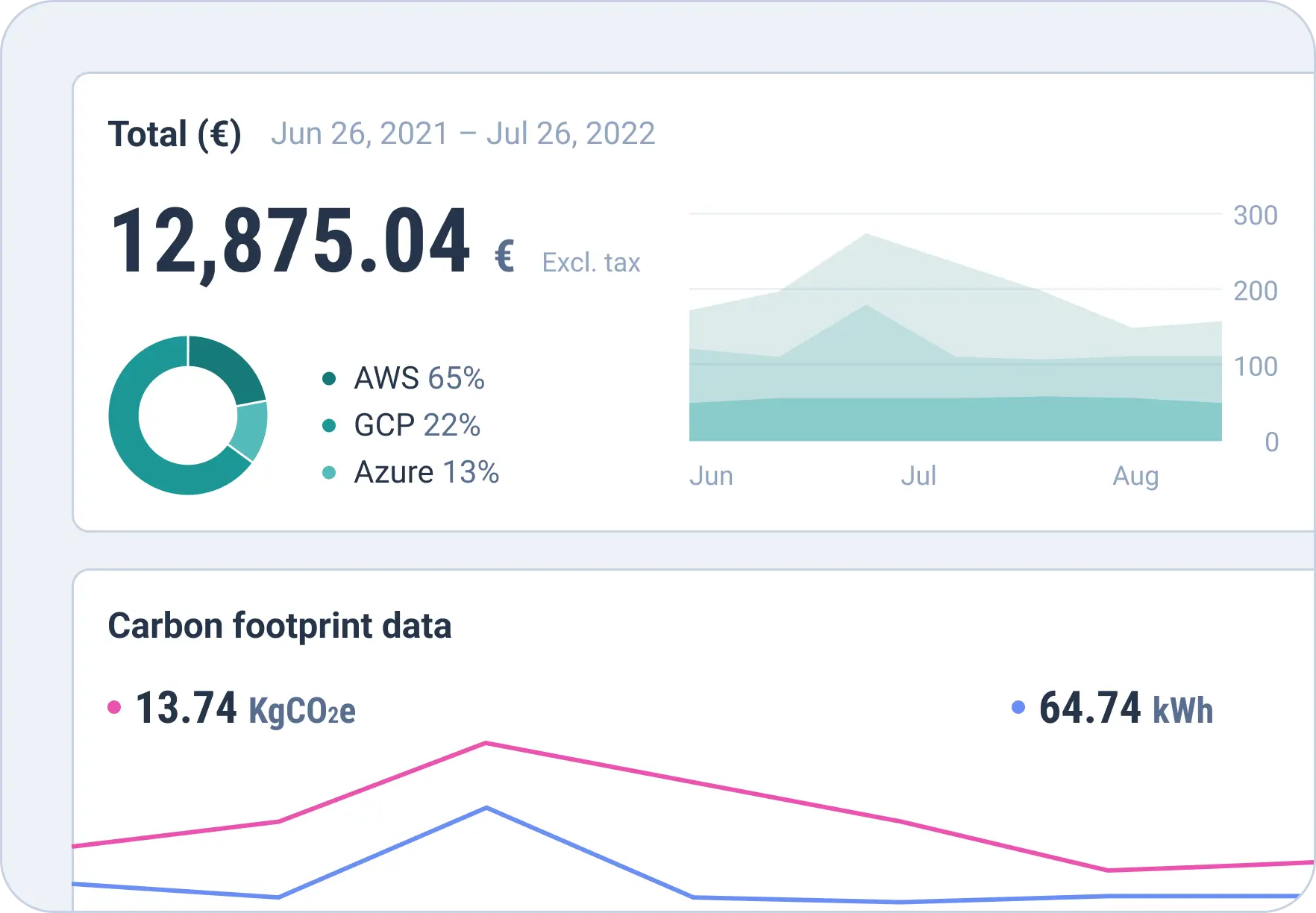
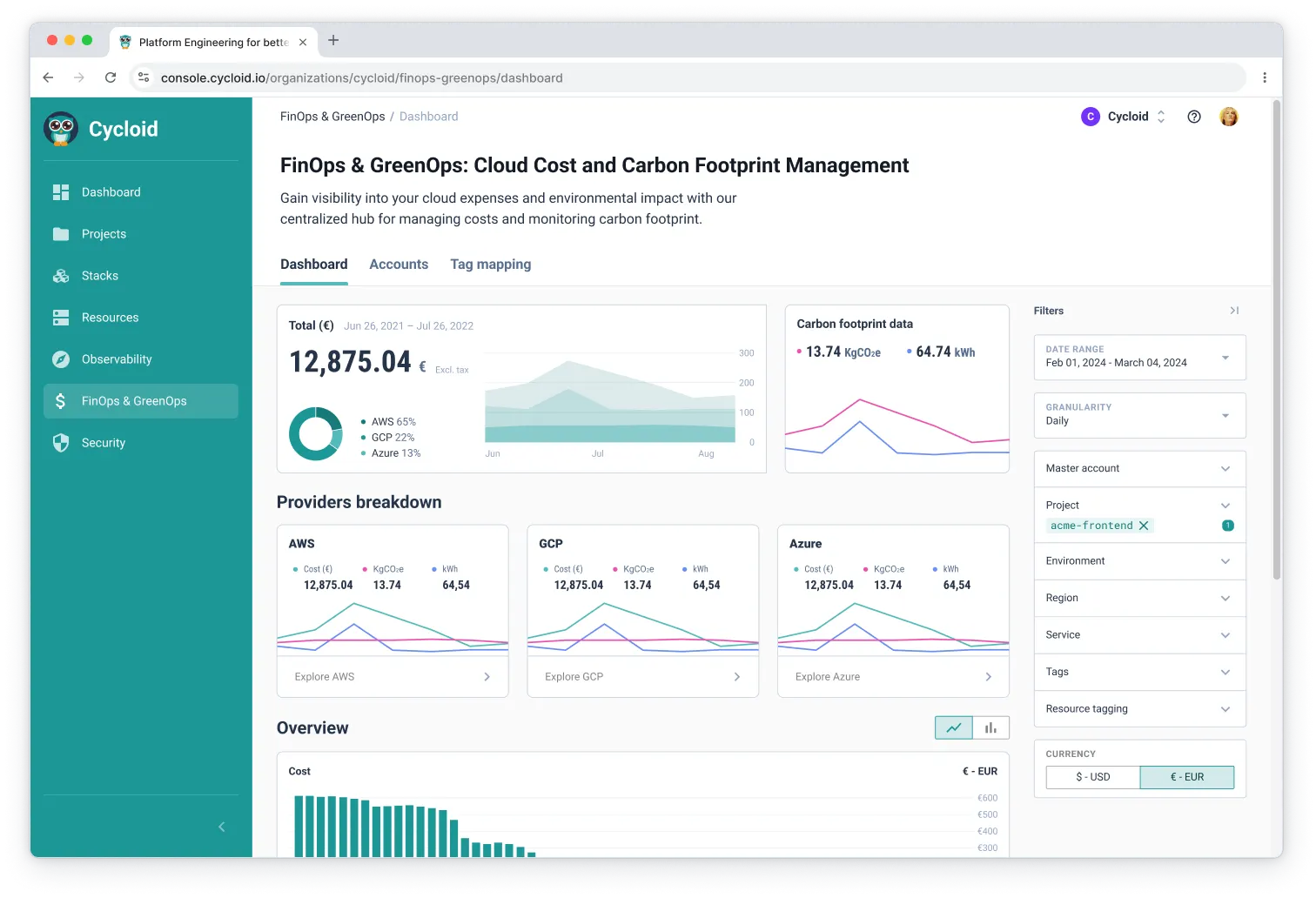
All your cloud providers in one place
Centralize and monitor all your expenses from one interface.
- Supports AWS, Azure, GCP
- All your providers in one place
- Additional providers added on request
A granular breakdown of your expenses
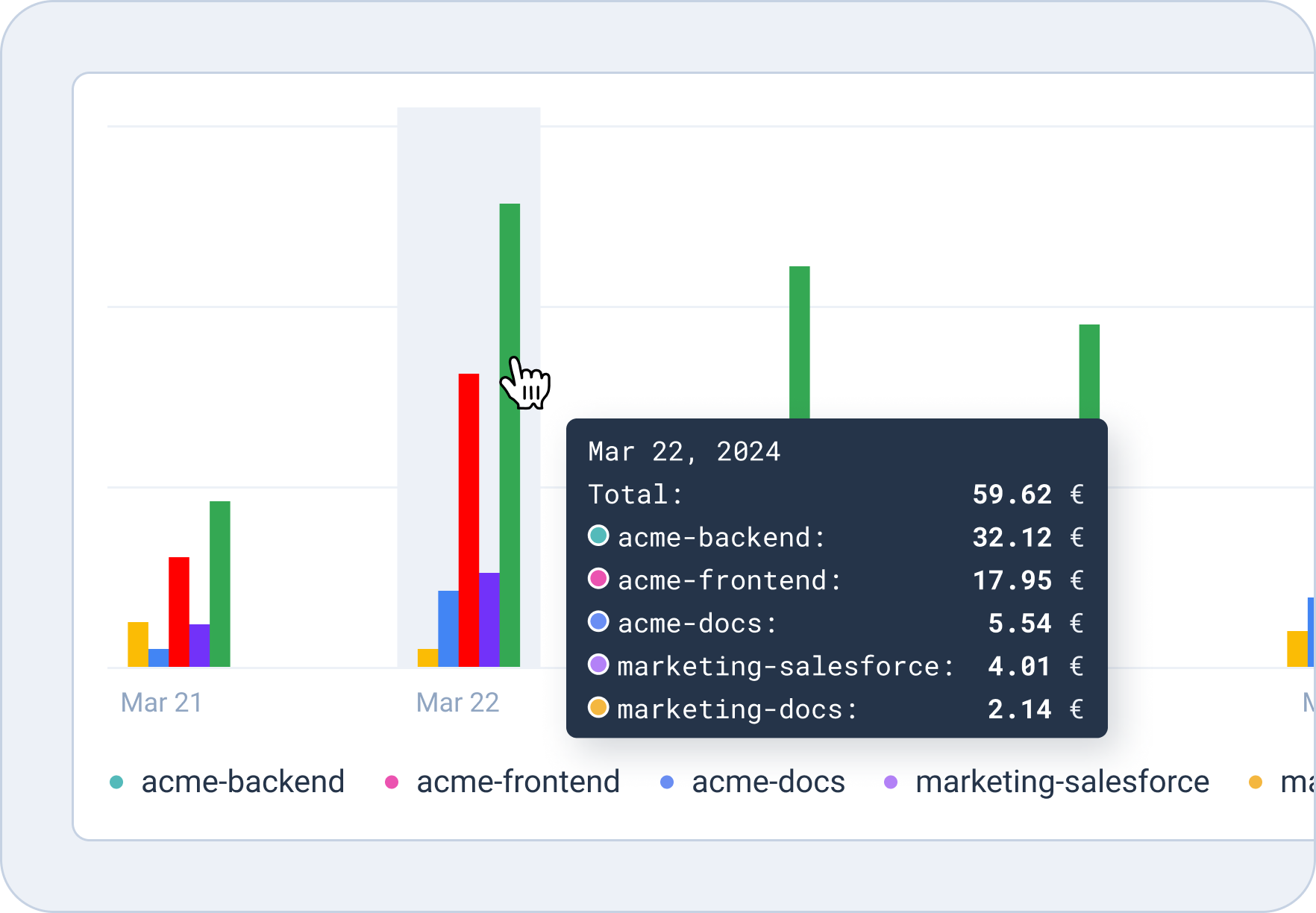
No more unexpected costs – see exactly what you are spending per project.
- Graphical representation of your costs
- Filter by account, project, date, tag, region, provider, etc.
- Manage multiple organizations
Comprehensive custom reporting
Easily set and manage cloud commissions and custom pricing.
- Project view
- Automatic tagging
- Ability to add custom pricing
Part of your platform engineering ecosystem
Cloud Cost Management doesn’t come alone – it brings a whole revolution with it! Cloud Cost Management is part of Cycloid, which means that you’re not only tracking costs, but also speeding up software delivery with an engineering platform.
Outcomes with Cycloid

Centralize your cloud costs

Take back cloud control

Get visibility of your expenses
What is a Cloud Cost Management Platform, Solution, or Software?
Direct Answer. A cloud cost management platform gives engineering teams real-time visibility and control over cloud spending across AWS, Azure, and GCP, before costs are incurred. Unlike native tools (AWS Cost Explorer, Azure Cost Management), which are reactive and single-cloud, a dedicated cloud cost management platform consolidates multi-cloud spend, links costs to teams and projects, enforces pre-deployment guardrails, and supports multi-tenant cost attribution for MSP environments.
Cloud spending is no longer a finance problem. Flexera’s 2026 State of the Cloud Report found wasted cloud spend rose to 29% last year, the first increase in five years, driven by AI workloads and newer PaaS services that make forecasting harder. The FinOps Foundation’s 2026 State of FinOps reports 78% of FinOps practices now report to the CTO or CIO rather than finance.
A cloud cost management platform is software that consolidates spend across cloud providers, attributes cost to teams and projects, and enforces budget policies at the point of deployment. The terms platform, solution, and software are used interchangeably by vendors. What matters is whether the tool covers four capabilities:
A cloud cost management solution that covers only the first two is a reporting tool. One that covers all four is a platform engineering capability.
Multi-cloud consolidation. AWS, Azure, GCP, and on-prem in one dashboard with normalised cost categories.
Cost attribution. Tag-based mapping of spend to teams, projects, environments, and customers.
Pre-deployment estimation. Cost forecast generated from the Terraform plan before infrastructure is provisioned.
Governance and guardrails. Policy as Code rules that block deployments exceeding budget thresholds.
3 CRITIAL GAPS
Why Native Tools Are Not Enough
AWS Cost Explorer, Azure Cost Management, and GCP Billing solve part of the problem. They miss three things that matter at multi-cloud scale.
GAP 1
Single-Cloud by Design
One dashboard per cloud, tagging conventions that don’t line up, billing periods out of sync.
GAP 2
Reactive, Not Proactive
Costs surface after the resource is running and the budget is spent – when the invoice arrives.
GAP 3
No Governance Guardrails
Native tools report; they don’t enforce. No policy check on Terraform plans, tags, or cost centres.
See how Cycloid compares to Native Tools, Apptio & Spot.io
Apptio’s strength is enterprise IT financial management depth. Spot.io’s strength is automated optimisation of compute (right-sizing, spot instances). Cycloid’s differentiator is the pre-deployment estimation built into the deployment pipeline, paired with native multi-tenancy for MSPs and GreenOps in the same platform. Native tools are the floor for any single-cloud team and the bottleneck for any multi-cloud team.
Criteria
AWS Cost Explorer / Native
Apptio (IBM)
Spot.io (NetApp)

Cycloid
Pre-deployment cost estimation
Not available
Cloudability, limited scope
Not available
TerraCost, in-pipeline
Multi-cloud unified view
Single-cloud only
Supported
Supported
AWS, Azure, GCP
Automated tagging
Manual
Plugin-dependent
Supported
StackForms-driven
Team-level cost attribution
Limited
Supported
Limited
Native, per project/team
Governance guardrails
None
Limited
Limited
InfraPolicies on every run
Multi-tenant support (MSP)
Not supported
Limited
Not supported
Native Child Organizations
Sustainability / GreenOps
Not supported
Limited
Not supported
Native Cloud Carbon Footprint
Open source foundation
Cloud-vendor specific
Proprietary
Proprietary
TerraCost, TerraCognita, InfraMap
What's the Difference?
FinOps vs Cloud Cost Management
The terms overlap heavily. A FinOps solution is the practitioner-facing term, anchored to the FinOps Foundation’s framework of inform, optimise, and operate. A cloud cost management platform is the buyer-facing term, anchored to the procurement question of which software to install. In practice the same product is sold under both labels.
It implies a methodology and a maturity model. Covers the human practice: allocation, forecasting, and optimisation rituals.
It implies a product purchase. Provides the tooling layer underneath the FinOps practice.
Cycloid’s FinOps solutions page covers the methodology side. This page covers the platform side. Buying decisions need both.
Industry Data on Cloud Cost Management Outcomes
A platform that catches even a third of typical cloud waste at pre-deployment time pays for itself in the first quarter for a 100-engineer multi-cloud estate.
29% Cloud Waste
Flexera 2026: the first rise in wasted IaaS/PaaS spend in five years, driven by AI workload forecasting.
98% Manage AI Spend
FinOps Foundation 2026: up from 31% two years ago. 90% of practices now also manage SaaS spend.
Hotel Spider Outcome
Real multi-cloud cost centralisation across an engineering team – see the customer story.
Frequently Asked Questions
What is a cloud cost management platform?
A cloud cost management platform is software that consolidates cloud spending across providers (AWS, Azure, GCP, on-prem), attributes costs to teams and projects through automated tagging, forecasts spend before deployment through Terraform plan analysis, and enforces budget policies as part of the deployment pipeline. The terms platform, solution, and software are used interchangeably; what matters is whether the tool covers all four capabilities or only the first two.
What is the best cloud cost management solution in 2026?
The best cloud cost management solution depends on cloud footprint and engineering practice. For multi-cloud teams needing pre-deployment estimation and platform engineering integration, Cycloid’s module combines TerraCost-driven forecasting with multi-tenancy and GreenOps. Apptio (now IBM) suits IT financial management at large-enterprise scale. Spot.io suits compute optimisation at scale. Native tools (AWS Cost Explorer, Azure Cost Management) are the floor, not the ceiling.
What is the difference between a cloud cost management platform and AWS Cost Explorer?
AWS Cost Explorer reports on AWS spend only, after deployment. A cloud cost management platform consolidates AWS, Azure, GCP, and on-prem spend, attributes costs to teams and projects through automated tagging, forecasts cost before deployment, and enforces governance through Policy as Code. The platform sees the whole estate and stops spend before it happens; AWS Cost Explorer sees AWS and reports after the fact.
How does pre-deployment cost estimation work in cloud cost management?
Pre-deployment estimation parses the Terraform plan inside the CI/CD pipeline, applies current cloud provider rates, and produces a forecast cost for the proposed change. The forecast surfaces in the merge request before the deployment runs. Cycloid uses TerraCost, the open-source engine the team also publishes. The engineering team sees the cost impact at the moment the decision is made, not when the invoice arrives.
How does Cycloid compare to Apptio for cloud cost management?
Apptio (acquired by IBM) is strongest at IT financial management for large enterprises managing both on-prem and cloud across thousands of cost centres. Cycloid is strongest at platform engineering teams that want cost management integrated with deployment pipelines, multi-tenancy for MSP use cases, and GreenOps in the same product. Apptio offers depth in IT finance; Cycloid offers depth in engineering integration.
Curious how this compares to Terraform-centric platforms? See Cycloid vs Terraform Cloud.Cloud Cost Management is available as a stand-alone solution