






TL;DR
- Hand-maintained ownership drifts after team changes, leaving incidents with the wrong owner and stale escalation paths. Linking ownership to provisioning keeps the record current and makes it usable for day-2 actions.
- A catalog that only shows existing services can help developers find resources but still sends creation requests to an operations queue. Self-service requires the catalog item to connect directly to a constrained provisioning template.
- Unrestricted request fields push governance after deployment, where fixing a bad region or configuration can require migration. Enforcing allowed choices and policies before creation prevents that rework.
- Versioned templates keep existing deployments stable, but they also create multiple supported generations for the platform team. Recording the deployed version beside each resource makes those differences traceable during operations.
- Giving an AI agent a separate service identity can grant it more access than the person making the request. Acting as the requesting user preserves attribution and keeps the agent within that user’s permissions.
- Brownfield resources cannot become governed simply by discovering them or generating code from them. Imported infrastructure needs review because generated code can reproduce existing misconfigurations, while tenant boundaries must be enforced through template visibility.
The Ticket Queue Sitting Behind Every Developer Portal
Portal search finds the Postgres service in thirty seconds. The request for a database of their own still routes to a ticket. Platform engineering took the DevOps idea that teams own what they run and gave it an interface. Gartner’s inquiry volume on internal developer portals rose 120% in 2023, mostly on the back of Backstage. Backstage made the software catalog the portal’s front page: metadata YAML stored beside the code, harvested into one view of what the company runs and who owns it. Service catalogs arrived from the opposite direction, out of ITSM desks and tools like AWS Service Catalog, where end users launch only pre-approved products under constraints the organization sets. Vendors now swap the two names freely, and the swap hides a real split: one catalog records what exists, the other governs what gets created.
The split shows up in the data model i.e., Catalog entries are hand-written files keyed to repositories, and moving a catalog-info file to a new path has left the old entity orphaned and the new location unprocessed. The infrastructure itself sits in Terraform state keyed to cloud accounts the catalog never reads.
This article follows one request, a staging database for a checkout service, from catalog lookup to a running resource with day-2 actions attached. It names where a split software and service catalog breaks at each step. It also shows how Cycloid handles the same request when the template that provisions a resource writes its catalog record too.
What a Software Catalog Records and Where It Stops
A software catalog stays current only as long as something keeps writing to it, and in most portals that something is a person remembering to edit a file. The fields that matter at 2 a.m., owner and on-call, are the ones nobody touches until a pager goes off.
Ownership Metadata That Decays After the First Import
Owner fields rot first because nothing fails when they’re wrong; A service changes teams in a reorg, the catalog-info.yaml still names the old group, and the first person to notice is an on-call engineer following a stale link mid-incident. Across a hundred repositories, that drift outpaces any quarterly cleanup.
Auto-discovery looks like the fix, and it half works; A scanner that walks cloud accounts keeps the resource list current, but it reads tags and ARNs, not intent. It won’t tell you who’s accountable for a bucket or which security contact signs off on changes to it, so you end up picking between a catalog that’s fresh and one that means something.
Cycloid sidesteps the choice by building its catalog from what it deploys. The template that provisions a resource also decides how that resource appears in the catalog, so an entry exists the moment the resource does. Services running outside Cycloid register as catalog-only entries. Each resource carries a stewarding team plus named owners for code, security, privacy and SRE. A coverage dashboard lists orphans and alerts when ownership coverage drops below the default 90% threshold.
In the listing below, look at the owning-team and version columns. Both come from the deployment itself, not from a file someone edited last quarter.
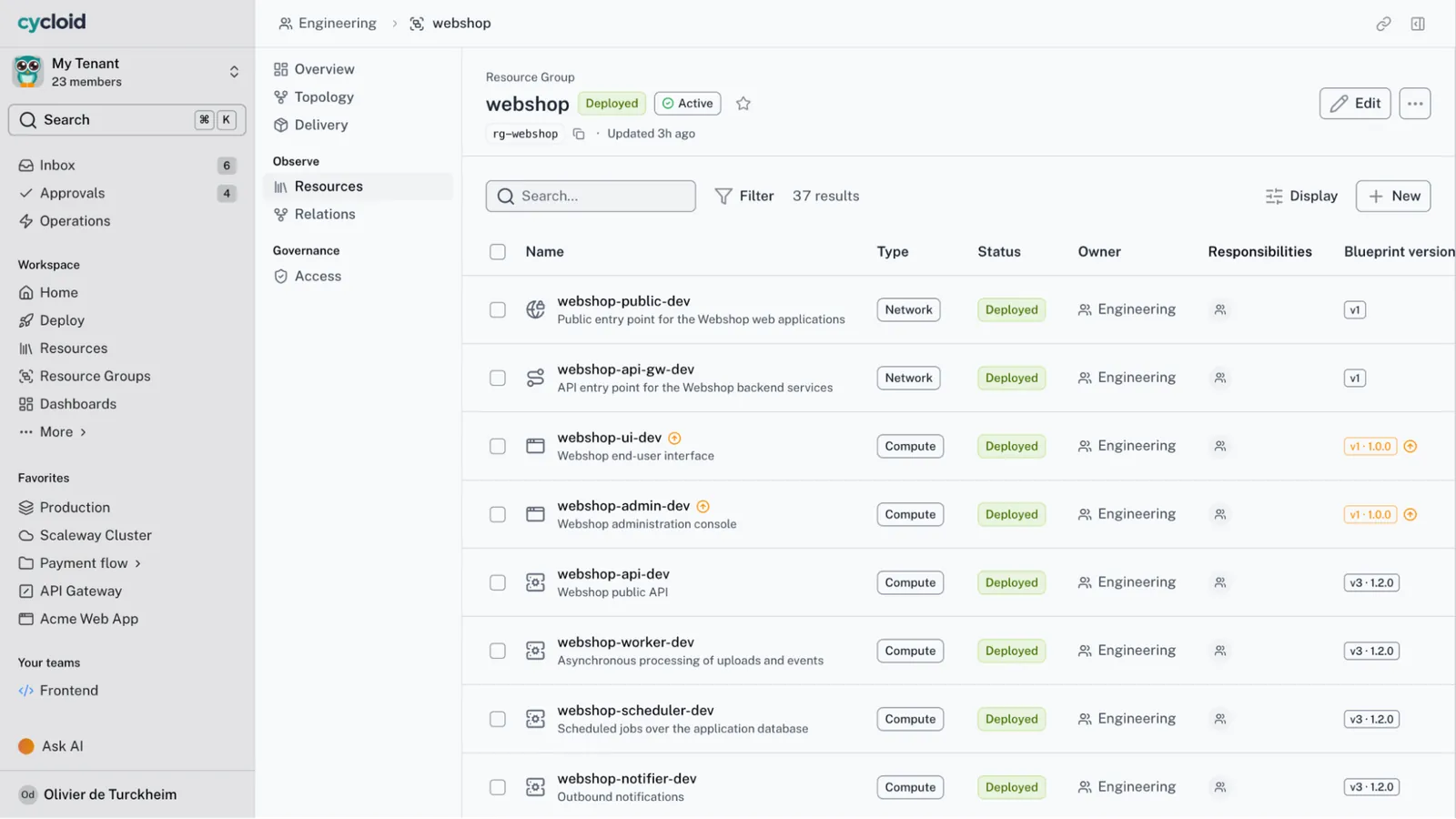
Cycloid’s software catalog listing the resources in a resource group, with type, status, owning team and blueprint version on each row. The reader should focus on the owning team and blueprint version columns, which the platform fills from the deployment rather than from hand-maintained metadata.
Discovery Without a Request Path Still Ends in a Ticket
A read-only catalog answers who owns the payments database and says nothing about how to get another one. Portals like Backstage read from existing infrastructure and don’t provision or deploy anything themselves. A self-service action there is a button wired to a workflow somebody else built and maintains.
Catalog-first rollouts happen anyway, for defensible reasons. The catalog is cheap to stand up and shows value in its first month, long before anyone agrees on golden paths. The catch is where the money comes back. Cycloid’s own build-versus-buy analysis puts most of the return in the provisioning integration, not the catalog UI, and the integration is the expensive half to build.
Cycloid’s self-service page states the division plainly: a catalog lists what exists, while a Blueprint deploys it, checks it at submission and carries its day-2 actions. Deployment, submission checks and day-2 operations belong to a second catalog with a different owner and a different failure mode.
What a Service Catalog Offers and Who Decides What’s on It
A service catalog is a list of promises: every item on it is something the platform team has agreed to provision and support on demand. Who writes those promises, and in what format, decides whether a request takes minutes or a sprint.
Request Menus Inherited From ITSM Tooling
ITSM catalogs were designed for laptop requests and ticket routing, where a human fulfills each item after approval. Copy that model for infrastructure and you get a nicer front end on the same queue: the developer picks “PostgreSQL, staging” from a menu, and the request lands in a backlog.
AWS Service Catalog moved the approval somewhere else. Administrators restrict the regions a product launches in and the instance types it uses, so the constraint lives in the product definition and the user launches without waiting on anyone. The tradeoff is authorship; Somebody has to encode every constraint in advance, and a constraint nobody thought of doesn’t get enforced.
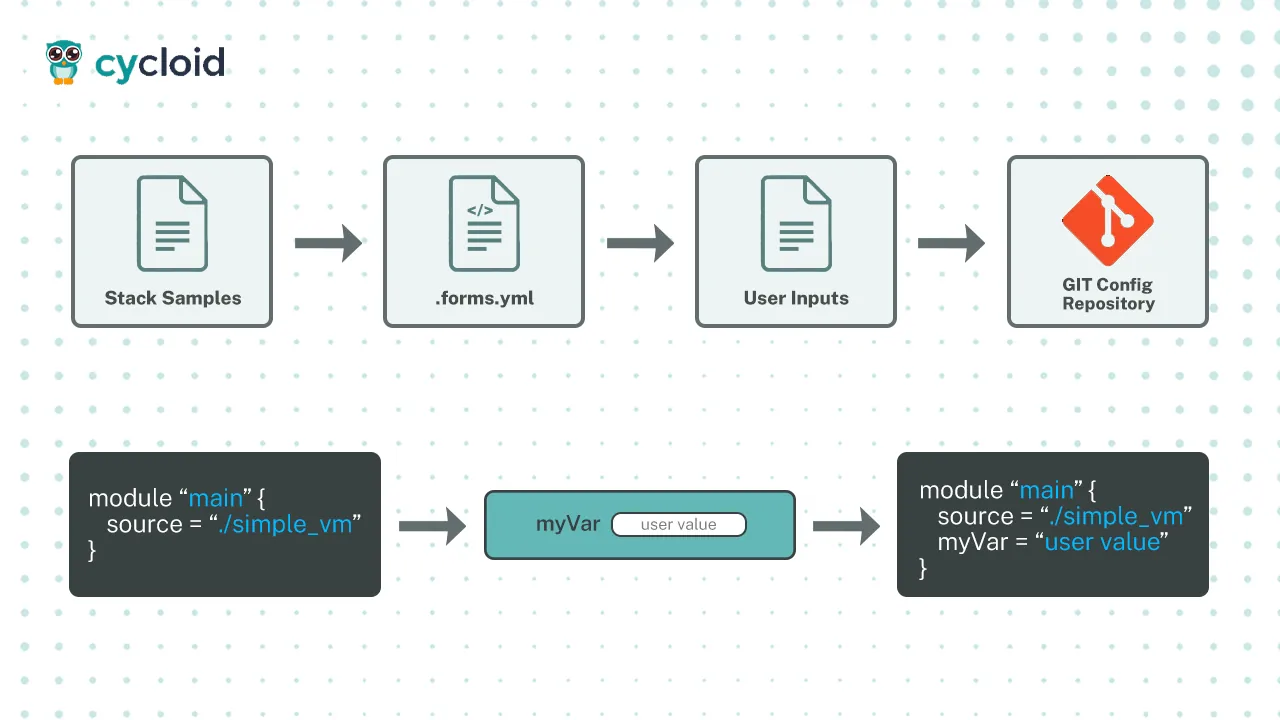
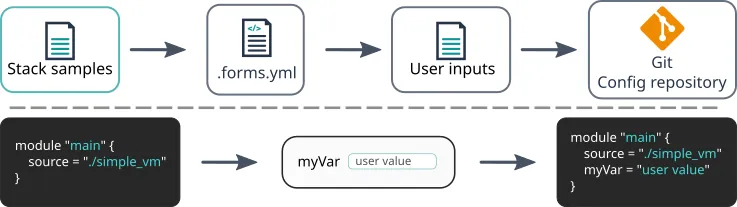
Cycloid follows the second model; Its docs describe a stack as a reusable infrastructure-as-code template the platform team shares as a list of available services, with stack maintainers writing templates and stack users on app teams consuming them. Stack code lives in Git catalog repositories, where each stack directory holds a .cycloid.yml metadata file and a .forms.yml file defining what the user fills in.
The sample file is where the platform team decides which parts of a template a requester touches and which they never see. In the excerpt below from Cycloid’s StackForms widgets reference, project, env and organization sit in a block marked do-not-modify. Those values come from the Cycloid project context, not from the user. other_module_variable is an ordinary module argument the maintainer controls. my_terraform_variable is the single line StackForms writes, filled with whatever the user entered in the form field whose key matches that name.
module "example" {
  #####################################
  # Do not modify the following lines #
  source = "./module-example"
  project = var.project
  env = var.env
  organization = var.organization
  #####################################
  other_module_variable = ""
  # The terraform variable will be injected by StackForms as a module argument here
  # like that :
  my_terraform_variable = "mydefaultvalue"
}
StackForms replaces only what the form declares, and everything else in the sample file stays exactly as the maintainer wrote it.
Versioned Templates as the Unit of Offering
A template keeps changing after teams deploy from it. Six months later the estate runs four variants of the same database pattern, and nobody can say which environments got the encryption fix and which are still waiting.
Pinning versions gives consumers stability and multiplies what the platform team maintains. Floating versions keep everyone current until an upstream change breaks staging on a Friday afternoon, which is traditionally when these things break.
Cycloid’s docs recommend stack versioning to keep a clean production history alongside development branches for testing. The software catalog then shows the blueprint version next to each deployed resource. That column is the first place the two catalogs share a field: the version of the offering, recorded on the thing it created.
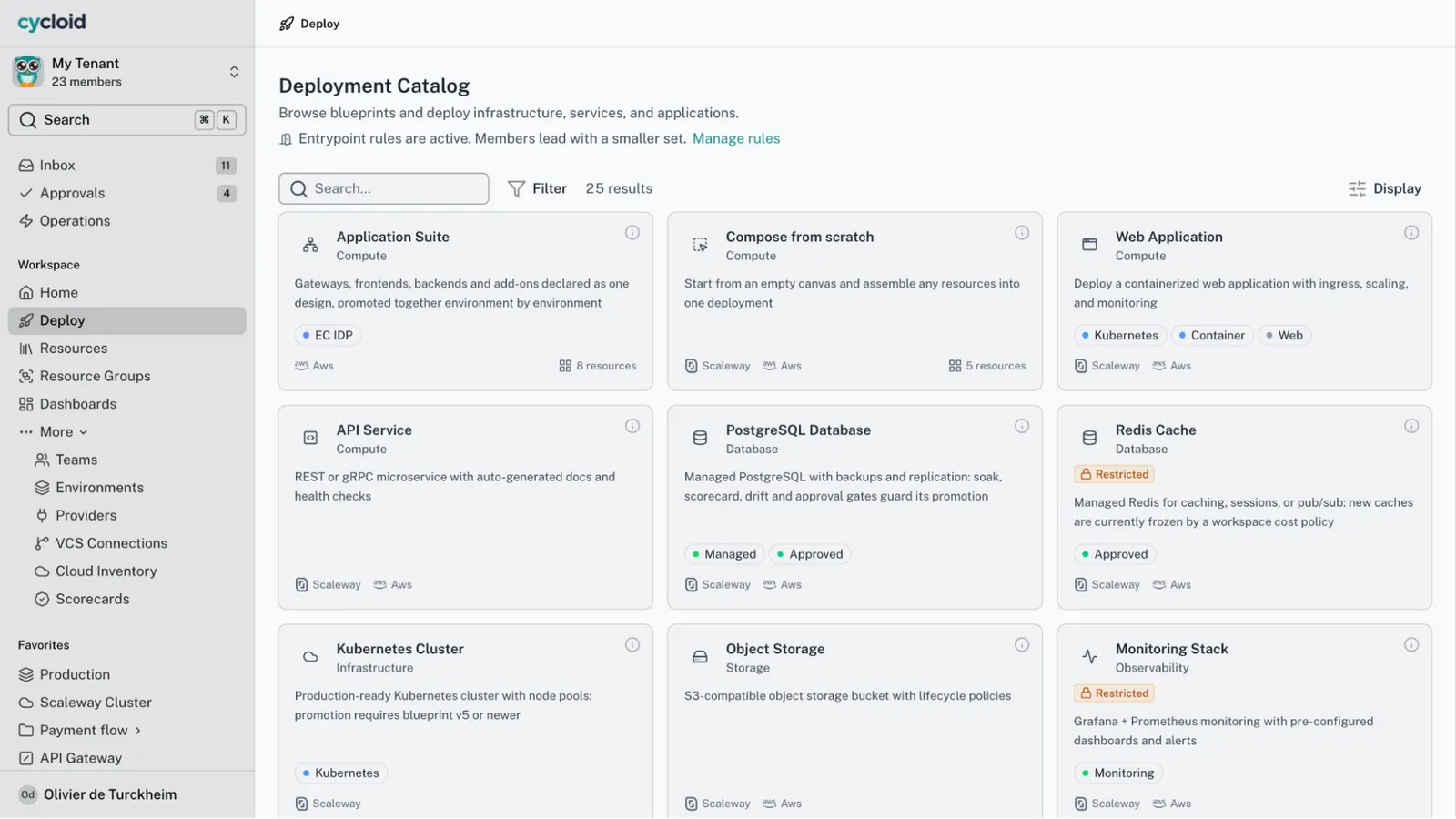
In the catalog view below, check which cards carry restricted or approved flags. Those flags are the platform team deciding what’s on the menu for this particular user.
Cycloid’s self-service catalog showing 25 deployable blueprints as cards, with restricted and approved items flagged. The flags matter more than the card count, because they show the offering filtered per user before any request exists.
Where the Software Catalog and Service Catalog Share One Record
Two catalogs that describe the same database from different sources will disagree, and the disagreement surfaces during an incident, when nobody has time to reconcile them. The only structural fix is for the act of provisioning to write the record.
Provisioning That Writes Its Own Catalog Entry
Backstage Software Templates register the new component in the catalog as the final scaffolding step, which covers the repository. The database Terraform created for that component lands in a state file the catalog never reads, unless someone writes and maintains an entity provider for that source. On day one, the service record and the infrastructure record already describe different things.
Coupling the two has a cost. When the provisioning template defines catalog shape, changing how resources appear means changing templates. Every environment deployed from an older version keeps the old shape until someone upgrades it.
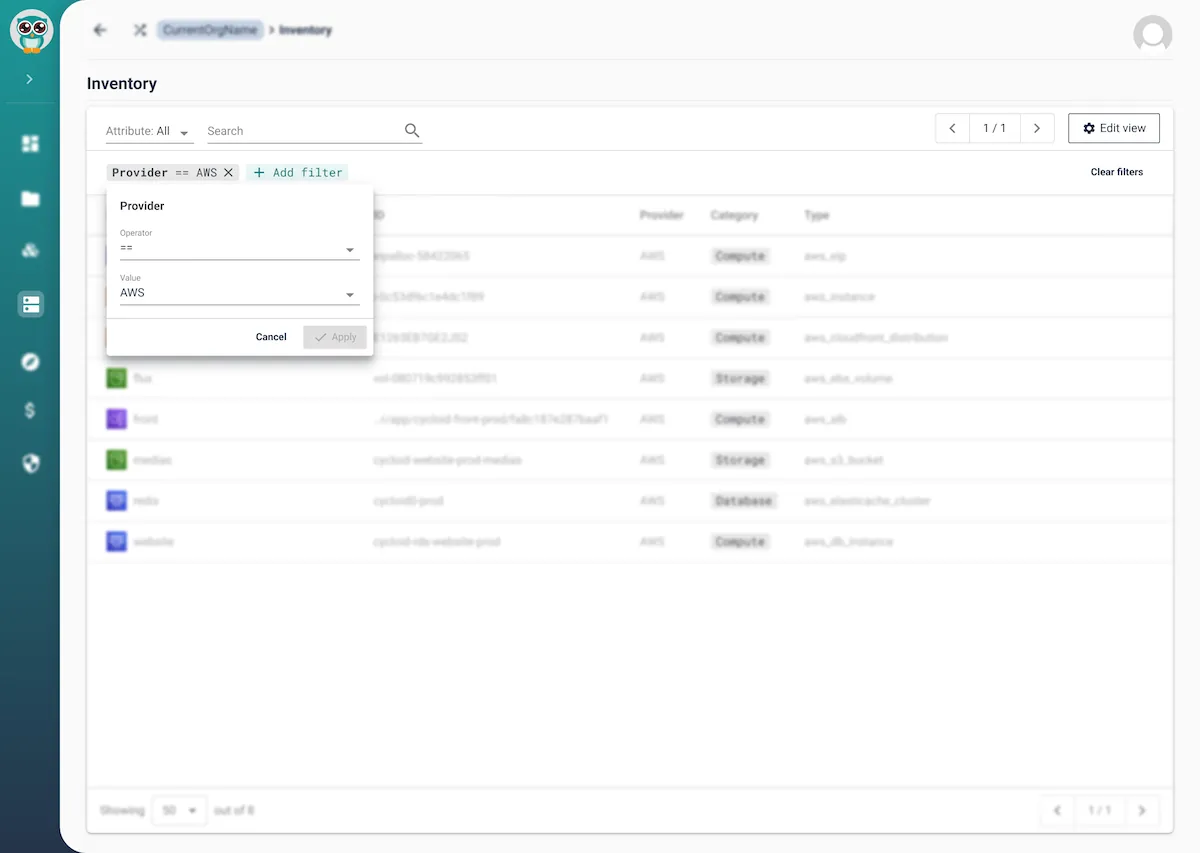
Cycloid routes Terraform state through its own HTTP backend, so every apply updates the Asset Inventory with no separate registration step. Cycloid doesn’t store the tfstate itself. It writes to object storage the customer configures at the organization level, such as an S3 bucket. A stack that skips this backend produces infrastructure the inventory never sees, which is why the excerpt below from Cycloid’s pipeline examples matters. The resource_types block registers Cycloid’s Terraform resource image. The tfstate resource sets backend_type: http and points it at the inventory endpoint. ((cycloid_api_url)) and ((cycloid_inventory_jwt)) are pipeline variables resolved at runtime, so no token sits in the stack’s Git repository.
resource_types:
- name: terraform
  type: docker-image
  source:
    repository: cycloid/terraform-resource

resources:
- name: tfstate
  type: terraform
  icon: terraform
  source:
    backend_config:
      address: '((cycloid_api_url))/inventory?jwt=((cycloid_inventory_jwt))'
    backend_type: http
Outputs close the loop in the other direction i.e., Terraform outputs from a component flow into the inventory and can be reused in StackForms through the cy inventory_output widget, so the next request form reads values from the record the last deployment wrote. In the excerpt below from the same Components reference, database_url and api_url are ordinary outputs. _cycloid_pinned_output is a special output whose value lists the keys shown on the component page by default.
output "database_url" {
  value = "https://db.cycloid.io"
}
output "api_url" {
  value = "https://api.cycloid.io"
}
// This output will define the list of output keys to pin by default
output "_cycloid_pinned_output" {
  value = ["database_url", "api_url"]
}
Ownership Fields That Gate Day-2 Actions
In most portals the owner field is decorative. Anyone with cloud console access resizes or deletes the database regardless of what the catalog says, and the audit trail lives in a cloud provider log instead of next to the record.
Making ownership load-bearing introduces its own failure. An orphaned resource has nobody entitled to approve changes, so a harmless credential rotation stalls until someone claims the service. Once ownership gates actions, the coverage alert from the first section stops being a nice-to-have.
Cycloid uses the stewarding team and named owners to decide who runs which action and who approves it. Day-2 operations such as rotating credentials, editing a lifecycle policy, extending a TTL or running a plan sit on the resource page, with the same audit trail as the first deployment.
The actions tab below shows where that gating lands. Look at the destroy row: its restriction to owner and admin roles means the catalog’s ownership record, not console access, decides who deletes the bucket.
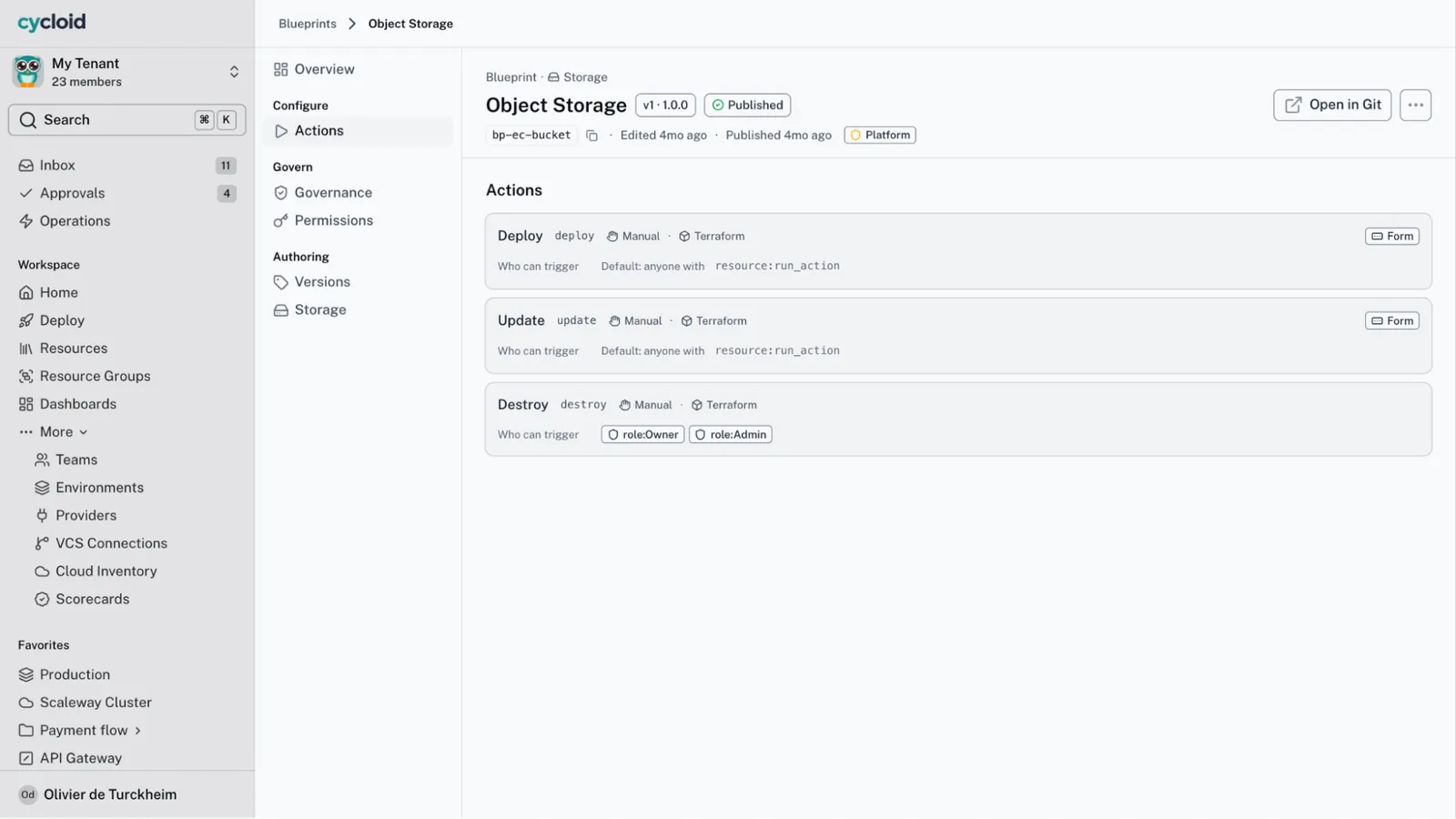
The Actions tab of Cycloid’s object storage blueprint, where the destroy action is restricted to the owner and admin roles. The permission column ties a day-2 action to roles on the resource instead of cloud console credentials.
Developer Self-Service Governed at the Moment of Request
A policy checked after deployment becomes a line item in an audit report, while a policy checked at the form becomes a dropdown with fewer options. The second costs less to fix and more to design, because someone has to settle the allowed values before anyone asks.
Policy Review That Arrives After the Resource Exists
Review-based governance finds the staging database in the wrong region two weeks later, during a data residency audit. By then the fix is a migration with downtime instead of a corrected form field.
Cycloid’s self-service flow validates the Form, then passes the request through a four-layer authorization chain before anything is created. The chain is fail-closed, so an unresolved check counts as a denial. Fail-closed evaluation protects the estate and produces a blocked developer whenever a check can’t resolve, and the platform team should own that tradeoff on purpose rather than discover it in a support thread.
A region allowlist is the simplest version of that constraint, and it’s where most residency incidents start. The excerpt below from Cycloid’s .forms file format reference shows the AWS use case:
- values limits the auto_complete widget to three regions, and default preselects one.
- The cy_cred widget offers only stored credentials of type aws.
- display_keys: false keeps the key material out of the form.
- “((aws))” points the field at a stored credential rather than a pasted key.
use_cases:
- name: "aws"
  sections:
  - name: "Cloud provider settings"
    groups:
    - name: "Credentials"
      technologies: ["pipeline"]
      vars:
      - name: "AWS Region"
        key: "aws_default_region"
        type: "string"
        widget: "auto_complete"
        values:
          - "eu-west-3"
          - "eu-west-2"
          - "eu-west-1"
        default: "eu-west-1"
      - name: "AWS access keys"
        description: "AWS access key which should be used"
        key: "aws_cred"
        type: "string"
        widget: "cy_cred"
        widget_config:
          display_keys: false
          cred_types: ["aws"]
        default: "((aws))"
Constraints that don’t fit in a form field go to InfraPolicies, Cycloid’s policy-as-code layer for fine-grained control over infrastructure changes. The form handles what a requester picks, and the policy layer handles what the resulting plan is allowed to do.
AI Agents Requesting Infrastructure Through the Service Catalog
An MCP host that provisions through its own service account is the easiest privilege escalation in the org. The agent holds rights no individual user was granted, and the audit log names a bot.
Blocking agents outright pushes developers back to console clicks, while broad agent rights break attribution. The design problem is giving an agent reach without giving it an identity of its own.
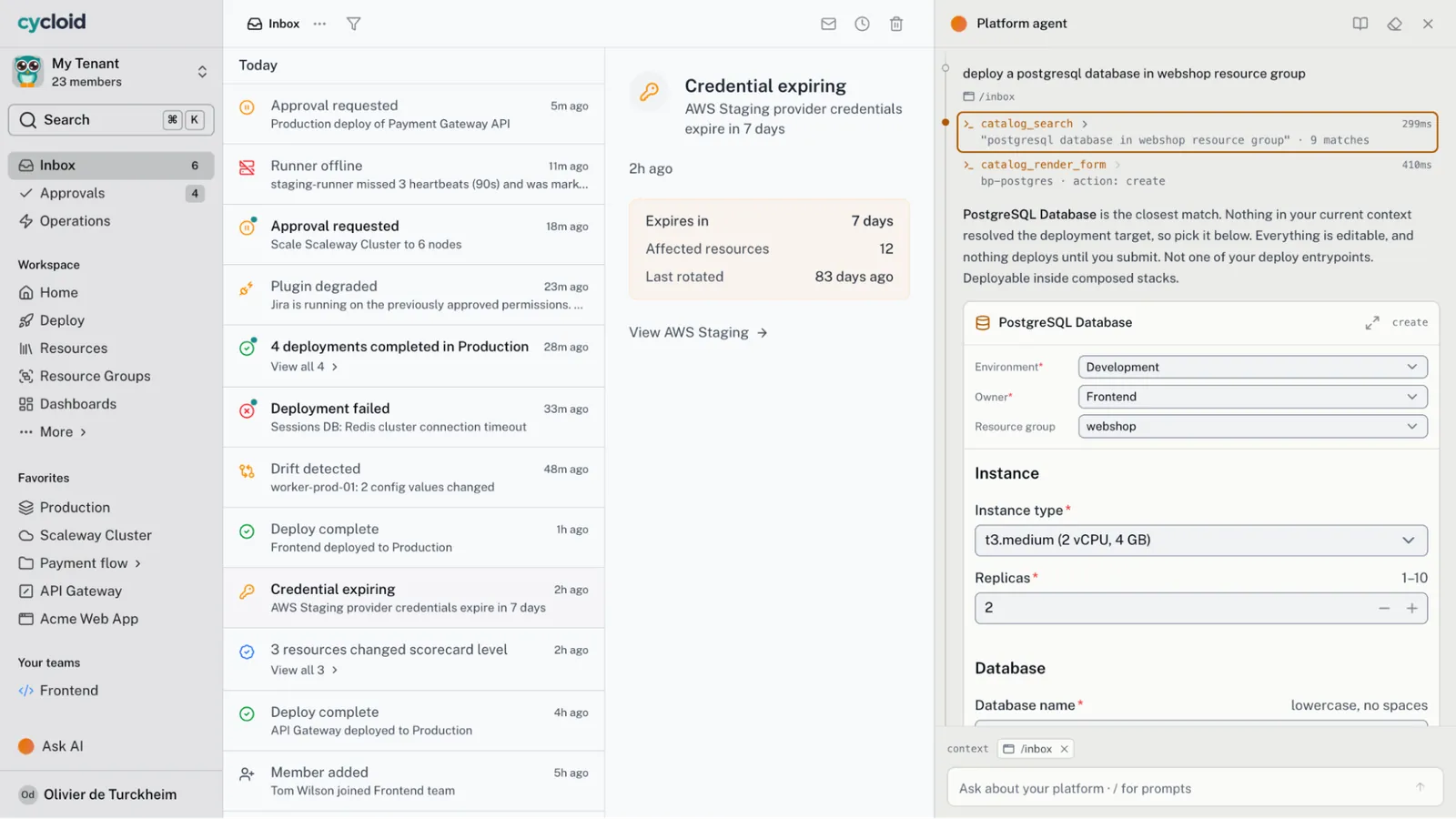
Cycloid’s assistant and MCP server act as the requesting user, with no service account and no elevated assistant role. Asked for a Postgres database in staging, the assistant finds the matching template, renders its Form inline with the defaults it could infer, and waits for the person to confirm. The audit log records both the assistant session and the person it acted for. Tenant admins can also cap the assistant below the user’s own rights, such as read-only or never destroy.
Brownfield Infrastructure the Service Catalog Never Provisioned
Everything above assumes resources enter through a template. The estate that existed before the platform didn’t, and it’s usually the part holding production data.
Resources Created Before the Platform Existed
Console-built resources and the output of retired pipelines never passed through a template. They sit outside both catalogs and outside every ownership rule, and they’re also the resources most likely to be missing tags.
Importing them creates a fresh risk: generated infrastructure code nobody reviewed, carrying whatever misconfiguration the original resource had. Treat imported code with the same review as hand-written code. The importer copies a security group open to 0.0.0.0/0 just as faithfully as everything else.
Cycloid’s Infra Import builds a new stack from existing cloud resources, and its Discovery feature gives a read-only inventory of what already runs. The same page lists bringing discovered resources under a Blueprint as planned for the near term. Until then, a discovered resource is visible without being governed by the template path.
Multi-Tenant Estates Where Catalogs Need Boundaries
Forty customer tenants on one MSP platform should draw from a single template library, without any tenant seeing another’s resources or quietly forking the library for itself.
Per-tenant copies drift within a quarter. A single shared library stays consistent but makes every tenant wait on the same release, and neither extreme survives contact with a customer who needs a one-off change.
Cycloid handles the hierarchy through stack visibility. Stacks default to local visibility, restricted to the organization where their catalog repository is defined, and shared stacks propagate from parent organizations to child organizations, never upward. The docs recommend defining shared stacks at the root organization. Stacks also inherit the catalog repository’s visibility at import, so the repository layout draws the tenant boundary before the first template ships.
Software vs. Service Catalog Comes Down to One Shared Record
The two catalogs do different jobs, and every tradeoff in this article sits where they join. Auto-discovery buys freshness at the cost of meaning; Versioned templates buy stability at the cost of support load. Ownership that gates actions turns orphans into blockers, and fail-closed policy turns unresolved checks into denials. None of those tradeoffs disappears by choosing one catalog over the other. Pick a production database and check whether the catalog entry describing it came from the template that created it, because a portal where those two records disagree is still a ticket queue with a search bar.
This piece traced a single staging database request through the points where split catalogs fail:
- owner fields that decay after import
- a catalog with no request path
- ITSM-style menus against constraint-encoded templates
- provisioning that writes its own record through a Terraform HTTP backend and pinned outputs
- form-level region allowlists with fail-closed authorization
- agent requests that act as the user
- brownfield resources that enter through import and stack visibility instead of templates
FAQs
1. What is the difference between a service catalog and an internal developer platform?
The catalog is the menu and the record. The platform is the machinery behind it: pipelines, infrastructure-as-code runs and policy checks that execute what the menu offers. A catalog without a platform routes requests to people, and a platform without a catalog leaves developers guessing what they’re allowed to request.
2. Is maintaining a Backstage catalog worth the effort for a small platform team?
The answer turns on whether the catalog writes itself. A catalog fed by hand-edited YAML costs engineering time every sprint and drifts anyway. One populated by the provisioning path costs setup time once, which suits a small team with no capacity for entity providers and plugin upgrades.
3. What is the difference between an IT service catalog and a self-service portal?
The catalog is the definition layer: which items exist, who may request them, and what inputs each one takes. The portal is the interface that renders those definitions to a user. The two often ship in one product, but a catalog change shouldn’t require a portal redesign.
4. Can a service catalog template exist without a matching software catalog record?
Yes, until someone deploys it, since a template describes something that doesn’t exist yet. The problem starts after deployment, when the created resource never shows up in the software catalog with its owner and template version. Automate the check that catches that miss.
Check our Comparisons: Cycloid vs Backstage, Cycloid vs Port, Cycloid vs Compass, Cycloid vs Humanitec